
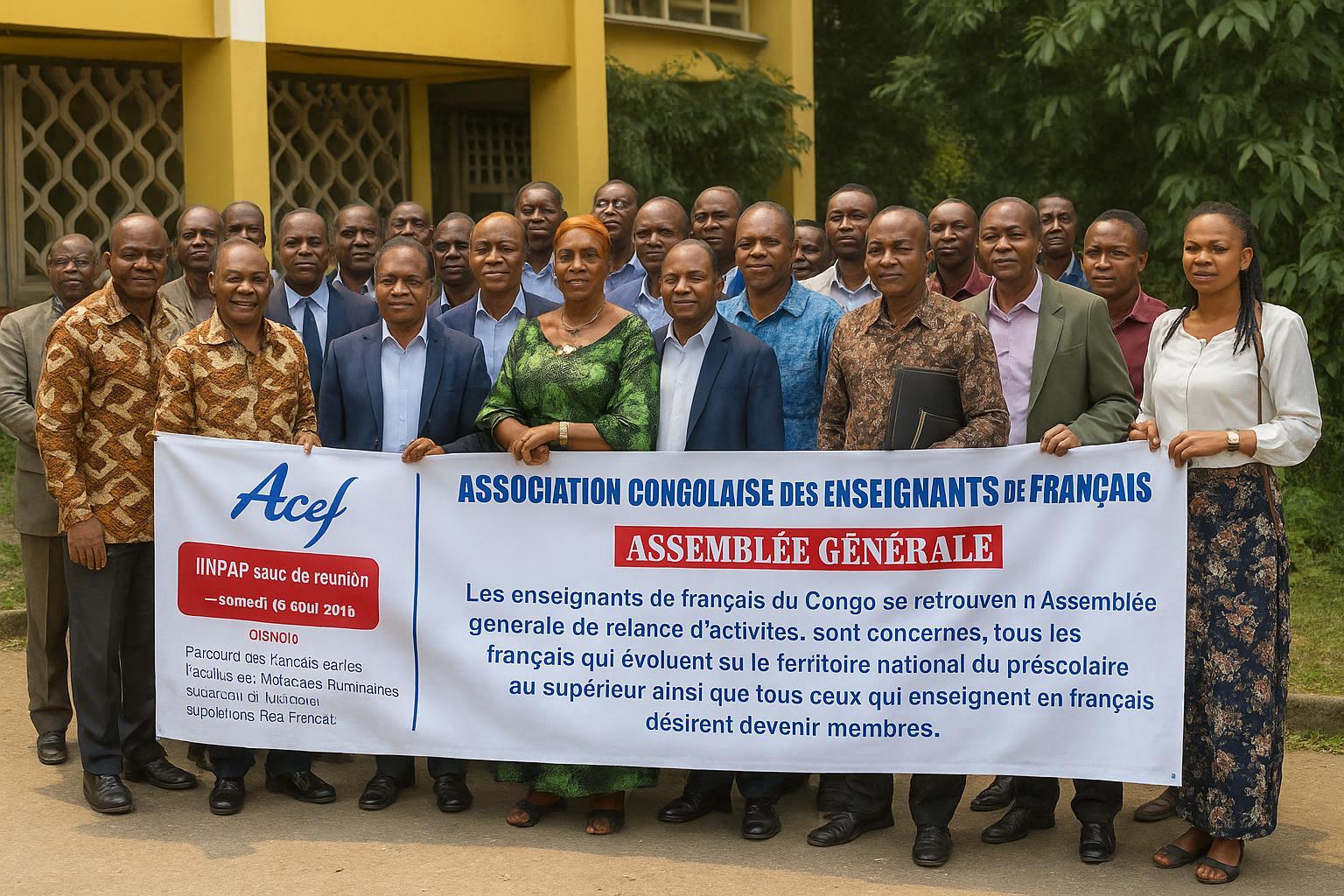
ACEF Returns to the Forefront
After nearly a decade of silence, the Congolese Association of French Teachers, known by its French acronym ACEF, reconvened in Brazzaville this August. Dozens of lecturers, inspectors and classroom teachers packed the National Institute for Educational Research, eager to script a renaissance for the national language they steward.
Presiding over the assembly, Professor Omer Massoumou outlined a simple mandate: reactivate regional chapters within six months and draw fresh members from every level, preschool to university. “Our classrooms need renewed energy,” he told participants, his remarks later confirmed by local radio coverage and minutes shared with the newsroom.
Challenges in French Instruction
Despite constitutional recognition of French as Congo’s official language, national examinations reveal persistent slips in grammar, syntax and reading comprehension. The Ministry of Primary and Secondary Education reports 42 percent of Grade 9 pupils fell below proficiency benchmarks in 2024, a statistic echoed by UNESCO’s regional office.
Many educators blame uneven pre-service preparation. Teacher colleges emphasize subject mastery, yet practicum hours often shrink when budgets tighten. “You can’t expect magic from half-trained instructors,” said Ninelle Josianne Balenda of Marien Ngouabi University, citing survey data that 28 percent of rural French teachers hold no specialized linguistic diploma.
Urban classrooms confront different headaches: oversized rosters and a flood of digital distractions. According to the Brazzaville Education Observatory, an average secondary French period hosts 62 learners, triple the pedagogical standard proposed by the International Organisation of La Francophonie. Teachers struggle to correct assignments, let alone animate debate.
A Roadmap for Teacher Training
In response, ACEF members endorsed a tiered professional-development calendar. First, veteran academics from the École Normale Supérieure will coach novice teachers through weekend clinics focusing on phonetics and storytelling. Second, a digital repository of open-access lesson plans will be curated, drawing inspiration from French ministries’ Eduscol platform and Cameroonian peer networks.
Professor Alain Fernand Loussakoumou, who leads the ENS master’s track in French, insisted on assessing impact, not just attendance. “Each trainee will upload a micro-teaching video before and after the clinic,” he explained. A rubric measuring pronunciation accuracy, classroom pacing and student engagement will feed a national dashboard.
Funding remains the prickliest piece. Participants floated modest membership dues, but real scale may hinge on institutional allies. The French Embassy signalled interest in co-financing resource corners with contemporary youth literature. A pilot agreement, marked confidential, proposes an annual grant of €40,000 pending ministerial endorsement.
Government and Partners Align
Officials from the Ministry of Culture and Arts attended the relaunch, framing ACEF as complementary to the government’s National Reading Plan unveiled last March. “We are not outsourcing our responsibility; we are multiplying expertise,” deputy director Mireille Mouanda clarified to reporters. Her remarks were broadcast on Télé Congo.
The ministry has already distributed 120,000 illustrated primers to rural schools and is negotiating a second print run with Congolese publishers. If ACEF can accompany that effort with vocabulary games and teacher mentoring, officials believe pass rates could jump five percentage points within two examination cycles.
International observers strike a cautiously positive note. The World Bank’s education specialist for Central Africa, Lucia Rossi, told this magazine that community-grown associations often outlast donor projects because “their legitimacy is local, their accountability immediate”. She flagged, however, the need for transparent bookkeeping and gender-balanced leadership in ACEF’s statutes.
What Comes Next for Learners
For students, the most tangible change may arrive through storytelling competitions scheduled for November. Draft guidelines circulated at the meeting envisage district-level heats culminating in a national festival streamed online. Winners will receive tablets pre-loaded with grammar apps and Wolfram-grade dictionaries, a first for many provincial schools.
Literature circles are also making a comeback. Pilot groups in Pointe-Noire announced collaborations with local theatres to dramatize excerpts from Congolese francophone authors such as Henri Lopès and Alain Mabanckou. Teachers hope performance will help teenagers internalize complex tenses while nurturing pride in home-grown storytelling traditions.
Parents, meanwhile, are lobbying for practical support. The National Parent-Teacher Confederation has requested evening French literacy classes for adults who wish to supervise homework more effectively. Early discussions suggest municipal cultural centers could host sessions, leveraging retired educators ACEF intends to recruit as volunteer tutors.
Stakeholders converge on a single priority: sustainability. To that end, ACEF’s new constitution introduces staggered mandates, caps presidential terms at four years, and mandates annual public audits. Civil-society lawyer Jérôme Mbemba praised the provisions as “rare foresight in a sector where passion sometimes eclipses governance”.
If the plan holds, French teachers across Congo could soon teach with fresh resources, clearer standards and a professional network attuned to their everyday hurdles. As Professor Massoumou reminded closing delegates, “A language thrives through those who serve it.” The coming months will test that maxim.
Local media echoed the relaunch. Radio Kayes fielded jubilant call-ins, and Les Dépêches de Brazzaville urged firms to sponsor reading corners, signaling public thirst for practical learning fixes.