
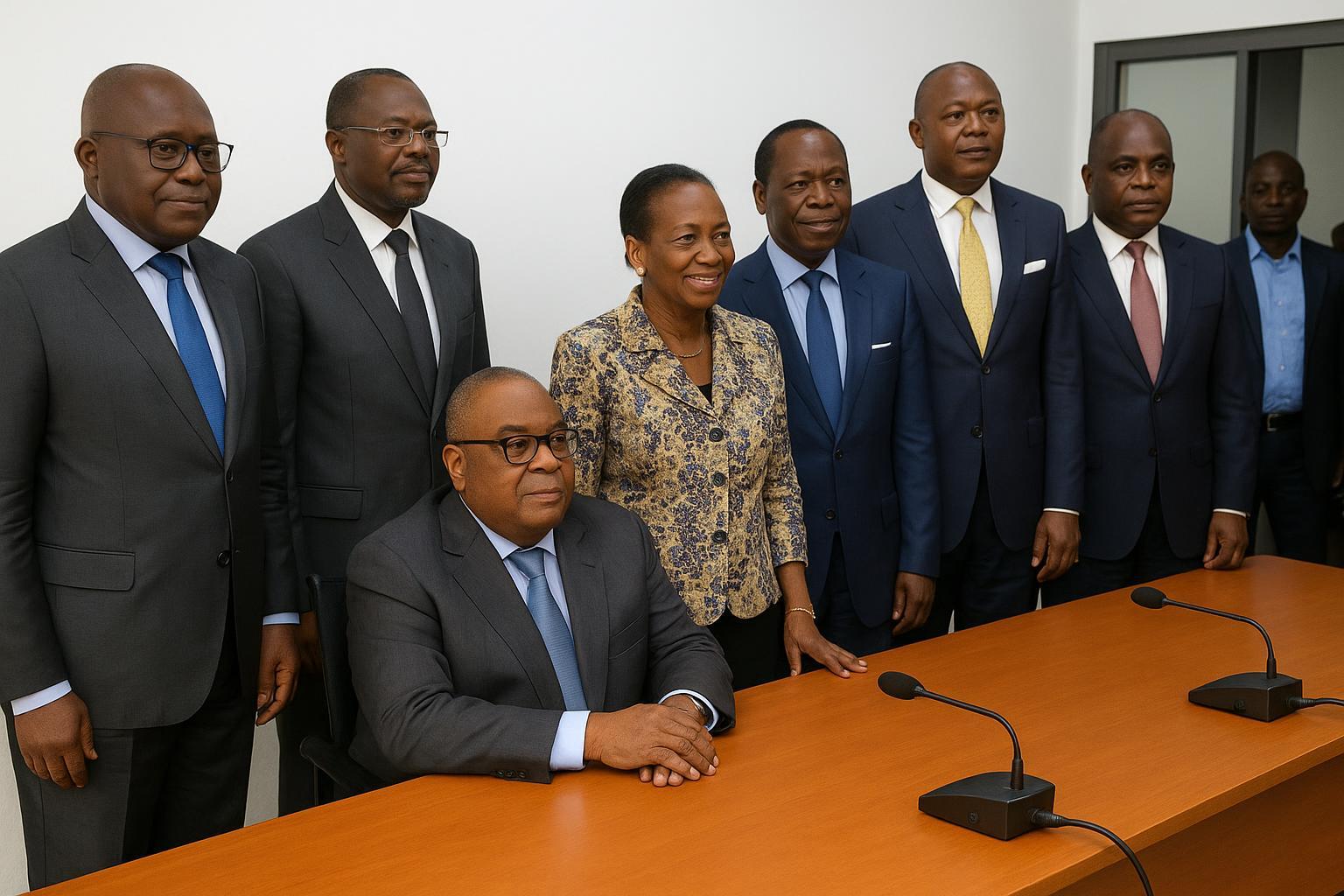
Fresh leadership energises advisory council
A presidential decree signed earlier this month quietly redrew the internal map of the Economic, Social and Environmental Council, one of Congo-Brazzaville’s oldest advisory chambers. The handover ceremony, overseen by presidential adviser Rodrigue Malanda Samba, offered both symbolism and concrete instructions to the new bureau.
Reconfirmed president Emilienne Raoul opened the proceedings with a concise message: the Council must step out of the shadows and into daily public debate. Her appeal captured growing calls from civil society organisations, echoed in recent press analyses by Les Dépêches de Brazzaville and the weekly La Semaine Africaine.
New appointments reshape inclusive governance
The decree introduced three fresh faces to top positions. Former disability advocate Jean de Dieu Goma assumes the vice-presidency, economist Hyacinthe Defoundoux becomes rapporteur, and seasoned administrator Arsène Mokoma takes over as questor, the official in charge of budgets and logistics.
Each profile brings distinct networks. Goma spent a decade coordinating grassroots forums for persons with disabilities, earning praise from the United Nations Development Programme in 2022 for piloting accessible polling stations. Defoundoux lectured on public-finance discipline at Marien Ngouabi University, while Mokoma managed procurement during the Talangaï hospital upgrade.
Observers argue that such complementary résumés answer a persistent critique levelled by think-tank Cercle des Réformateurs: the Council needed more technocratic skills to translate citizen petitions into actionable policy suggestions. Government spokesperson Thierry Moungalla recently acknowledged, on Télé Congo, the importance of that technocratic reinforcement.
Mandate within Congo participatory framework
Created in 1959, the Council advises the President and Parliament on economic, social and environmental matters. While its opinions are non-binding, they often inform budget priorities. Raoul reminded newcomers that the chamber issued 17 recommendations during the latest national development plan, ten of which were partially adopted.
Political scientists at the University of Cape Town describe the Council as part of Brazzaville’s soft veto system, giving organised groups space to refine contestations before they reach parliamentary confrontation. That model mirrors similar advisory organs in Morocco and France, both cited in the Council’s founding rationale.
Inside the chamber, sessions resemble committee hearings. Representatives from workers’ unions, employers, women’s associations and youth councils debate draft opinions that later circulate to ministries. Analysts interviewed by RFI noted that this process helps dilute tensions, especially around subsidy reforms and rural land-use regulations.
Continuity preserves institutional memory
Outgoing interim rapporteur-questor Louis Patrice Ngangon formally transferred volumes of archived minutes, including pending reports on artisanal mining and coastal erosion. In a brief address he urged the newbies to keep the red thread of evidence-based advice, a sentiment later welcomed by Environment Minister Arlette Soudan-Nonault.
Raoul, who previously served as Minister of Social Affairs, emphasised that continuity does not mean inertia. She cited digitalisation of the Council’s library as an urgent priority, pointing to a partnership protocol currently under negotiation with the National Research and Education Network of Congo.
Stakeholders outline urgent expectations
Private-sector federation Unicongo wants the revamped Council to accelerate opinions on the impending African Continental Free Trade Area tariff schedule. Agribusiness executive Florent Mihindou told our newsroom that clear guidance from the Council will help firms adapt investment plans and protect fragile supply chains.
Civil-society coalition Plateforme 242, meanwhile, calls for stronger monitoring of recommendation follow-up. Its coordinator Clarisse Mbani argues that publishing a traffic-light scorecard, similar to Senegal’s model, could boost transparency. Several deputies privately concede that such monitoring would ease legislative deliberations during the next budget session.
International partners also watch closely. The World Bank’s latest Country Partnership Framework lists the Council as a strategic interlocutor for social-protection reforms. Resident representative Jean-Christophe Carret confirmed to Bloomberg Africa that disbursement of a 30-million-euro support envelope in 2025 will partly hinge on advisory progress.
Regional comparisons and future outlook
Neighbouring Gabon recently elevated its own economic council to constitutional rank, granting it pre-legislative review powers. Some pundits wonder if Brazzaville could follow suit. For now, Minister of Institutional Reform Ingrid Olga Ghislaine Ebouka-Babakas says the current set-up already guarantees sufficient democratic ventilation of policy.
Independent pollster Opinion Way Congo measures public awareness of the Council at just 28 percent. Raoul’s team eyes social media campaigns and provincial outreach tours to raise that figure. Communication adviser Désiré Mampouya insists that visibility is not vanity; it is the doorway to citizen ownership.
In the medium term, the bureau will prepare an opinion on green-hydrogen prospects, aligning with the national energy-transition road-map adopted last year. Early drafts obtained by our newsroom suggest proposals for tax incentives and vocational training to localise components manufacturing near Pointe-Noire.
Stakeholders agree that the coming months will reveal whether the new lineup can convert its diverse expertise into consensus-building clout. For President Denis Sassou Nguesso’s administration, success would not only validate participatory governance but also strengthen the evidence base behind flagship programmes outlined in the 2022–2026 plan.