
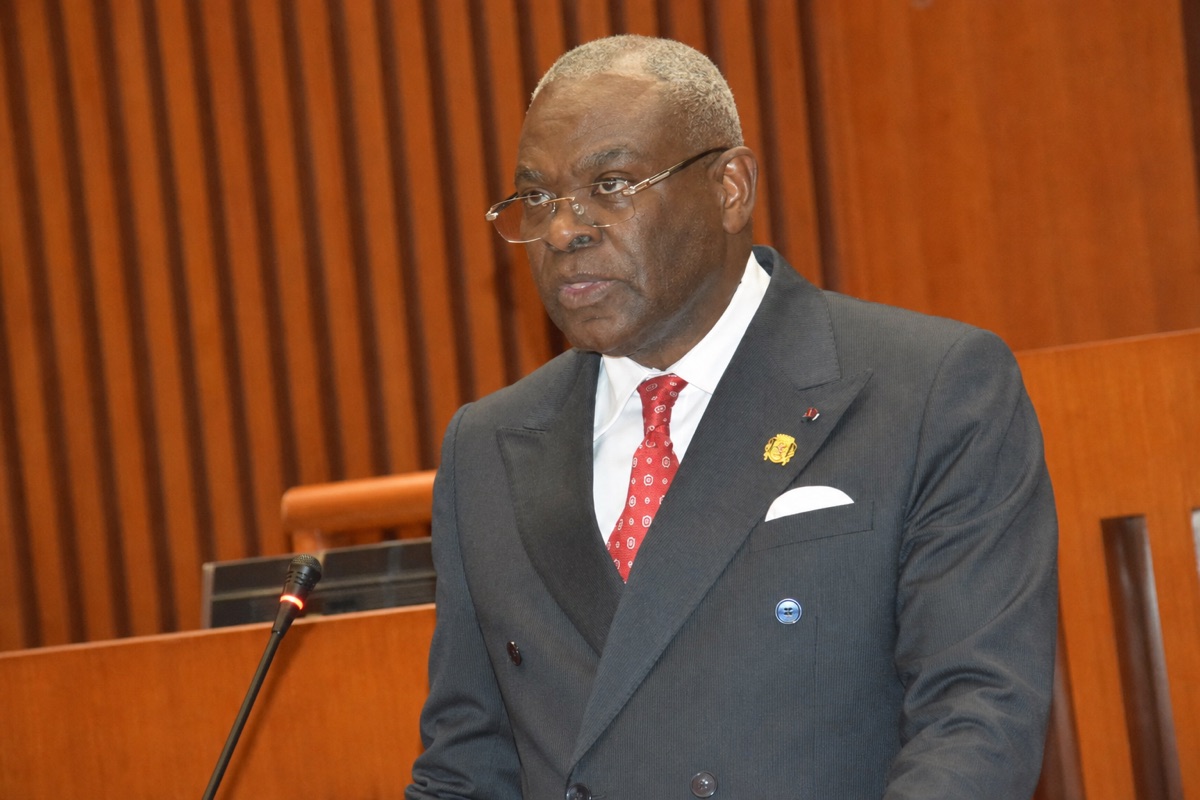
Congo-Brazzaville’s government has put its cards on the table. On Monday, June 22, Prime Minister Anatole Collinet Makosso stood before the National Assembly and laid out the roadmap that will guide the country through the next five years.
The presentation introduced the Government Action Programme (PAG) for 2026-2031, a document meant to turn campaign promises into concrete policy after President Denis Sassou N’Guesso’s re-election.
A Five-Year Plan Built on Ten Clear Priorities
The blueprint rests on a tidy structure: ten priorities, six major axes and twenty missions. Together they form what officials describe as the operational translation of the president’s societal project.
That project carries a telling name, “The Acceleration of the March Toward Development.” The wording signals urgency, and Makosso leaned into that tone throughout his address to lawmakers.
The Prime Minister framed the programme as a shift in method as much as ambition. Public action, he argued, should now be measured by outcomes rather than intentions, with results placed at the center of every ministry’s mandate.
Economic Diversification Tops the Agenda
Among the headline goals, the government wants to speed up economic diversification. For an economy long shaped by a handful of dominant sectors, the pledge points toward a broader, steadier base of growth.
Infrastructure development sits beside that ambition. Roads, networks and public works are presented as the backbone of a modernization drive intended to reach communities well beyond the capital.
The plan also targets the basic social services that families rely on daily. Improving access and quality here, officials suggest, is where citizens are most likely to feel the difference between rhetoric and reality.
Jobs, Skills and a Digital Future
Youth employment features prominently, a nod to the demographic weight of younger Congolese. The roadmap treats work for the young not as a slogan but as a structural test of the quinquennium.
Digital transformation rounds out the priorities. The government frames technology as a lever for efficiency and opportunity, threading it through governance and the wider economy rather than treating it as a standalone project.
Makosso placed strong emphasis on human capital. By investing in people and skills, the executive hopes to feed the productive sectors and, in turn, build a more resilient economy capable of absorbing future shocks.
Stronger Governance as the Common Thread
Reinforcing governance runs through the entire programme. The Prime Minister tied better institutions to inclusive growth, presenting credible public management as the precondition for everything else on the list.
Support for productive sectors completes the economic picture. The aim, as outlined, is to stimulate the creation of wealth so that diversification does not remain an abstract target but becomes a visible engine of activity.
The combination, officials say, should renew the country’s modernization momentum. Inclusive growth and improved living conditions appear repeatedly as the yardsticks against which the next five years will be judged.
A Call for Collective Effort
Facing the deputies, Makosso did not present the plan as the government’s burden alone. He insisted that reaching the targets would demand a collective mobilization stretching well beyond the corridors of the executive.
He called on every institution to play its part. Economic actors and ordinary citizens were urged to join in, with the message that accelerated development can only become real through shared commitment.
The address landed at a sensitive moment. The Prime Minister acknowledged a backdrop marked by fresh economic, social and structural challenges, a candid framing that set realistic expectations for the road ahead.
What the Roadmap Signals for the Years Ahead
Read as a whole, the PAG reads less like a wish list and more like a governing contract. By naming priorities openly, the executive has set markers against which its own performance can be tracked.
The promise to orient public action toward results raises the stakes. If outcomes truly become the measure, then ministries will face a clearer test than in cycles past, where intentions often outpaced delivery.
For families, navetteurs and small businesses, the practical questions are simple. Will services improve, will jobs appear, and will infrastructure ease daily life across Brazzaville, Pointe-Noire and the departments?
Makosso’s answer was an appeal rather than a guarantee. He bet on mobilization, on institutions and citizens pulling in the same direction to make development a concrete reality rather than a recurring ambition.
The coming months will show whether the structure holds. Ten priorities, six axes and twenty missions now sit on the table, and the country will watch how quickly intention turns into measurable progress for the Congolese people.