
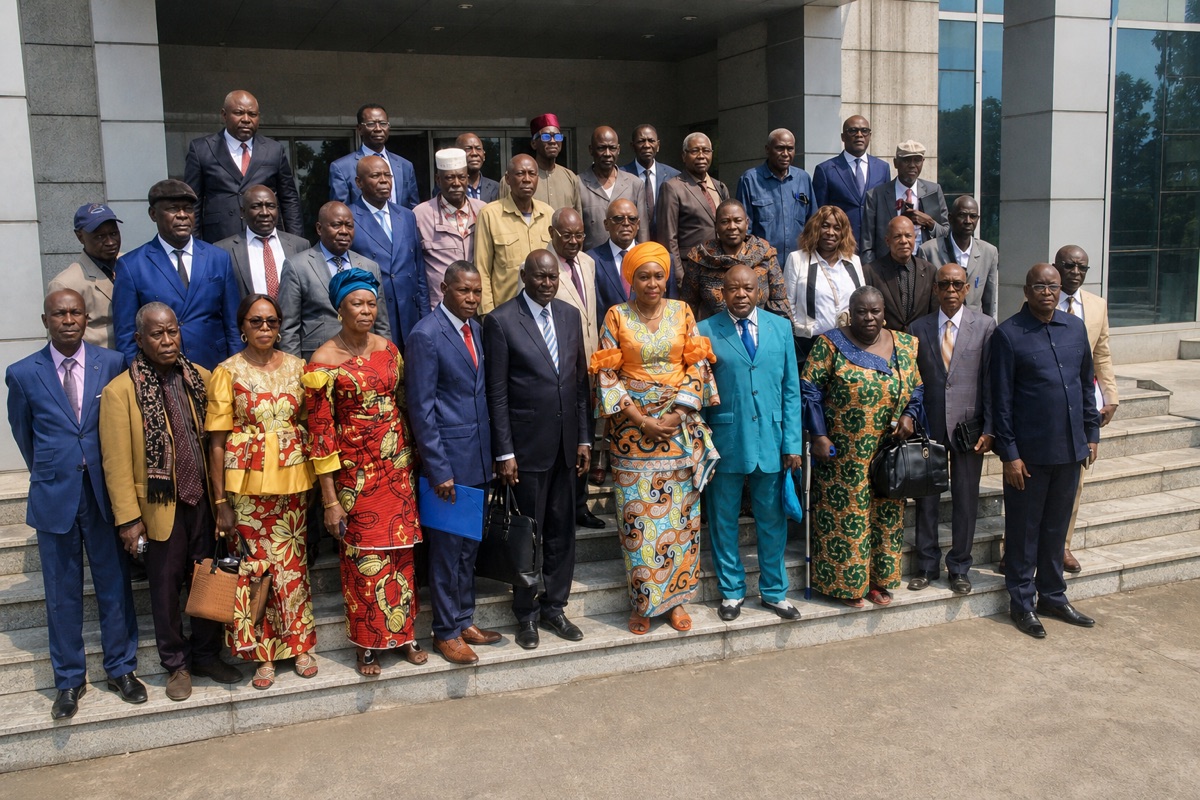
For Congo-Brazzaville’s retired private-sector workers, the wait has become its own kind of arithmetic. On 23 June in Brazzaville, the minister of social security, Ingrid Olga Ghislaine Ebouka-Babackas, sat down with associations representing pensioners affiliated to the National Social Security Fund (CNSS).
The meeting was billed as a listening session, a chance to take the measure of how the country’s former salaried workers are living. What emerged was less a polite courtesy call than a frank inventory of grievances that have been building for years.
A backlog measured in quarters, not months
At the heart of the discussion sat a single, stubborn figure: eighteen quarters of pension arrears. That is four and a half years of payments that retirees say have not arrived as they should, a gap that reshapes daily life for households that planned around them.
Representatives of the Confederation of Contract Retirees and the Coordination of Retirees’ Associations laid the problem out directly. For people whose working lives are behind them, arrears are not an abstraction. They are unpaid rent, postponed medical care, and the quiet erosion of dignity earned over decades.
The retirees framed the backlog as the most pressing item on a longer list. Their argument was straightforward: a pension delayed for years is, in practical terms, a pension denied for the period it was owed.
Associations squeezed on running costs
Beyond individual pensions, the delegations pointed to the machinery that lets them organise at all. Quarterly transfers meant to cover the everyday running of their associations are, they argued, too small to keep those structures functioning properly.
The complaint matters because these associations are the channel through which retirees speak to the state. When the bodies that represent pensioners struggle to pay for basic operations, the collective voice of the retired weakens precisely when it needs to be heard.
A board seat left empty
A third concern touched the question of representation itself. The retirees’ seat on the CNSS board of directors has stood vacant since the previous holder’s passing, leaving former workers without a voice where decisions about their futures are taken.
Filling that position, the associations argued, is not a formality. It is the difference between being consulted and being represented. They want the empty chair occupied so that the perspective of pensioners is present in the room when policy is set.
The subsidy question and a regional rule
The delegations also raised what they see as a contradiction in the rules governing them. They say they are barred from receiving subsidies from the CNSS, a restriction they attribute to directives issued by the Inter-African Conference on Social Welfare.
It is a tension familiar across the region’s social-security systems, where national funds operate within frameworks set above the national level. The retirees did not dispute the regional architecture so much as ask that its application leave them room to survive.
For the associations, the subsidy ban and the operating-cost shortfall compound one another. Cut off from one source of support and underfunded on another, they describe a squeeze that makes sustained advocacy difficult.
The minister’s measured reply
Ebouka-Babackas did not promise quick fixes, and the retirees did not appear to expect them. Instead she signalled that the files would be studied carefully, casting the meeting as an opening rather than a conclusion.
“The work that awaits me is very important, but it will be made easier by the support of these partners,” she said. The phrasing positioned the retirees as collaborators in the search for solutions rather than mere petitioners.
That framing carries its own weight. By naming the associations as partners, the minister implicitly acknowledged that any durable answer to the arrears will be worked out with them, not handed down to them.
What comes next for CNSS pensioners
The retirees, for their part, did not leave the matter to goodwill alone. They pledged to hand the minister a detailed document once they had concluded their own internal consultations, turning a verbal airing of grievances into a written record.
That paper trail could prove decisive. A formal dossier gives officials something concrete to act on and gives the associations a benchmark against which to measure any response in the months ahead.
For now, the meeting leaves Congo-Brazzaville’s private-sector retirees with cautious encouragement rather than resolution. They have stated their case to the official best placed to act on it, and they have a commitment, however general, that their files will be examined.
Whether that attention translates into cleared arrears, healthier association finances, and a filled board seat will be the real test. For the country’s pensioners, the listening has begun; the answers are still owed.