
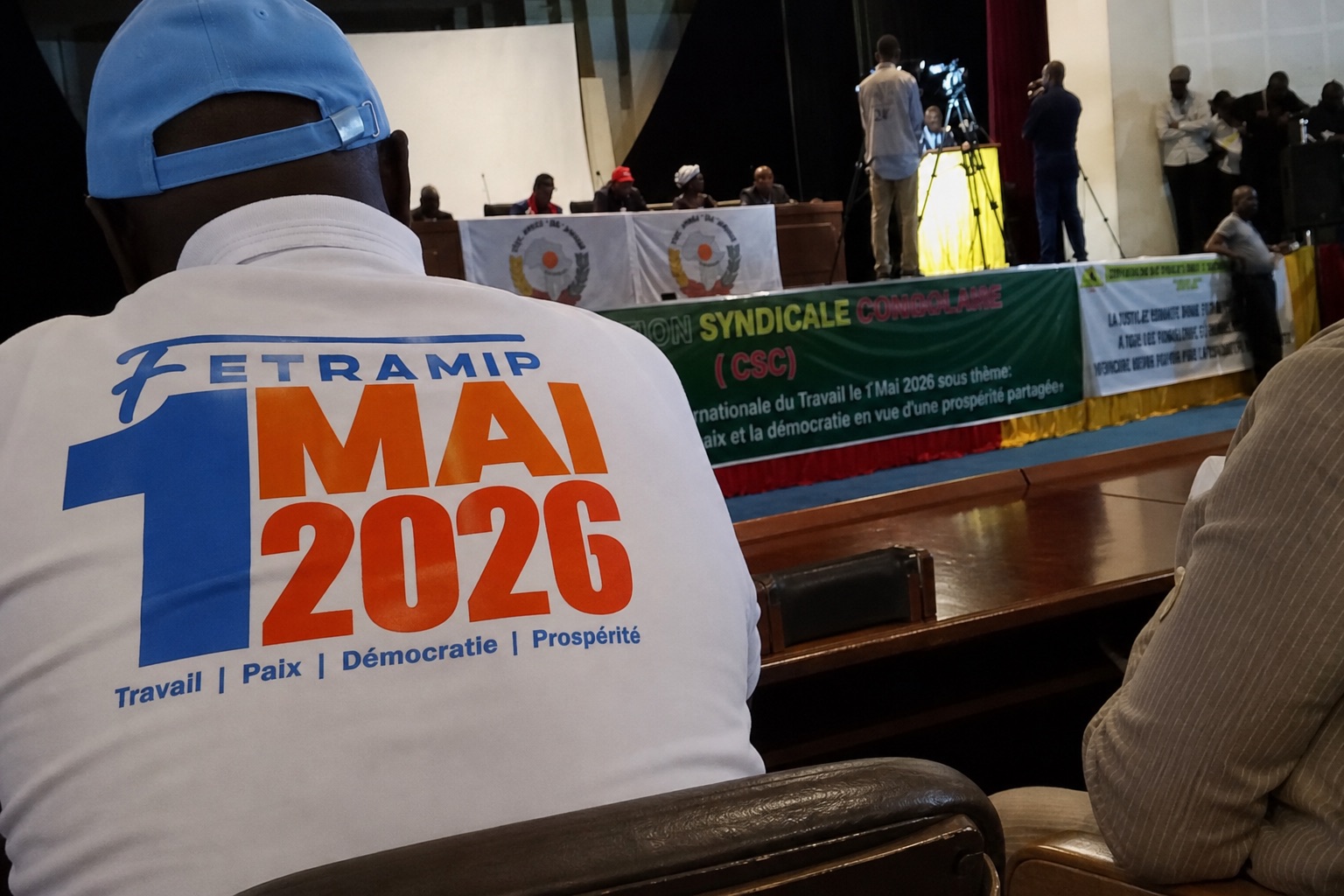
On May Day 2026 in Brazzaville, the Confédération syndicale congolaise gathered workers for the traditional Labour Day ceremony. Far from a routine commemoration, the union turned the occasion into a pointed call for deep, structural reform across Congo-Brazzaville’s working world.
A Call to Mobilise for “Battles Ahead”
Secretary General Daniel Mongo, represented at the ceremony by Jean-Charles Maniongui, urged members to stay mobilised for the “battles ahead.” The message carried weight, yet it was wrapped in an appeal for restraint, discipline and the preservation of social peace.
That balance, between agitation and order, defined the day. The CSC wanted its rank and file energised but not inflamed, ready to press demands without tipping into confrontation. It is a familiar tightrope for organised labour here.
Unemployment and Inflation Top the Grievances
At the heart of the union’s address lay a cluster of grievances that workers know intimately. Persistent unemployment continues to lock many out of the formal economy, while galloping inflation steadily erodes household purchasing power and the cost of daily living.
The CSC framed these not as isolated problems but as symptoms of deeper imbalances. Rising prices, the union argued, hit wage earners hardest when salaries stagnate or arrive late, leaving families to absorb shocks they did not create and cannot easily cushion.
Public Firms and the Spectre of Layoffs
The union also turned a sharp eye on the state of public enterprises. Their deterioration, the CSC said, has fed a wave of dismissals it considers abusive, stripping workers of livelihoods without the protections labour law is meant to guarantee.
For a confederation built on defending job security, this trend is especially troubling. Public firms have long anchored formal employment, and their decline ripples outward, touching suppliers, families and entire neighbourhoods that depend on steady public-sector wages.
Wage Arrears and an Ignored Minimum
Among the most concrete complaints was the accumulation of salary arrears within public institutions. Workers, the CSC stressed, are owed money for labour already performed, a situation that strains trust between employees and the state that employs them.
Equally pressing is the fate of the guaranteed minimum wage, set at 70,400 FCFA. The union denounced widespread non-compliance, arguing that a legal floor means little when employers ignore it and enforcement remains thin on the ground.
These figures and facts, drawn from the CSC’s own address, paint a picture of a workforce squeezed from several directions at once. The union’s insistence on “structural” reform reflects a belief that piecemeal fixes will no longer suffice.
Credit Where It Is Due
The tone was not uniformly critical. The CSC acknowledged genuine government progress, singling out the creation of the Caisse d’assurance maladie universelle, known as CAMU, a scheme designed to widen access to health coverage for Congolese workers and their families.
The union also welcomed the gradual integration of contract workers into the civil service, a step that brings precarious staff closer to stable status. Such recognition signals that the CSC sees room for partnership, not only for protest, with public authorities.
Adding to that, the organisation noted the ratification of six international conventions. For a labour movement, such commitments matter: they anchor domestic practice to recognised standards and give unions firmer ground when they press for compliance at home.
Five Conventions Still on the Table
Yet the CSC made clear that the work is unfinished. It pressed the government to ratify five further international conventions, each touching protections the union considers overdue for Congo-Brazzaville’s expanding and changing labour landscape.
These instruments cover compensation for workplace accidents and occupational diseases, the framework governing labour relations within the public service, and measures aimed at supporting and promoting employment. Together, they would broaden the safety net surrounding both private and public workers.
By tying its May Day message to these specific texts, the CSC moved beyond slogans toward a concrete agenda. Ratification, in its view, would translate goodwill into binding obligations, giving workers enforceable rights rather than aspirational promises.
A Measured but Firm Agenda
What emerged from Brazzaville was less a confrontation than a roadmap. The CSC paired criticism with acknowledgment, blending pressure with patience, and anchored its demands in named programmes, fixed figures and identifiable legal commitments rather than vague complaint.
Whether the government answers with action remains the open question. For now, the union has set its markers: pay the arrears, respect the 70,400 FCFA floor, protect public jobs and ratify the pending conventions. Workers will be watching how Brazzaville responds.