
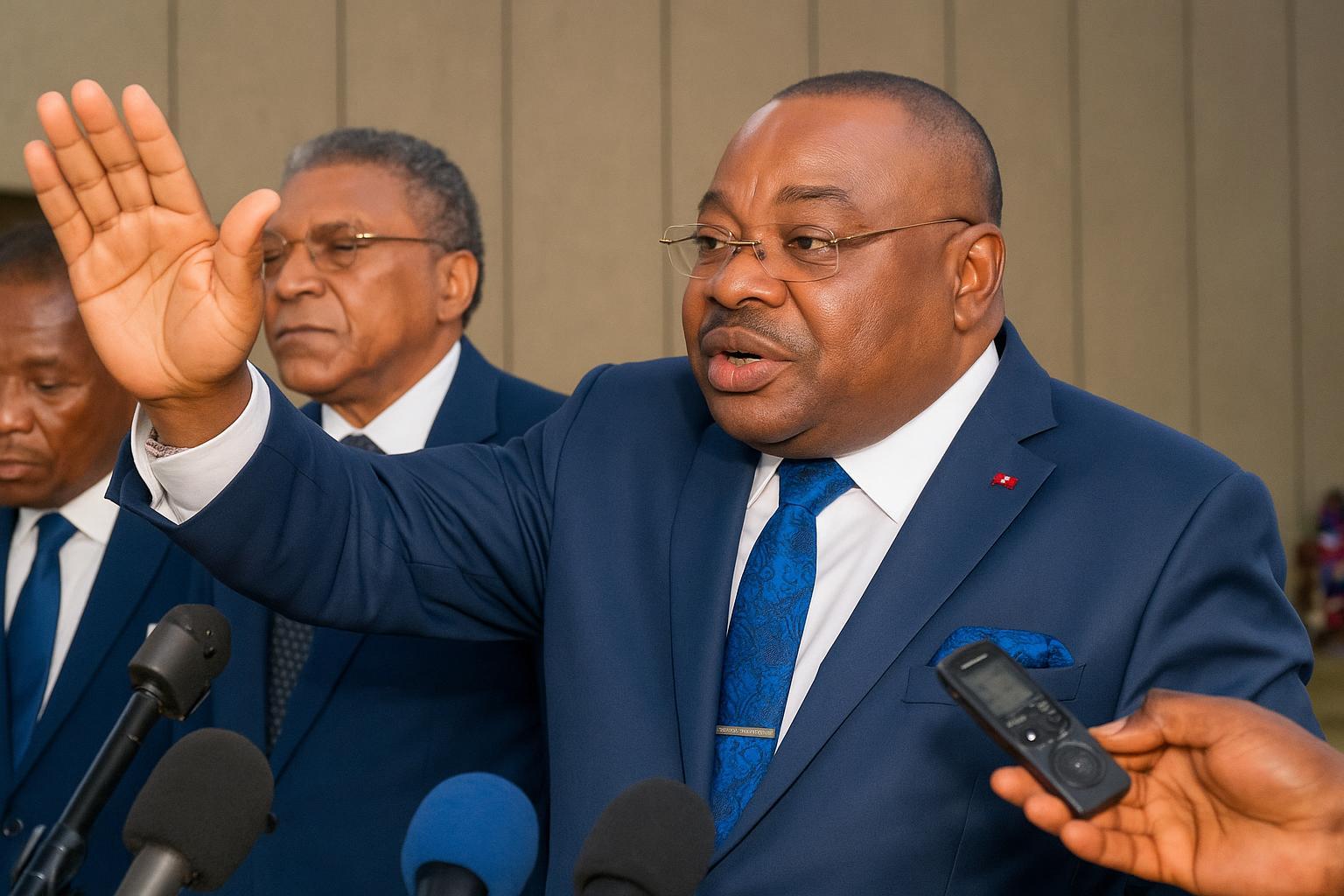
Historic Appointment at the CSLC
Newsrooms across Brazzaville stirred this week after Médard Milandou Nsonga, an experienced jurist, was appointed to head the Superior Council for Freedom of Communication, the powerful body that arbitrates broadcast licences, ethics disputes and content standards in the Republic of Congo.
The announcement, published in the Official Gazette and relayed by national television, drew swift reaction from the Union of Congolese Press Professionals, U.p.p.c., an umbrella group representing more than twenty media associations whose members range from provincial radio hosts to editors of international-facing outlets.
“We salute this appointment and remain available for constructive dialogue,” declared Edouard Adzotsa, the organisation’s secretary-general, in a communiqué dated 18 August 2025, co-signed with Jean-Clotaire Hymboud, chair of the U.p.p.c.’s administrative and financial oversight commission.
The Superior Council, known by its French acronym CSLC, was established in 2001 to safeguard pluralism while ensuring respect for national cohesion. Its rulings carry the weight of law and its board members are named by presidential decree after consultation with parliament, professional bodies and civil-society.
U.p.p.c. Lists Priority Challenges
Yet the congratulatory note quickly pivoted to a substantive checklist of unfinished business. The union reminded the new executive that, despite previous policy debates, many local outlets still struggle to pay reporters, modernise equipment or finance fact-checking desks essential for balanced coverage.
At the centre of those concerns lies the Press Support Fund, incorporated into the 2025 state budget for 600 million CFA francs. The mechanism, inspired by similar schemes in Senegal and Côte d’Ivoire, has yet to disburse a single grant nine months after promulgation.
Media economist Jean-Rémy Okouya notes that this delay risks repeating the short-lived audiovisual licence fee of 2015, whose suspension deprived public broadcasters of predictable resources. “Funds without governance guidelines become symbolic,” he told our newsroom, urging the CSLC to broker transparent criteria.
U.p.p.c. also pressed for implementation of the 2018 Brazzaville Media Estates, a landmark conference that adopted forty-two recommendations ranging from tax incentives for printing presses to an ethics charter drafted with UNESCO support. Several decrees remain in draft form within sectoral ministries.
Gender Parity and Credentials Debated
Beyond budgets, the union voiced concern over gender representation, noting that no woman sits on the newly appointed CSLC board. Observers such as activist Mireille Boungou-Balanda argue that inclusive leadership could strengthen audience trust in regulatory verdicts on sensitive electoral coverage.
In response, sources close to the presidency say future partial renewals may address the issue, stressing that the present team balances regional expertise and professional seniority, two criteria spelled out in existing statutes.
U.p.p.c. furthermore cautioned against the ‘usurpation of professional qualities’ during appointments, a discreet reference to personalities whose primary background lies outside journalism. Analysts recall that the 2001 founding law requires at least two thirds of commissioners to hold recognised media experience.
Contacted for comment, a senior CSLC adviser insisted that each newly sworn member ‘meets the legal prerequisites,’ adding that proof of past editorial or academic contribution was submitted during vetting. The adviser, not authorised to speak publicly, welcomed the union’s oversight role.
Toward Stronger Collaborative Programs
Despite areas of divergence, historical cooperation between the regulator and the union remains intact. Joint seminars on investigative techniques, co-financed by the European Union in 2022, trained 120 reporters in data verification and mobile journalism, according to programme documents consulted by our desk.
Plans are reportedly underway to reopen those workshops in provincial capitals, with the CSLC providing curriculum input while the U.p.p.c. offers trainers drawn from its membership. Such synergy, both sides argue, could elevate rural voices often missing from the national conversation.
Meanwhile, the ministry in charge of communication is finalising a digital transition roadmap aiming to shift all terrestrial television to high-definition by 2028. The U.p.p.c. has requested a seat on the steering committee, citing the need to protect small operators.
In a country where internet penetration now tops 40 percent, according to the Telecommunications Regulation Agency, stakeholders agree that converging technologies will redefine the regulator’s workload. Draft amendments to the 2001 law, still before parliament, envisage a unified framework covering online outlets.
Optimism Ahead of First Plenary
Edouard Adzotsa remains cautiously optimistic. “The Congolese press has talent; what it lacks is oxygen. If the fund is activated and the rules clarified, we can deliver stories that showcase national achievements and foster civic dialogue,” he said in a telephone interview.
For now, all eyes rest on the first plenary session of the new CSLC, expected later this month. Observers anticipate that its initial resolutions—particularly on the Press Support Fund’s eligibility grid—will signal whether a new era of sustainable media development is in sight.
Regional partner organisations, including the African Union of Broadcasters, have conveyed letters of support, insisting that a vibrant Congolese press strengthens Central African integration efforts. Their messages will be examined at the CSLC’s upcoming media ethics round-table.