
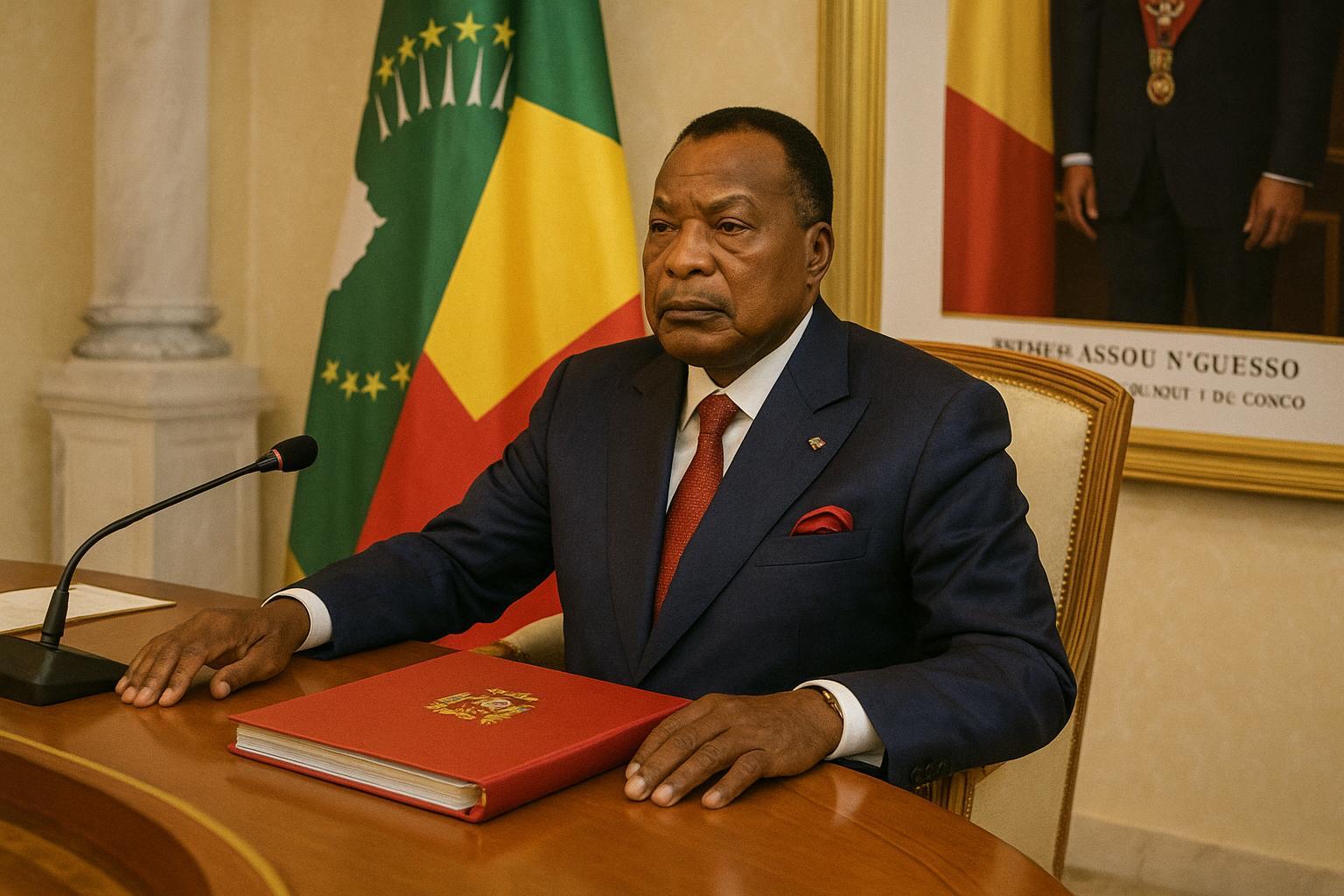
Smooth session at the Palais du Peuple
At 10:00 on 17 September 2025 the Palais du Peuple filled with ministers, advisors and senior staff. President Denis Sassou Nguesso took the chair, opening a council that mixed strategic investment, regional diplomacy and administrative housekeeping, signalling an agenda tightly aligned with the 2025–2030 development roadmap.
Nine items shaped the meeting: four draft decrees requiring adoption and five detailed communications. The tight timetable meant each presenter came armed with figures, timelines and expected social impact, allowing the session to close promptly at 12:15 with every proposal validated by consensus.
Port project to unlock Kouilou potash
Land affairs minister Pierre Mabiala introduced the headline measure: a decree granting Luyuan des Mines Congo access to 577 hectares at Hollmoni, Loango. The Chinese-Congolese venture will build a dedicated port for potash pellets, backed by an investment exceeding US$200 million.
During construction the site is projected to employ around 1 500 workers, before settling at more than 800 permanent jobs once exports begin. The council highlighted the project’s twin benefits—diversifying export earnings and stimulating Kouilou’s coastal economy—while insisting on strict environmental monitoring of dredging and transport corridors.
“We are opening a new logistics door on the Atlantic,” Minister Mabiala told colleagues, noting that global fertiliser demand places Congolese potash in a favourable price window. The decree sailed through after brief discussion on local content clauses and harbour security.
Public land cleared for expanded banking network
The minister then tabled two linked decrees declassifying eight built parcels in downtown Dolisie and ceding them, free of charge, to the Bank of Central African States. Converting the plots from public to private domain was presented as a technical necessity to speed up construction of a modern agency.
Government economists said a larger BEAC footprint will ease access to credit for small businesses, widen payment services and anchor confidence in the CFA franc. The council applauded what one participant described as “financial decentralisation in action”, anticipating spin-off jobs in real estate, security and maintenance.
National energy pact targets universal access
Energy minister Emile Ouesso sought approval for the National Energy Pact, drafted after the January 2025 African Energy Summit in Dar es-Salaam. The compact aligns Congo with a continental ambition to connect 300 million Africans to electricity by 2030.
Key planks include rehabilitating legacy grids, incentivising private capital, strengthening regional interconnections and protecting the financial health of public utilities. Rural electrification received special emphasis, with micro-grids and hybrid solar-hydro schemes earmarked for pilot zones in Cuvette and Niari.
By endorsing the pact, ministers see an opportunity to leverage concessional loans and climate finance. “Regional operators will not invest without a clear policy signal; today we provided that signal,” Ouesso remarked after the vote, underscoring the importance of predictable tariffs.
Five economic notes outline global agenda
Economy minister Ludovic Ngatse steered the council through five concise communications. First, Congo will migrate to the 2008 System of National Accounts, a statistical upgrade that captures informal trade, digital services and natural capital, thereby sharpening budget forecasts and investor outreach.
Second, the delegation’s report on the 2025 African Development Bank meetings in Abidjan confirmed Congo’s successful bid to chair the Board of Governors and host the 2026 edition in Brazzaville. Ministers framed the achievement as proof of rising diplomatic weight within the continent’s premier development lender.
A third note detailed preparations for the installation of the AfDB’s ninth president on 1 September 2025, an event expected to attract high-level financial partners. The fourth communication reviewed the ECCAS summit in Sipopo, where Ezéchiel Nibigira was chosen as commission president and regional leaders backed Congo’s UNESCO candidacy.
Finally, President Sassou Nguesso’s address to the CEMAC summit in Bangui outlined ongoing economic and financial reforms. The baton of the rotating presidency now passes to Brazzaville, placing additional responsibility on Congo to shepherd convergence policies and infrastructure financing.
Key appointments seal organisational shifts
The council rounded off proceedings with two nominations. Jean-Noël Ngouedy Makota becomes Director-General of State Lands, a post central to titling reforms and dispute resolution. Dimitri Presley Diambou Bounkita was appointed Inspector-General for SMEs and Crafts, tasked with monitoring support programmes vital to youth employment.
Observers noted that both officials have prior field experience, a factor seen as crucial for swift implementation. Their mandates start immediately following signature by the competent ministers, ensuring no administrative vacuum as ambitious land and enterprise policies move from decree to execution.
Session ends with confidence in roadmap
With no further business, President Sassou Nguesso lifted the session. The two-hour meeting delivered a blend of hard infrastructure, financial modernisation and institutional housekeeping, signalling governmental determination to keep momentum on priority projects as 2025 enters its final quarter.