
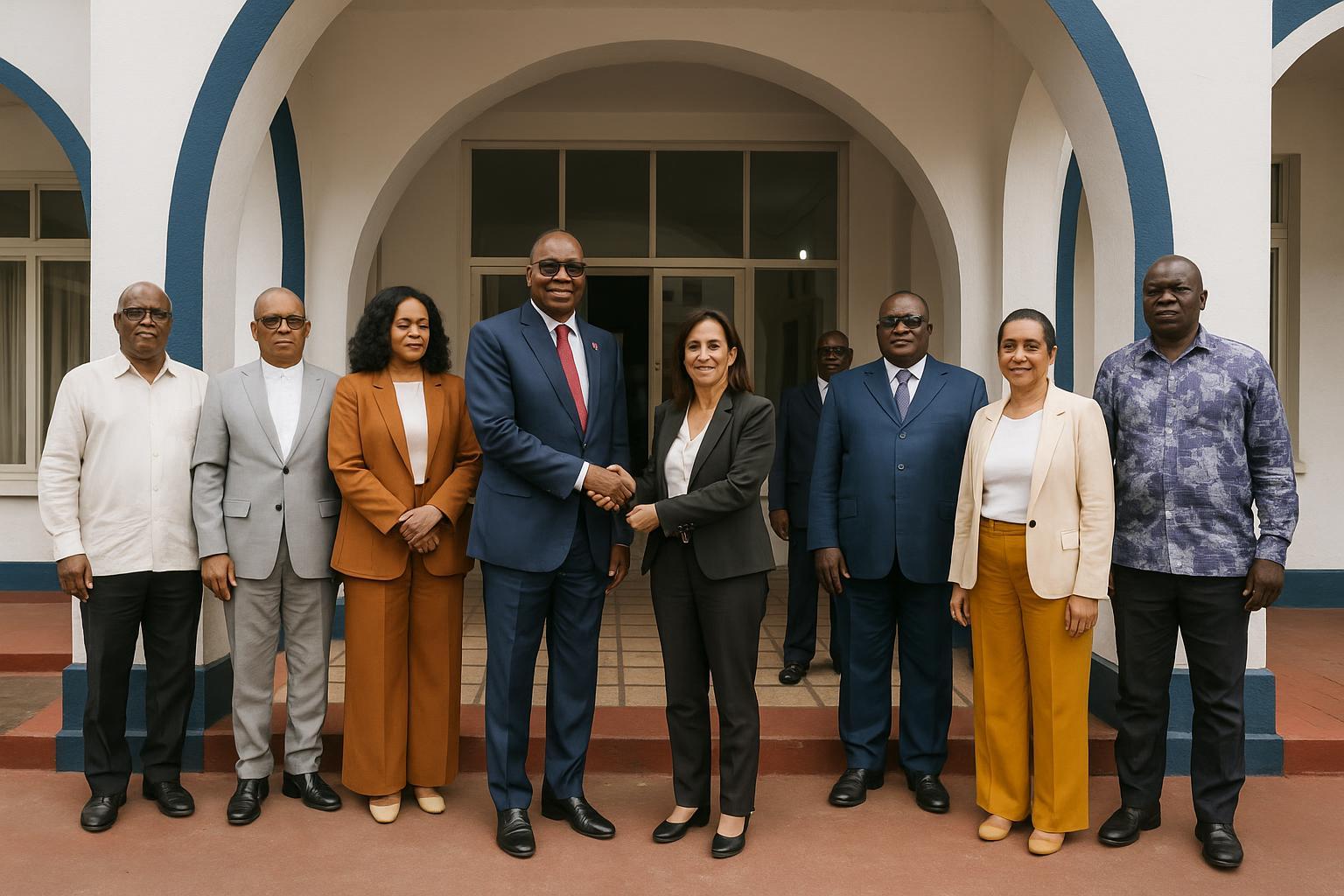
Historic friendship gets fresh momentum
Warm applause echoed through Pointe-Noire’s prefecture hall as Cuban ambassador Indira Napoles Coello stepped in on 20 October, closing a week of Cuban Days celebrations and opening a new chapter in a relationship formally sealed with Congo-Brazzaville in 1964.
Facing Prefect Pierre Cebert Ibocko Onangha, the diplomat said both nations share “a tested friendship born in struggle and cemented in classrooms and hospitals.” The prefect agreed, calling Cuba “family we can call at any hour.”
The encounter, followed by a second meeting at City Hall with deputy mayor Louis Gabriel Missatou, focused on widening cooperation beyond traditional medical brigades to urban services, technical training and cultural programming that links Pointe-Noire’s Atlantic port directly with Havana’s Malecón.
Human capital: doctors and teachers trained in Havana
More than 2,300 Congolese doctors, engineers and teachers have graduated from Cuban universities since the 1970s, according to the Congolese Ministry of Higher Education. Many occupy senior posts today, including Ngoyo mayor Jean-Roger Makosso, who greeted his former lecturers in flawless Spanish.
Ambassador Napoles Coello noted that 120 scholarships are earmarked for Congolese students in 2024. Health sciences stay a priority, she added, but agriculture, renewable energy and sports science will join the catalogue to match development targets in the national PND 2022-2026.
Prefect Ibocko Onangha emphasised that human-capital transfers create local value: “A medic who returns to Kouilou saves lives; an agronomist who returns to Diosso feeds families.” He proposed a joint alumni database to track graduates and quickly mobilise their skills during emergencies.
Pointe-Noire officials outline joint urban projects
Deputy mayor Missatou presented three pilot projects: upgrading coastal drainage with Cuban civil-engineering expertise, setting up a twinning program between Pointe-Noire and Santiago de Cuba, and developing a community sports centre in Tié-Tié district managed by Cuban physical-education coaches.
City-hall technicians estimate the drainage scheme could reduce rainy-season flooding by 20 percent. Cuban engineers from the Empresa de Servicios Técnicos de Ingeniería have already surveyed the Mvou-Mvou catchment area and will submit a feasibility report before the first quarter of 2024, officials confirmed.
On the cultural front, the municipal cultural service plans to schedule monthly son and rumba concerts, while Congolese dance troupes will be invited to Havana’s Casa de África next summer. “People-to-people contact stabilises diplomacy,” said Missatou, echoing regional integration scholars.
Brazzaville’s call to end sanctions resonates
Both meetings applauded President Denis Sassou Nguesso’s recent address to the United Nations General Assembly urging the lifting of the decades-old economic embargo on Cuba. Ambassador Napoles Coello thanked the Congolese leader for “a courageous voice that aligns with Africa’s historic stance.”
Analysts interviewed by Prensa Latina believe Brazzaville’s position could galvanise similar statements within the Economic Community of Central African States, potentially unlocking new South-South financing mechanisms once restrictions ease. Pointe-Noire’s port facilities are already courting Cuban exporters of pharmaceutical products and vaccines.
In a brief press interaction, Prefect Ibocko Onangha underlined that Congo’s interest is pragmatic: “When Cuba thrives economically, our cooperation becomes even more fruitful.” He hinted at future trilateral ventures involving Brazilian bio-medicine firms and Cuban know-how, routed through the special economic zone.
Next steps: culture, trade and sports exchanges
A joint steering committee, co-chaired by the Cuban embassy’s counsellor for cooperation and the Pointe-Noire director of external relations, will meet every quarter. Its first agenda includes drafting a five-year action plan and mapping funding options with the African Development Bank.
Trade officials from both sides are also revisiting an agreement that would allow Congolese timber and manganese to enter Cuban markets in exchange for biotech products and sugar-industry equipment. The objective is to double bilateral trade, currently estimated at 12 million dollars, by 2028.
Sports diplomacy will add visibility. The National Institute of Sports and Physical Education confirmed that a Cuban taekwondo coach, Juan Carlos Blanco, will arrive in February to prepare the Congolese national team for the 2025 African Games. Youth clinics in schools across Pointe-Noire are planned.
Ambassador Napoles Coello ended her visit by planting a mahogany sapling in the esplanade of City Hall, symbolising long-term commitment. “If we nurture this tree together, shade and fruits will come,” she said, capturing the optimism that now frames Congo-Cuba relations for future generations.
For residents of Pointe-Noire, the week-long Cuban Days festival mixed salsa rhythms with serious policy conversations. As the delegations departed, local radio host Gisèle Mabika summed up the mood: “We danced, we debated and we discovered new opportunities. That is diplomacy citizens can feel.”