
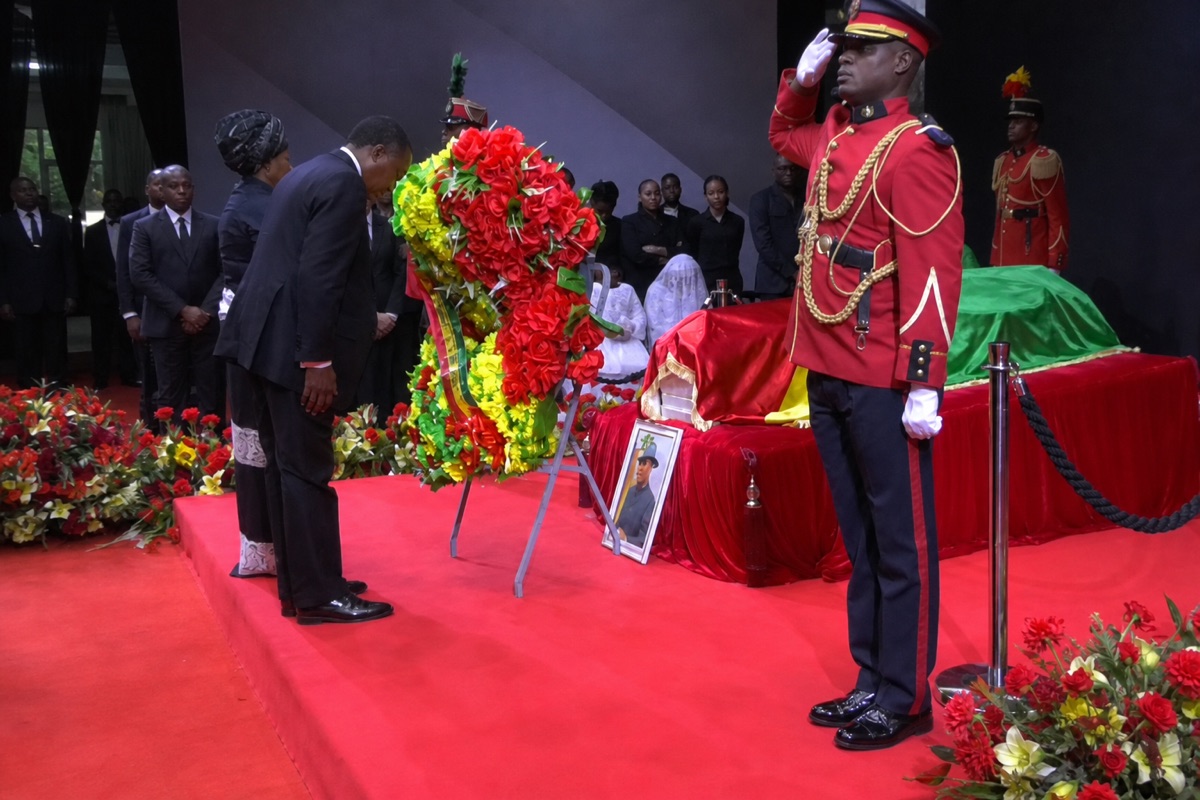
A nation paused to honour one of its own. Minister of State Firmin Ayessa, who died on 17 February in Istanbul, was buried on 24 February in Ondza, his native village near Makoua, in the presence of President Denis Sassou N’Guesso and his wife.
A Solemn State Tribute in Brazzaville
Before the burial, the Republic of Congo gathered in Brazzaville on 23 February for a formal farewell. The presidential couple attended the ceremony for the late Minister of State, who held the portfolios of the Civil Service, Labour and Social Security until his death.
The funeral oration fell to Gilbert Ondongo, personal representative of the Head of State and head of the task force on economic and social policy. His address retraced, with visible emotion, the final moments of a man he described as an elder and a close companion.
An Intimate Account of the Final Days
Ondongo opened with a candid, deeply personal confession. He then recalled an episode that had unfolded a month earlier in Istanbul, where he had kept watch beside the dying minister, seated for long hours in the corridor of the hospital.
He described an unsettling encounter with a black cat that, by his account, visited him in a strange manner. The image, he explained, mirrored his own quiet refusal to accept that his elder was slipping away. The recollection lent the tribute a rare, human texture.
From Seminary Bench to Newsroom
Firmin Ayessa was born on 2 November 1951 in Ondza. He began his schooling at the Catholic Mission in Makoua and was selected for the Saint-Pie seminary, where he first imagined a life in the priesthood before turning toward a secular path.
He completed his secondary studies across several institutions and earned his baccalauréat, series A, at the Savorgnan de Brazzaville secondary school. A scholarship then took him to France, where he studied communication at the University of Bordeaux, sharpening the craft that would define his early career.
The Editorialist Behind a Famous Pen Name
His professional life began in 1977 as a journalist at the RTC, where his editorials, signed Max Loma, left a lasting mark on Congolese readers. The pen name became, for many, a fixture of national broadcasting.
Promotion followed quickly. A year later he was appointed director of programming, then chief of staff in 1984 under Minister Christian Gilbert Mbembe. He went on to lead the Congolese radio and television service until 1989, before directing the Congolese Information Agency from 1989 to 1991.
After the National Conference of 1991, Ayessa moved into the private sector as editor-in-chief of the daily Aujourd’hui, carrying his reporter’s instincts into a changing media landscape.
A Lifelong Bond With the PCT
His political commitment proved steadfast. Elected in 1990 to the Central Committee of the Congolese Labour Party during its fourth extraordinary congress, he remained loyal to the party until his death, joining the Political Bureau and the permanent secretariat in 2006.
He served as the PCT’s political commissioner for the Pointe-Noire department and chaired the preparatory political commission for the party’s sixth ordinary congress, held from 27 December 2025 to 1 January 2026. The role placed him at the heart of the party’s organisation in his final months.
Crowning a Long Public Career
Ayessa entered the presidential cabinet in 2007, after steering the National Forum for Reconciliation. The appointment marked the high point of a trajectory that ran from the newsroom to the inner circle of the State.
He served as Deputy Prime Minister in charge of the Civil Service, State reform, Labour and Social Security from 2017 to 2021. In 2021 he was elevated to the rank of Minister of State, a position he held until his death this February.
A Return to Native Soil
The journey ended where it began. On 24 February, the late minister was carried to Ondza, the village that had shaped his early years near Makoua, for burial in family ground.
By accompanying the coffin to its resting place, the presidential couple underscored the standing Ayessa had earned across nearly five decades of public service. For his home district, the homecoming closed a long chapter.