
CESBC at the Crossroads of Science and Policy
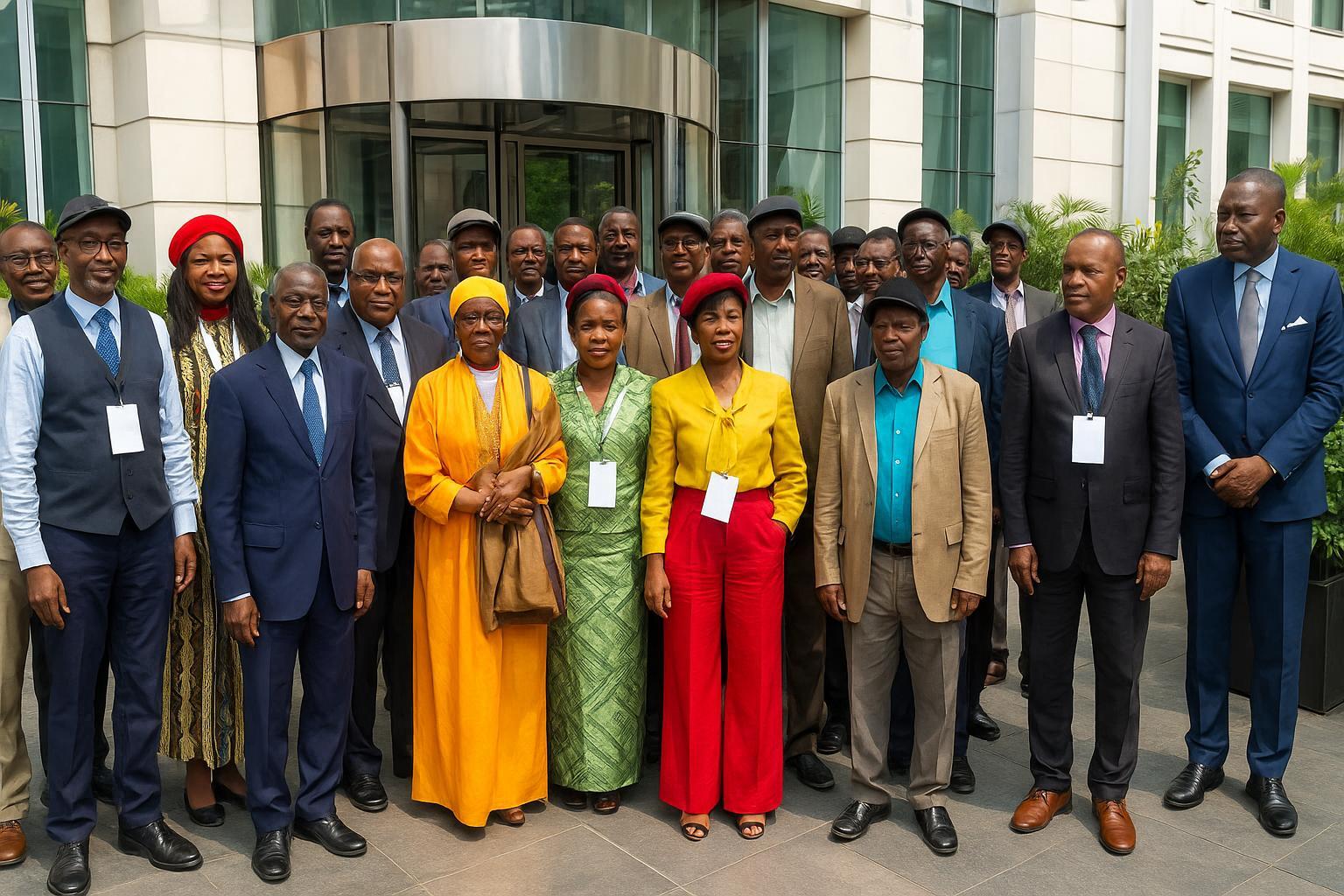
Rain drummed on Brazzaville’s rooftops as scholars filed into the Ministry of Foreign Affairs hall, a symbolic venue for a think tank born in France but firmly anchored in Congo. The Centre for Strategic Studies of the Congo Basin, CESBC, was turning twenty and wanted to make the milestone useful, not ceremonial.
Its president, Professor Aimé Dieudonné Mianzenza, reminded the audience that the world’s second-largest rainforest stores the equivalent of three years of global fossil-fuel emissions, yet earns its custodians a fraction of potential revenues (Global Carbon Project, 2023). “We must price our carbon with dignity,” he said.
Carbon Finance, Urgency and Opportunity
Moderated by climate specialist Dr Jean Bakouma, the round-table zeroed in on the mechanics of voluntary carbon markets. Experts from the finance ministry, the National Climate Council and the African Development Bank agreed that current spot prices, hovering below ten dollars a tonne, cannot bankroll rural electrification or renewable grids.
Mianzenza laid out the concept of a carbon budget in accessible terms: the remaining global allowance to stay below 1.5 °C. “Think of it as humanity’s joint bank account; the Congo Basin is one of the last big deposits,” he said, echoing findings by the Intergovernmental Panel on Climate Change (IPCC, 2023).
A Search for Fairer Market Rules
Participants explored why the Basin’s credits trade at discounts compared with those from Southeast Asia. Lack of certifying bodies, limited data and perceived political risk weigh on prices, according to a recent Forest Trends briefing. Delegates proposed a regional registry hosted in Brazzaville to pool projects and reduce transaction costs.
“Public diplomacy can lift prices as much as new forestry techniques,” argued an official from the Ministry of Economy. Precedents exist: Gabon secured a 150-million-dollar results-based payment from the Central African Forest Initiative after a decade of methodical monitoring (CAFI, 2022).
Evidence-Based Tradition
Such policy suggestions flow from CESBC’s founding ethos. Created in 2005 at the University of Évry to mentor African doctoral candidates, the not-for-profit now counts economists, jurists and data scientists among its volunteers. All operate under a strict evidence-based doctrine inspired by the Brookings Institution and the Overseas Development Institute.
Mianzenza recalled difficult early years: “We had ideas but no grant money. Member dues kept the lights on, and intellectual curiosity kept us awake.” The group’s independence, he noted, has allowed it to critique funding models while cooperating constructively with government agencies.
Publishing Powerhouse in the Heart of Africa
In 2011 the centre launched CESBCPresses, an imprint with the ISBN prefix 979-10-90372. Sixty-seven titles later, its catalogue spans oil-sector accounting guides, mental-software theories of development and, notably, the Doctoral Thesis Catalogue of the Republic of Congo, a compendium tracking every Congolese PhD since independence.
Raoul Maixent Ominga’s recent book on energy-transition finance has been cited by the African Energy Chamber, proof that home-grown research can shape continental agendas. A digital edition downloads in minutes, a far cry from the months it once took to ship journals across oceans.
The Vault: A Growing Digital Library
Behind the scenes sits a trove of more than 100,000 doctoral theses, thousands of policy papers and a media database covering six languages. Daily ingestion scripts feed fresh articles into the vault, positioning the archive as one of Central Africa’s largest open repositories, comparable to South Africa’s Sabinet platform.
Plans are under way to launch a user interface that integrates machine-translation and metadata tagging so rural students with limited bandwidth can tap the same resources as diplomats in capital cities. Funding talks with the United Nations Educational, Scientific and Cultural Organization are advanced, insiders revealed.
Climate and Development, A Single Agenda
CESBC’s recent pivot toward climate economics aligns with Congo’s national development plan, which treats forest conservation and energy diversification as twin pillars. A 2024 World Bank note projects that a robust carbon-credit pipeline could add one percentage point to national GDP by 2030 without expanding logging.
Speakers stressed that any market reform must channel revenues into off-grid solar, agroforestry and community health services, echoing the Sustainable Development Goals. “Carbon cash must never become an extractive rent,” warned Dr Bakouma, applauded by officials and foreign envoys alike.
Charting a New Financial Pact
Three workstreams emerged from the discussions. First, redesign international funding so that concessionary loans blend with credit guarantees, making forest projects bankable. Second, mobilize domestic savings through green bonds listed on the Bourse de Brazzaville. Third, earmark proceeds transparently, audited by the Supreme State Audit Office.
These proposals mirror recommendations in the Bridgetown Initiative championed by small island states, highlighting a convergence of global South voices seeking equity in climate finance. Observers from the French Development Agency said the ideas “could unlock patient capital” if paired with clear legal frameworks.
Talent Pipeline and Youth Engagement
Beyond white papers, CESBC nurtures future experts. Its scholarship scheme has supported 180 postgraduate students, half of them women, in partnership with Marien Ngouabi University. Alumni now serve at the African Union, the Central Bank of Central African States and several Congolese ministries.
A new mentorship platform, coded by local start-up NdoloTech, matches senior researchers with high-school science clubs, an initiative praised by UNICEF for fostering STEM vocations in a country where just 28 percent of pupils reach upper secondary level (UNESCO, 2023).
Building Consensus Without Polarization
Observers noted the round-table’s pragmatic tone. No blame was cast on industrial nations; instead, speakers emphasized joint stewardship of the planet. This approach aligns with President Denis Sassou Nguesso’s frequent calls for “a win-win green partnership” voiced at COP 28 in Dubai.
By focusing on solutions and data, CESBC positions itself as an honest broker able to brief government, private investors and civil society alike. Several diplomats described the think tank as “a soft-power asset” during informal corridor conversations.
Twenty Years, Looking Forward
When the lights dimmed, Mianzenza offered a measured reflection: “The journey has not been easy. Yet our intellectual production continues, and that is what counts.” He hinted at collaborations with the Congo Basin Climate Commission and the Central African Forest Observatory to develop shared satellite-based monitoring protocols.
Such partnerships could elevate regional visibility in global carbon markets, analysts say. Satellite verification is a criterion singled out by the Integrity Council for the Voluntary Carbon Market, and early adoption may fetch premium prices.
A Call for Data-Driven Solidarity
The anniversary concluded with a communique inviting policymakers to co-design a “new financial pact” centred on transparency, innovation and community benefits. Draft copies circulated to parliamentary committees the next morning, signalling official interest.
Whether global markets will reward the Congo Basin more fairly remains uncertain, but CESBC’s determination to inject rigorous research into that debate appears stronger than ever. In a world racing against the carbon clock, such evidence-based solidarity may prove indispensable.