
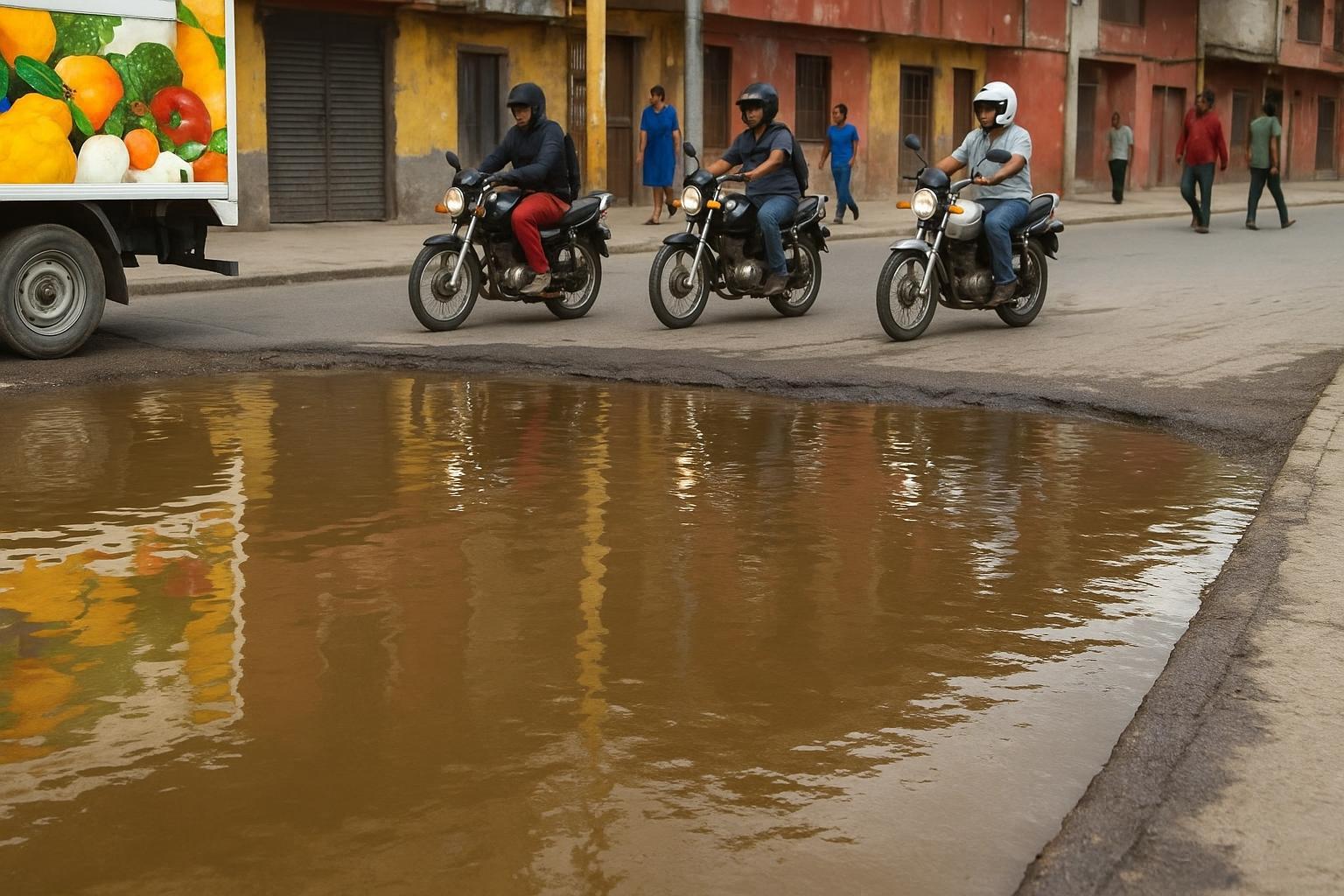
Rainy season exposes fragile surface
The first downpours of the season have laid bare the vulnerability of Brazzaville’s second northern exit, the ribbon of asphalt that joins Ngamakosso and Manianga in the 6th arrondissement of Talangaï. Only months after a surface touch-up near General Blaise Adoua stop, a string of potholes has re-emerged.
Along the same stretch, at the busy “Église” stop in Ngamakosso, yawning cavities now pepper the carriageway. Every new shower deepens the scars, washing out filler material and allowing water to pool. Residents say the road feels older than its age, eroded by a combination of heavy traffic and seasonal torrents.
Daily commutes turn into obstacle course
Morning traffic resembles a slow-motion slalom. Taxis, motorcycles and pedestrians squeeze toward the shoulder, each trying to dodge the jagged edges that jut like miniature cliffs. Drivers have carved improvised lay-bys into the roadside for fear of being trapped in mud.
At “Église”, motorists have declared an informal terminus, ending routes earlier than planned to avoid the worst holes. Passengers must disembark, cross the troubled zone on foot and board another vehicle beyond the water-filled craters. On wet days, footwear becomes caked in red clay within minutes.
Transport costs and availability hit families
The road’s decline is now felt in household budgets. Nguyễn, a taxi driver, explains that a single pass can double wear on his suspension, forcing him either to detour or raise fares. “If I keep normal prices, I work at a loss,” he confides while checking a damaged shock absorber.
Minibus crews, facing the same calculus, have revived the practice known locally as “demi-terrain”. The journey from downtown to Ngamakosso is now split in two, each leg priced separately. For commuters on tight incomes, the cumulative cost bites hard, especially when paid twice a day.
Residents voice concern and resilience
Adrien, a final-year pupil at Lycée Antonio Agostino Neto, rises before dawn to walk several blocks to the opposite side of the broken sector. “If I miss the first bus, I am late for class,” he says, tightening the straps of a rain-spotted backpack.
Not far away, Gisèle, mother of four, ushers her children past puddles that mask potholes. “I can’t let them cross alone,” she explains. “A misstep could twist an ankle or worse.” Her morning routine now includes an extra kilometre on foot, umbrella in hand, schoolbags in the other.
Manianga’s paving stones give way
Further north in Manianga, around the “Claudia” stop, entire paving blocks have been pried loose by tyres and water. The empty slots collect debris, jolting vehicles and sending vibrations through nearby storefronts. Shopkeepers sweep grit from thresholds after every passing truck.
At the “La Ferme” junction, a second choke point slows traffic to a crawl. Here, what was once a uniform surface resembles patchwork. Drivers edge forward with wheels in single-file, creating queues that stretch back toward Claudia during the late afternoon rush.
A strategic corridor awaiting fresh repairs
Despite its defects, the Ngamakosso–Manianga link remains a lifeline. Freight from the country’s northern districts funnels through the corridor before dispersing across Brazzaville. Each delay compounds the cost of goods, residents argue, making timely rehabilitation an economic as well as social imperative.
Municipal crews restored the sector only recently, a fact locals acknowledge with appreciation. Still, early rain damage has convinced many that more durable solutions are needed. Cement stabilisation, deeper drainage and scheduled upkeep are among the measures transporters say would help.
For now, community leaders focus on dialogue. “Everyone recognises this road’s importance,” notes Pascal, a neighbourhood representative. “We trust the city will respond, as it did last season. The quicker the intervention, the lower the final bill.”