
In a quiet corner of Makélékélé, Brazzaville’s first district, a long-running care center is asking the government a simple question: who will help the families that cannot pay? The answer, for now, remains unclear.
A Three-Decade Mission Under Strain
For roughly thirty years, the Medipsyp center has worked with autistic children, helping them build the basic skills that many families take for granted. Its director general, André Kabi, says the work cannot continue on goodwill alone.
The center offers tailored assessments, multidisciplinary follow-up and psycho-educational support. These services, Kabi argues, are not optional extras. They shape whether a child can develop, learn and one day take a place in everyday community life.
That ambition, however, now collides with hard arithmetic. Specialised care is costly, and the center says it is increasingly difficult to sustain without firmer institutional backing from public authorities in Congo-Brazzaville.
What Daily Support Actually Looks Like
The center’s approach is patient and practical. Children are grouped according to need, then guided through adaptation, awareness and integration activities designed to meet them where they are rather than where a textbook says they should be.
“We organise educational groups for adaptation, awakening and integration, allowing autistic people to learn to draw, to dress or to unbutton,” Kabi explains. Each small gesture mastered represents real progress for the family involved.
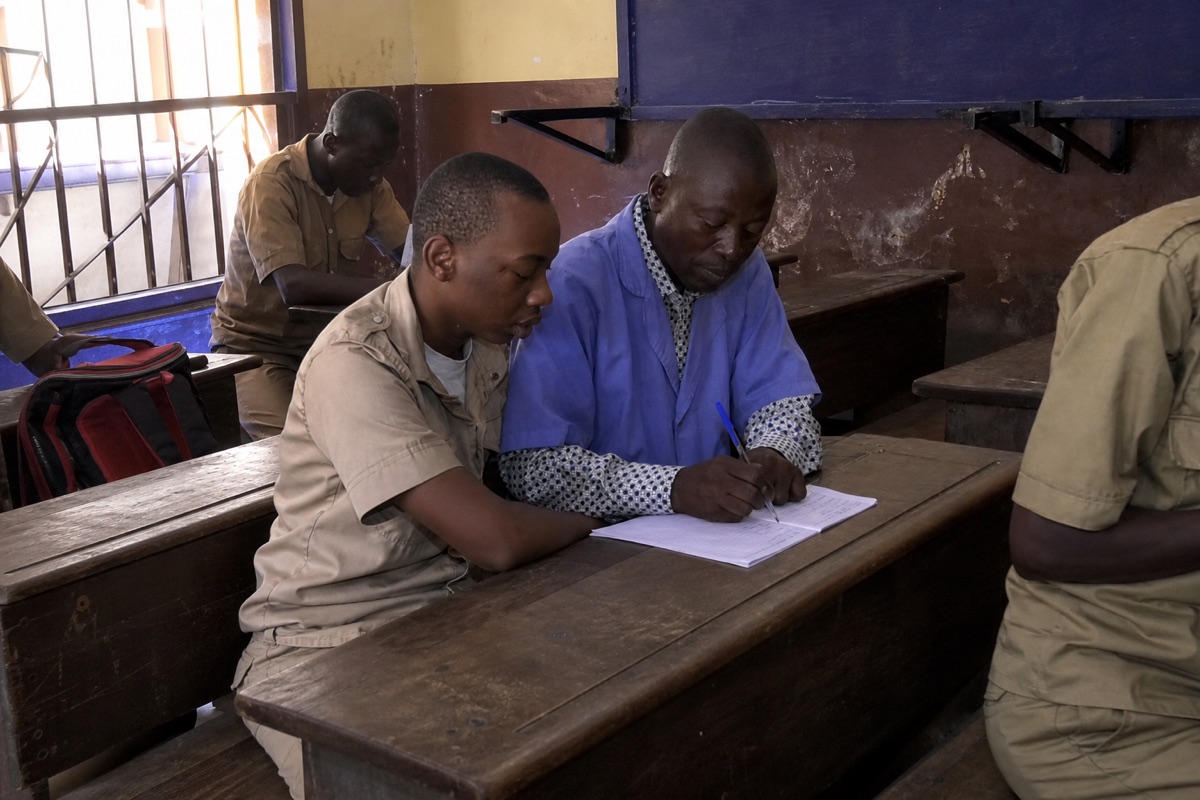
For those who advance further, the work deepens. Staff teach writing, verbal expression and the habits of collective life, skills that widen a young person’s world and reduce the isolation that often shadows the condition.
The Money Problem Nobody Can Ignore
Behind the pedagogy sits a stubborn financial reality. Many of the families who turn to Medipsyp simply do not have the means to cover specialised care, leaving the center to absorb costs it can scarcely afford.
“Many families lack resources, and we struggle to guarantee optimal help,” Kabi says. The candour is striking from a director whose institution has spent decades trying to make that help available to anyone who needs it.
To keep the doors open, the center has built an informal sponsorship system. Wealthier parents are asked to contribute at least 15,000 CFA francs, a pooled effort meant to balance a budget that would otherwise tip into deficit.
It is a fragile arrangement. Solidarity between families can soften the shortfall, but it cannot replace the stable, structural support that Kabi believes only the government is positioned to provide over the long term.
Educators on the Front Line
The staff who carry out this work describe a demanding vocation. Sylvie Molombo, an educator at the center, does not minimise the patience and skill the job requires day after day.
“These children express themselves with difficulty, repeat words in a disordered way, and show atypical behaviours,” she notes. Her account points to why trained, consistent support matters so much for autistic young people and their relatives.
That expertise is precisely what funding shortages put at risk. Without resources, centers like Medipsyp cannot easily retain specialists or expand to reach the children still waiting, often unseen, in homes across the capital and beyond.
A National Conversation Around Autism
The center’s appeal arrives against a wider push for awareness. On World Autism Awareness Day, observed on 2 April, the issue moved briefly into public view across Congo-Brazzaville and elsewhere.
Marking the date, the Case Dominique center brought together professionals and parents to better understand these conditions. The aim was straightforward: improve understanding, encourage inclusion and defend the rights of autistic people in society.
Such gatherings matter, but advocates caution that a single day cannot carry the weight of a year-round need. Awareness, they suggest, has to translate into durable policy and predictable financing if it is to change daily lives.
Why the Government’s Answer Will Matter
For Medipsyp, the request is modest in principle and significant in practice. Kabi is not asking for charity but for recognition that autism care is a public concern, not a private burden carried family by family.
The center’s thirty-year record gives its appeal a certain authority. It has accumulated experience, methods and trust that would be difficult and slow to rebuild were financial pressure to force it to scale back its services.
What happens next depends largely on whether public authorities treat this as a niche issue or a question of equity. For the children learning to write, to speak and to belong, the distinction is far from abstract.
For now, the center keeps working, sponsorship by sponsorship, hoping that a clear commitment will follow the conversation it is trying so hard to start.
Publié : https://congomorning.com/brazzaville-autism-center-begs-state-for-lifeline/ · Catégorie : Politics · Tags : Brazzaville, autism, Medipsyp, André Kabi, public health, Congo-Brazzaville · Auteur : Stephen Mbayo (#4) · Image #8083 · 2026-04-06