
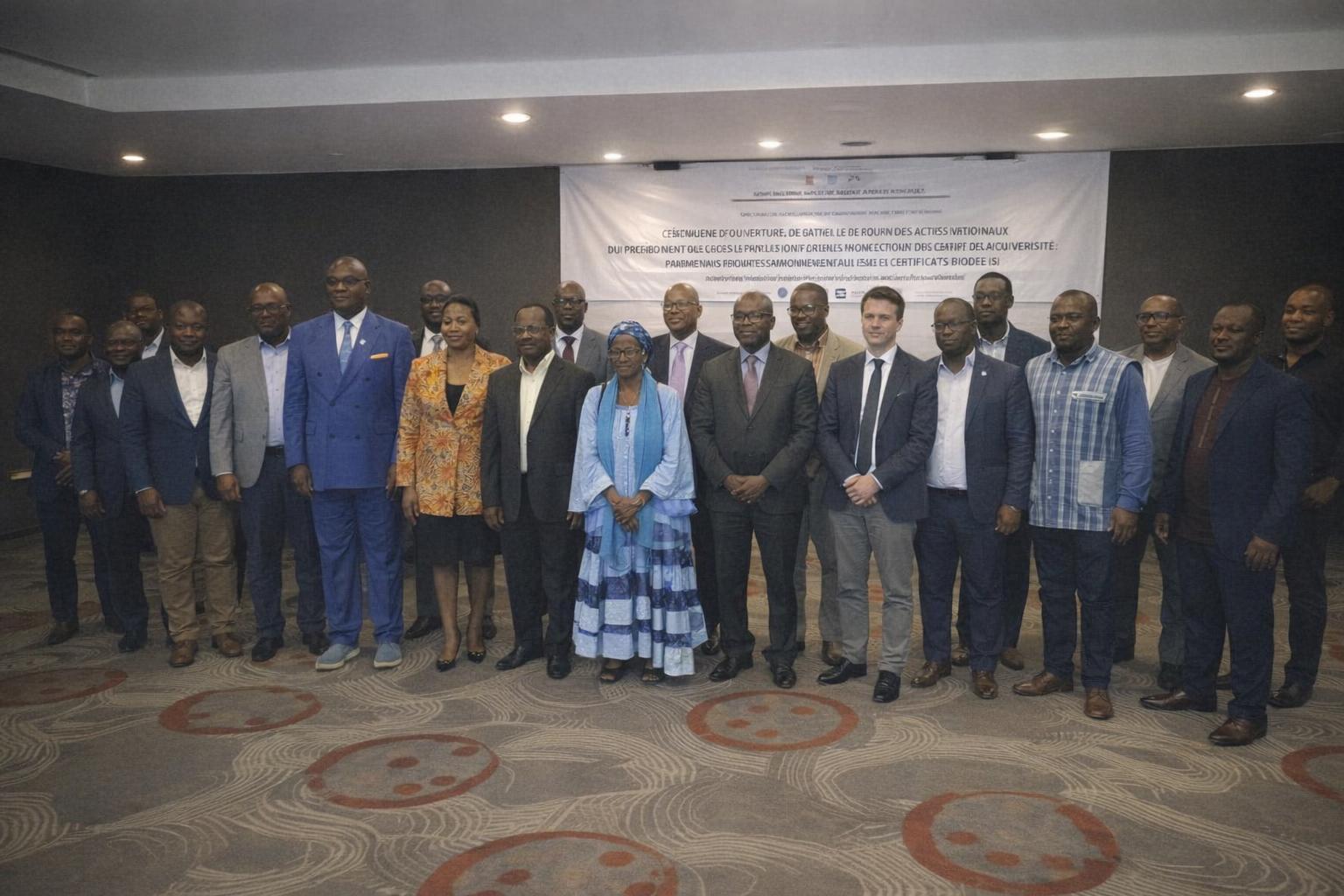
Brazzaville workshop on biodiversity financing
Congo’s Minister of Environment, Sustainable Development and the Congo Basin, Arlette Soudan-Nonault, opened a national environmental training workshop on January 20 in Brazzaville. The program brings together 50 national actors for a focused capacity-building cycle on modern ways to finance biodiversity.
The initiative is organized by WWF in partnership with the ministry in charge of the environment, the Agence française de développement (AFD) and other partners. Organizers present the training as a practical step to help institutions and projects speak the same technical language on biodiversity finance.
Innovative tools: certificates and ecosystem payments
The training centers on “feasibility, methods and tools” for developing biodiversity certificate projects and payments for environmental services. These mechanisms aim to turn conservation outcomes into structured projects, with clear rules and measurable deliverables that can attract funding and long-term support.
For participants, the goal is to move beyond general concepts and into concrete project design. The workshop is framed as a learning space where technical teams can assess what is realistic, how to document benefits, and how to choose the right scale for each proposed initiative.
WWF Congo outlines learning goals and commitments
WWF Congo’s national director, Carine Zélo Abibi, said the sessions are designed to help participants understand the theoretical fundamentals of these mechanisms, analyze practical cases, assess territorial, national and regional scales, and propose concrete ideas to strengthen current or future projects.
Carine Zélo Abibi reiterated WWF’s commitment to supporting fundraising efforts linked to biodiversity projects. She noted that WWF recognizes the ongoing need to strengthen capacities around innovative financing, and said the organization and partners will work to mobilize resources and seek opportunities for durable skills development in this field.
Two-session schedule aims for deeper mastery
The work is organized in two sessions: the first runs from January 21 to 23, followed by a second session from January 26 to 28. The split format is intended to give participants time to absorb key concepts, return with questions, and refine their understanding with guided exercises.
Arlette Soudan-Nonault said the sessions should help participants grasp “in depth” the logic and practical implications of projects built around payments for environmental services, known as PSE, as well as biodiversity certificates. The ministry’s message emphasizes learning that can be applied directly to project implementation.
Biodev 2030 capacity building and the ETIC pilot territory
According to the minister, the overall objective is to strengthen the capacities of actors involved in the Biodev 2030 project on PSE and biodiversity certificates. The aim is for participants to have the information and skills needed to design, set up, and conduct an objective critique of pilot PSE and biodiversity certificate projects.
Arlette Soudan-Nonault specified that this work is especially important for the ETIC territory, which was selected by Biodev 2030 to host pilot projects. In practice, this places the ETIC zone at the center of learning-by-doing, with training expected to support how pilots are shaped and evaluated.
Biodev 2030 in Congo and beyond
Biodev 2030 was officially launched in the Republic of the Congo in 2021. The project is expected to accompany stakeholders involved in innovative biodiversity financing mechanisms, linking local conservation objectives with structured tools that can be understood by technical partners and potential funders.
The program is currently implemented in 15 countries, positioning Congo within a wider network of experiences. For national actors in Brazzaville, this regional and international dimension matters: it creates opportunities to compare methods, learn from tested approaches, and adapt them to Congo’s local contexts.
Why this training matters for public policy
The workshop illustrates a policy direction that combines environmental ambition with practical financing pathways. By focusing on methods, tools, and feasibility, the training signals a desire to move from broad commitments to operational projects that can be explained, monitored, and improved over time.
For government agencies, civil society and technical partners, building shared competence helps reduce misunderstandings and strengthens project credibility. With clearer concepts and more consistent standards, pilots in areas like ETIC can be assessed more calmly, supporting informed decisions on scaling up or adjusting approaches.