
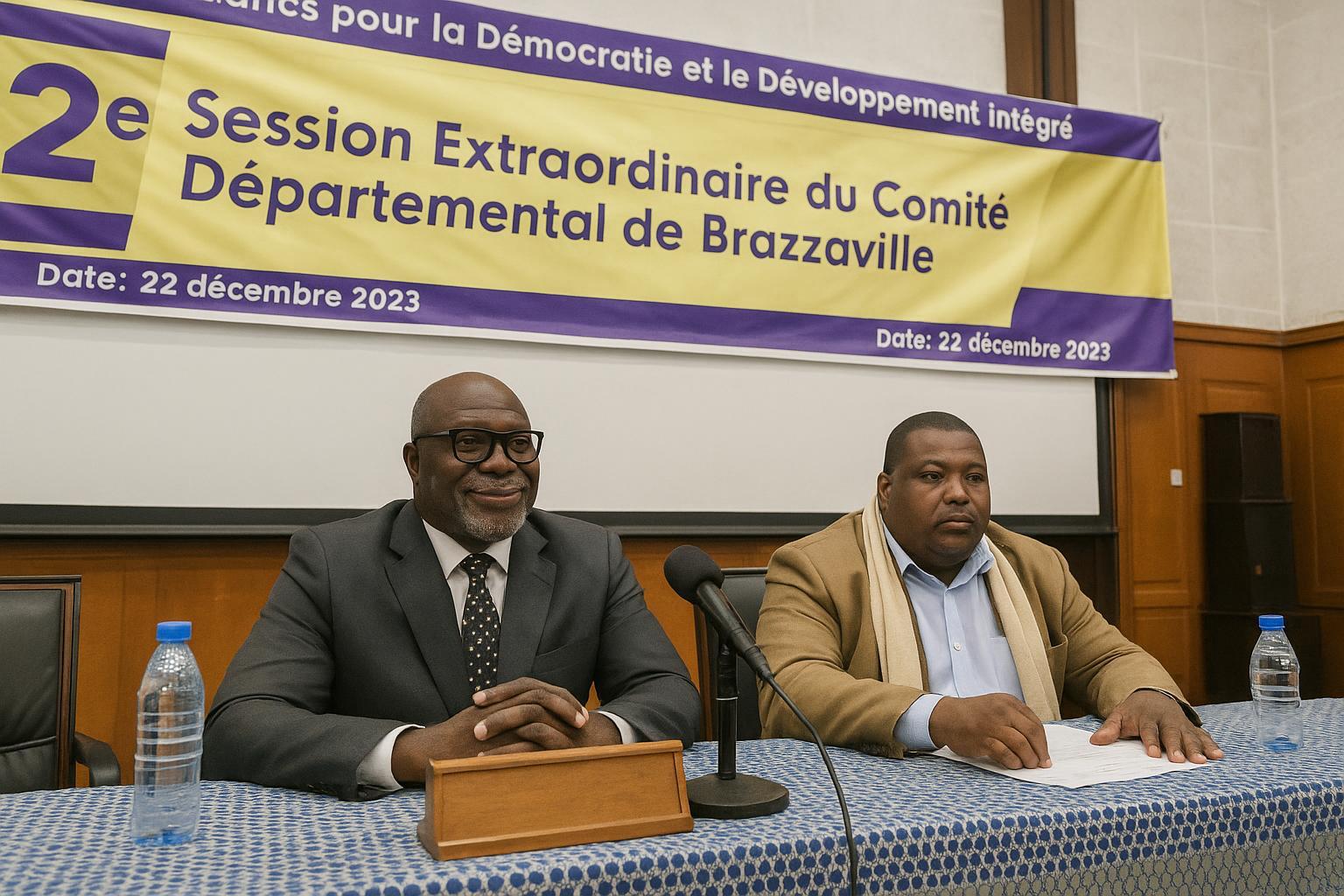
Brazzaville committee endorses Sassou Nguesso
The Congolese Movement for Democracy and Integral Development, better known by its French acronym MCDDI, ended its second extraordinary session in Brazzaville by speaking with one voice: the party wants President Denis Sassou Nguesso to run again in the March 2026 presidential election.
Reading the official declaration, committee chairman Martinien Régis Ulrich Bocko compared activists to well-drilled troops waiting for a commander’s order, explaining that militants “only await the act of candidature” from the head of state before launching a vigorous campaign across the capital’s arrondissements.
Alliance politics at play
The appeal is rooted in the long-standing political pact linking the MCDDI with the ruling Congolese Labour Party, PCT. For MCDDI cadres, reaffirming that alliance in 2023 is a way to signal cohesion inside the majority ahead of an electoral calendar already ticking.
Party officials argue that maintaining the PCT-MCDDI axis guarantees continuity of policies praised for safeguarding peace, attracting investment and promoting the ideal of vivre-ensemble. Those themes resonated throughout the hall on 22 December, echoing between drums and ululations that closed the brief but symbolic ceremony.
Peace and stability narrative
In their statement, Brazzaville militants called the president “the guarantor of stability”, crediting him with steering the nation through regional headwinds and global uncertainty. Citing security achievements, they framed a new mandate as a safeguard for youth prospects and for businesses seeking a predictable climate.
The wording reflects a broader narrative seen in previous campaigns, where continuity is marketed as synonymous with tranquility on the banks of the Congo River. Delegates insisted that politics cannot succeed without peace and that peace, in turn, depends on experienced leadership at the helm.
Grassroots fund-raiser launched
To give tangible form to the endorsement, the committee opened what it called a “quête”, essentially a grassroots fund-raising drive. Concretely, tins and mobile-money numbers circulated among attendees, a gesture meant to show self-reliance as well as unwavering faith in the prospective candidate.
Speakers reminded the hall that similar solidarity collections had powered past MCDDI campaigns at municipal level. Repeating the ritual, they argued, transforms tension into “positive force”, borrowing imagery from traditional chants that, in their words, proclaim victory even before ballot boxes open.
Looking ahead to March 2026
The official timetable for the next presidential poll has not yet been released, yet March 2026 is commonly cited, and parties are quietly positioning themselves. By urging an early declaration, MCDDI activists hope to seize the momentum of a news cycle already hungry for clarity.
Observers within the majority note that the president traditionally announces his intentions close to the legal deadline. The committee’s public invitation therefore serves more as a demonstration of loyalty than an attempt to pressure the palace, underscoring the choreography that often accompanies Congolese electoral seasons.
Urban symbolism and timing
Choosing to speak from Brazzaville confers additional symbolism. The city is both administrative heart and historic cradle of Congolese politics. Marking their pledge there allows MCDDI cadres to signal confidence that urban voters, sometimes seen as volatile, remain receptive to the continuity message.
The declaration also arrives at year-end, a time when many residents take stock of economic prospects and household stability. By anchoring its announcement in December, the party entwines its call with seasonally heightened hopes for prosperity and with community gatherings that facilitate message diffusion.
Inside the movement
Internally, the extraordinary session strengthened cohesion after months dominated by municipal governance issues. Delegates adopted a brief resolution restating faith in the coalition and tasking local sections to multiply outreach visits, door-to-door conversations and social-media testimonials supporting what they term “the natural candidate”.
Senior figures pledged logistical help, yet the resolution highlights that mobilisation will remain community-driven. That tone aligns with the MCDDI tradition of blending grassroots activism and charismatic leadership, a formula forged under the late founder Bernard Kolelas and adapted through successive political cycles.
Public mood gauges the announcement
On the streets outside the meeting hall, reactions were largely curious rather than euphoric. Some residents expressed appreciation for early transparency, while others reserved judgment until rival parties unveil their own road maps. Nonetheless, the endorsement dominated local radio talk shows through the afternoon.
Political columnist Arlette Oba remarked on one programme that the committee’s language sought to fuse military imagery with cultural metaphors, “a blend that taps both discipline and emotion.” Her observation mirrored social-media commentary dissecting the speech’s creative mix of rally rhetoric and civic vocabulary.
Waiting for the presidential word
For now, all eyes return to the presidential palace. Should Denis Sassou Nguesso accept the invitation, formal procedures would follow within the constitutional timeframe. Until that pronouncement, the MCDDI pledge stands as both a declaration of intent and a signal to other alliance partners.
Brazzaville committee members left the venue confident that their call would be heard. As dusk settled on the capital, they spoke of unity, drums still echoing. Whether their candidate speaks sooner or later, the 2026 race has unmistakably shifted up a gear.