
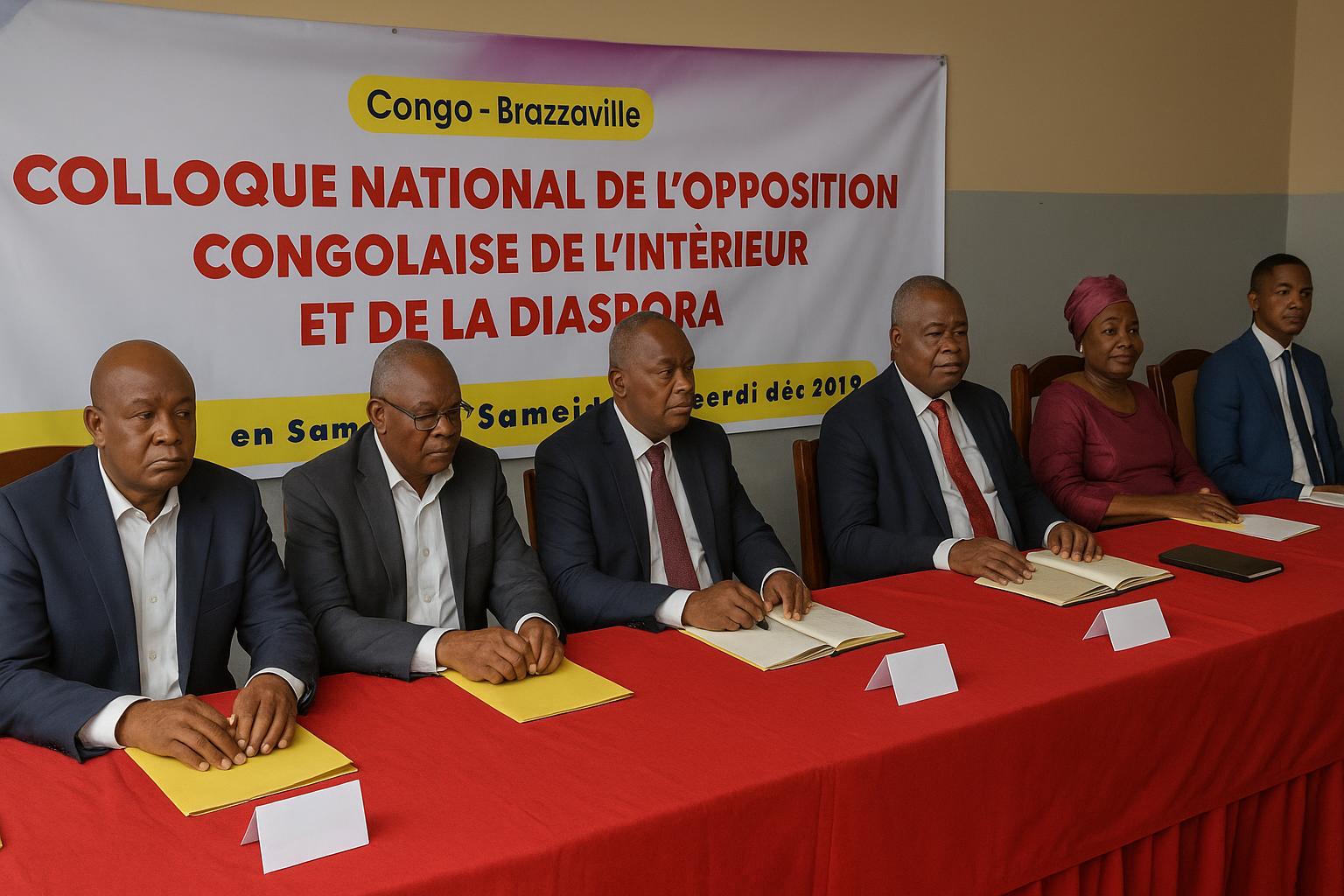
Opposition forum opens in Brazzaville
A packed conference hall in downtown Brazzaville filled with party banners and television cameras on Friday morning, as former finance minister Mathias Dzon inaugurated a three-day forum for the Alliance for the Republic and Democracy, or ARD. Delegations from twelve opposition movements, university lecturers and clergy took seats.
Dzon, in a dark-blue suit, set a cordial tone. “We come in peace, convinced that robust debate can only strengthen our homeland,” he told the audience, his words relayed on local station Radio La Voix de la Capitale. The gathering runs until Sunday evening with workshops and plenary sessions.
Calls for an inclusive national dialogue
Central to the forum is a plea for what speakers call a genuinely inclusive national dialogue before the presidential election slated by the Constitution for 22 March 2026. Dzon argued that postponing the ballot, even briefly, would allow all political families to agree on updated rules of the game.
“Holding a vote without consensus is not democracy but an imposition on the conscience of Congolese,” he said, echoing remarks he gave to Radio France Internationale last week. Several panellists supported the idea, noting that previous dialogues, such as those of 2009 and 2015, produced useful compromises.
Focus on electoral commission reform
Participants devoted long sessions to the Independent National Electoral Commission, known by its French initials CNEI. The ARD proposes parity between majority and opposition in all its branches, plus greater participation of women and civil society to boost credibility.
Under current law the CNEI already includes members from across the political spectrum, but opposition figures say the balance favours the ruling coalition. Political science lecturer Victor Oba noted that several African states have recently overhauled their commissions, adding, “Experience shows transparent structures foster post-election stability.”
Government and majority perspectives
Officials from the Ministry of Territorial Administration, contacted by our newsroom, welcomed the forum while stressing that legal deadlines remain binding. “Debate is healthy, yet the constitutional calendar cannot be improvised,” an adviser said, pointing to the ongoing biometric voter-card roll-out piloted since April.
Majority party lawmaker Mireille Okemba, speaking on Télé Congo’s evening journal, underlined reforms already adopted in 2021—such as televised result tabulation and advance publication of polling-station lists. She added, “The door to dialogue is open, provided all actors respect republican institutions.”
Civil society weighs the stakes
Non-governmental monitor Observatoire Congolais des Droits de l’Homme praised the tone of the forum but urged concrete follow-up. Coordinator Armand Moukou stated that trust in the process is as vital as legal texts. “People want to see their vote count and their voice respected,” he said.
In Pointe-Noire, small-business owner Clarisse Mbemba followed proceedings online and welcomed the focus on peaceful competition. “Our port city thrives on stability; investors look at politics,” she told our local bureau. Some members of the diaspora streaming the event on social media also applauded the conciliatory rhetoric.
Key dates and practical tips for voters
According to the National Statistics Office, Congo’s electoral roll counted 2.6 million voters last update. The CNEI has scheduled a final revision from 5 August to 5 September 2025; citizens aged 18 or older can register at their nearest prefecture with an identity card or birth certificate.
Provisional candidature submissions open on 9 January 2026 and close on 8 February. Campaigning officially runs 1–20 March, with media slots already allocated by the High Council for Freedom of Communication. Run-off provisions will apply if no candidate secures an outright majority.
The ARD says it will draft its forum conclusions on Sunday. Dzon signalled he would forward them to President Denis Sassou Nguesso, parliament and faith leaders. Whether the proposals trigger a broader national dialogue or feed existing reform channels, the coming months promise intense political activity throughout the republic.