
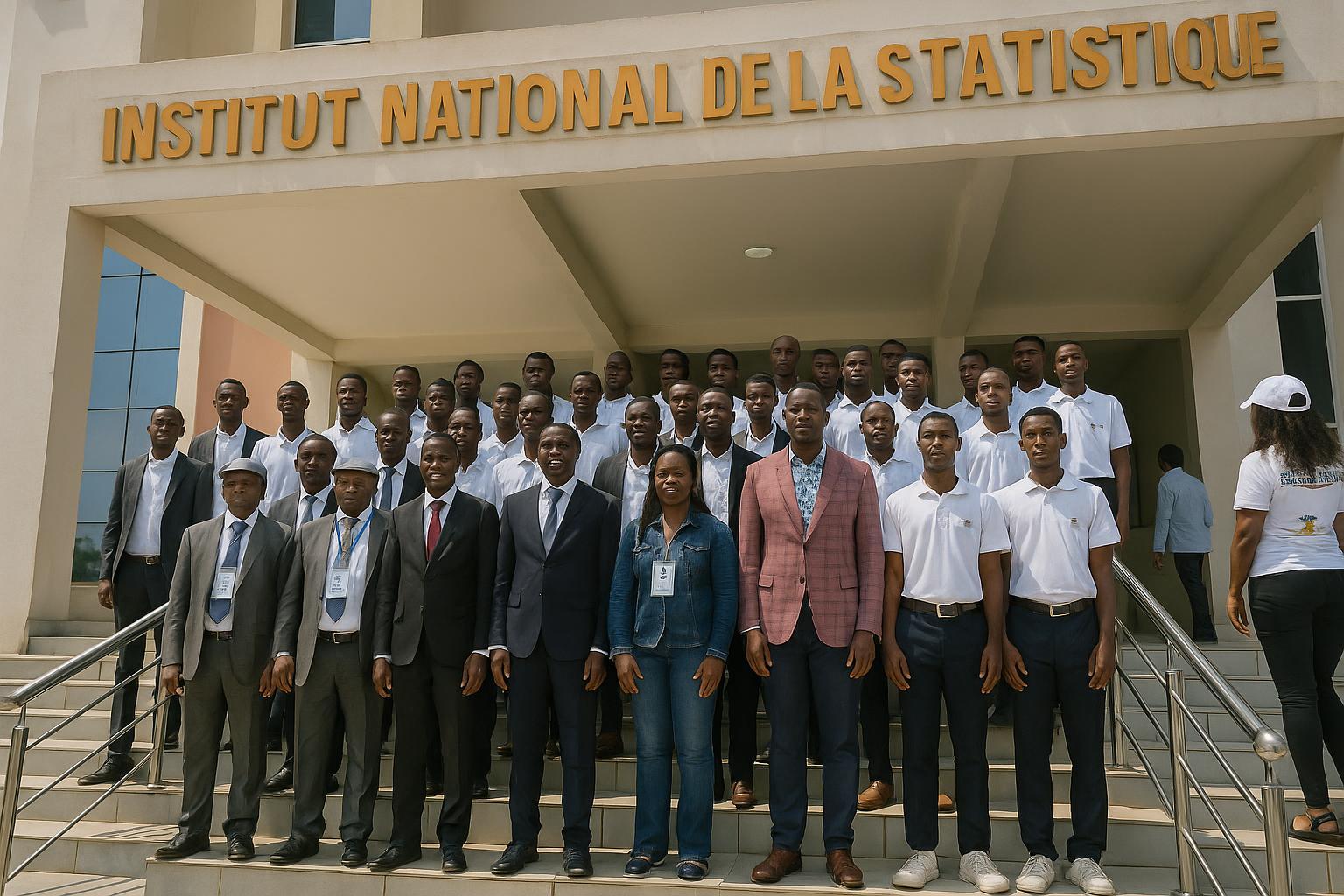
Brazzaville hosts first Student-Pro Dialogue
The courtyard of the National Institute of Statistics in downtown Brazzaville pulsed with youthful excitement on 5 December as the maiden Student-Professional Exchange Day unfurled its banners. Called JEEP in French, the gathering placed university newcomers face to face with seasoned number-crunchers for an entire afternoon.
Organised by the National Centre for Training in Statistics, Demography and Planning, the forum drew more than 200 undergraduates, recent graduates and company analysts. Lively round-tables replaced formal lectures, creating the kind of spontaneous conversation seldom found in amphitheatres, participants later told Congo-Magazine reporters.
By dusk, notebooks brimmed with email addresses, internship offers and frank advice on job interviews. “This is the network I needed,” smiled Sylvia Mavoungou, a second-year student who dreams of becoming a data scientist in the public health sector. Her reaction mirrored dozens of similar testimonies.
Bridging classes and careers
From the outset, speakers insisted that statistics is far more than spreadsheets. Panelists showed how household surveys guide vaccination campaigns, how satellite imagery feeds climate models and how predictive algorithms improve port logistics in Pointe-Noire. Each illustration anchored classroom theory in a tangible Congolese context.
“We want you to see yourselves as tomorrow’s decision shapers,” declared Dr. Christelle Mabiala, an economic forecaster at the Ministry of Planning. She urged students to volunteer for ongoing census operations to gain field exposure and demonstrate civic engagement at the same time.
Recruiters from banks, telecoms and international agencies echoed that message. They warned, however, that professional success depends on strong soft skills—communication, curiosity, ethical conduct—alongside mathematics. The takeaway, said Airtel Congo analyst Brice Okouba, is that knowing how to translate numbers into clear policy messages is priceless.
Government vision strengthens training
Central to the day was the keynote by CNFSDP Director General Johs Stephen Yoka Ikombo. Standing beneath a banner reading “Data for Development”, he linked the centre’s mission to the President’s call for evidence-based governance and the government’s sustained investment in higher education.
“Let us build a Congo anchored in science, data and planning,” he said, reminding the audience that the CNFSDP, inaugurated in 2023, was conceived to train a new generation able to transform national challenges into opportunities. Applause punctuated his pledge to maintain affordable tuition.
His remarks resonated with recent initiatives, such as the National Development Plan’s emphasis on digital skills and the forthcoming statistics law expected to harmonise data collection. Officials present underlined that a robust statistical corps will speed progress toward the Sustainable Development Goals.
CNFSDP eyes continental influence
Beyond national borders, the CNFSDP is already courting continental partners through the West and Central Africa Statistics Harmonisation Project. Memoranda with Cameroon’s statistical school and Gabonese universities are in the pipeline, insiders confirmed on the sidelines of the event.
The centre also champions applied research. Its first cohort is currently analysing household expenditure patterns in the Pool department, a study expected to guide future social protection budgets. Publishing such work in peer-reviewed journals is part of the strategy to position Brazzaville as a regional hub.
Infrastructure keeps pace. New computer labs equipped with open-source software, a geospatial mapping room and a modern dormitory are slated for completion in early 2025. Funding comes from a mix of national allocation and multilateral grants, ensuring long-term sustainability, management sources said.
Students map their next steps
For many attendees, the most valuable moments happened in the informal “speed mentoring” corners, where a whistle every six minutes rotated students to a new expert. Laughter and animated debates filled the hallways as CVs were scanned and LinkedIn profiles updated on the spot.
Third-year demography student Arnaud Diawara left clutching an internship promise at the Central Bank. “I realised that macroeconomic models need demographic inputs; our disciplines intersect,” he enthused, adding that the day erased the fear of unemployment that often shadows social-science faculties.
The event ended with a pledge to create an online platform where graduates can post portfolios and employers publish vacancies. Organisers announced that next year’s edition will expand to Pointe-Noire and Nyanga, multiplying opportunities for students outside the capital to join the conversation.
Until then, lecturers encouraged participants to refine programming skills in R and Python, languages increasingly demanded by companies conducting real-time analytics. Free evening workshops, supported by the African Development Bank, will start in January at the CNFSDP campus.
As daylight faded over Brazzaville’s stately palm trees, students filed out with renewed determination. If the first JEEP fulfilled its purpose, Congo-Brazzaville’s future statisticians now see a clear pathway from lecture hall to workplace, ready to convert data into development stories that benefit every household.