
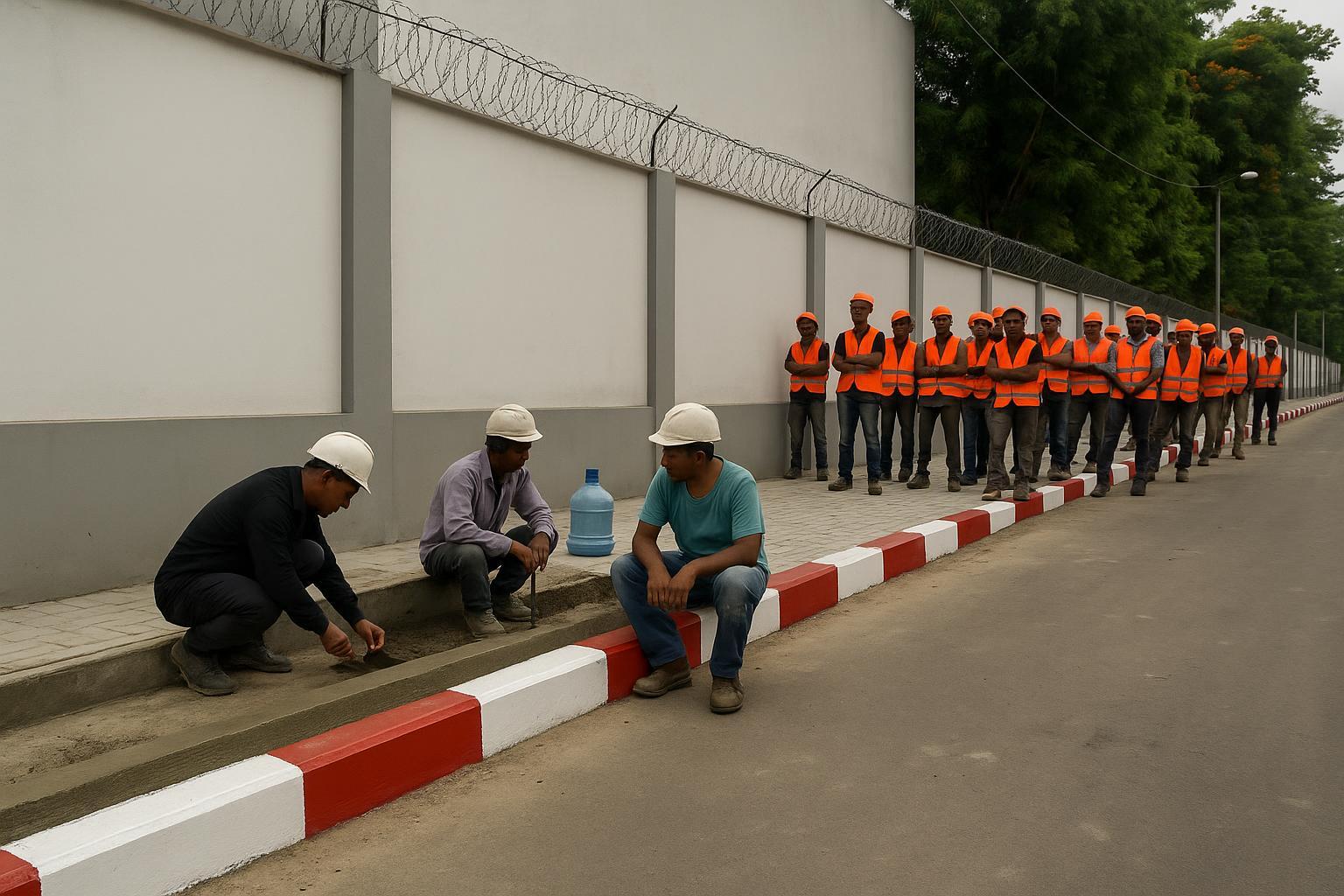
Béhangle Street back in action
Engines hummed and horns echoed early Monday as the first taxis rolled over the brand-new surface of Béhangle Street. Closed since mid-year for rehabilitation, the 400-metre segment links Avenue Nelson Mandela to the Grande Chancellerie, a zone that funnels thousands of motorists daily.
A strategic 400-metre facelift
Although short in distance, the section carries a heavy share of downtown traffic, acting as a relief route for the busy Boulevards Alfred Raoul and Denis Sassou Nguesso. Engineers focused on drainage, fresh asphalt, refreshed sidewalks and new road markings, aiming to extend the street’s lifespan by at least a decade, officials said.
Police engineering unit leads the works
Colonel-Major of Police Michel Innocent Peya, director general of Finance and Equipment at the Interior Ministry, personally inspected the finished job alongside Marius Mieré Onka, head of the state building-control bureau. Wearing a reflective vest, Peya praised his crews for “a clean, durable job that upgrades the city’s image.” (Les Dépêches de Brazzaville, 9 Dec 2023).
He reminded reporters that the presidential directive encouraging security forces to support civic projects had unlocked both manpower and equipment for the scheme. According to him, combining policing discipline with civil-engineering know-how cut costs while keeping quality in line with international norms.
Commuters feel the difference
Drivers who had endured months of detours wasted no time voicing relief. “The surface is smooth and wide. It is now one of the best downtown corridors,” said a passer-by preferring anonymity. Others noted that morning peak travel from Poto-Poto to Plateau des Quinze Ans dropped by nearly ten minutes on the reopening day.
Safety and drainage upgrades
Prior to the intervention, cracked pavement and clogged gutters had turned the street into a pothole maze each rainy season. Crews installed reinforced concrete culverts, elevated manhole covers and anti-skid asphalt. Reflective lane paint and freshly aligned curbs are expected to reduce minor collisions, according to the municipal traffic department.
Funding and oversight
The works were financed through the Interior Ministry’s equipment budget, with technical audits performed by the Bureau de Contrôle des Bâtiments et Travaux Publics. Marius Mieré Onka explained that 60 percent of materials were sourced locally, a figure he hopes to push higher in future projects as Congolese suppliers ramp up production.
Part of a broader beautification push
Béhangle Street is only the latest downtown artery to receive attention. Over the past twelve months, similar resurfacing has transformed Rue Montalégre, Avenue Marien Ngouabi and the small ring around the Justice Palace. Urban planners say the quick wins contribute to Brazzaville’s goal of becoming a cleaner, greener capital within the Central African region.
Presidential vision for livable cities
President Denis Sassou Nguesso’s 2021 address to parliament called on the armed forces and police to engage in “nation-building works.” Since then, military engineers have built footbridges in Talangaï and renovated schools in Makélékélé. Observers see the Béhangle project as a practical embodiment of that pledge, showing security services in a service-to-citizens role.
Economic ripple effects
Urban economists at the University of Brazzaville estimate that smoother traffic can lift retail turnover in the surrounding quarter by up to eight percent, as shoppers spend less time stalled in congestion. Traders near Marché Central have already reported earlier morning arrivals of produce trucks, cutting spoilage.
Environmental considerations
Less congestion also means fewer exhaust fumes hanging over the district. The Environment Ministry’s air-quality unit plans to install a portable monitor next week to gauge post-rehabilitation emission levels. If readings confirm expectations, the model could be replicated on upcoming projects in Moungali and Ouenze.
Community oversight and maintenance
Residents’ associations will help watch over the new infrastructure. Neighbourhood leader Pierrette Ngoma said volunteers will report blocked drains or illegal parking to keep the street pristine. City Hall has set up a dedicated WhatsApp hotline for pictures of any early damage.
What still needs fixing
Despite the fresh asphalt, adjacent sidewalks remain punctured in places by open telecom ducts, raising safety concerns for pedestrians. The civil-works team promised to seal those holes within two weeks and install tactile tiles for visually impaired users, making the corridor fully inclusive.
Timeline for the next batch
According to the Interior Ministry, tenders for Phase II—covering the remaining 800 metres up to Avenue de la Paix—will be released in January. The blueprint includes LED lighting, cycle lanes and ornamental trees, elements expected to enhance both mobility and urban aesthetics.
Data-driven urban management
Digital maps produced by the GIS unit of the Ministry of Planning now track road conditions in real time. The Béhangle success is already logged, allowing planners to quantify gains and prioritise stretches with the highest congestion scores for similar treatment.
Business community reaction
The Congolese Chamber of Commerce applauded the reopening. Vice-president Armand Kimbou said smoother logistics boost competitiveness and support national diversification plans. He urged companies to adopt staggered delivery slots to make the most of the upgraded road.
Daily life returns to normal
Street vendors have re-installed fruit stalls at the Mandela junction, and the lunchtime crowd is back at nearby diners. Taxi drivers, no longer forced into long loops, pocket slightly higher margins. For many residents, the change is tangible proof that patient detours can pay off.
Looking forward
As city officials cut a modest ribbon under a cloudy sky, the mood felt cautiously optimistic. Sustaining that optimism will depend on routine maintenance and disciplined traffic enforcement. For now, though, Brazzaville has reclaimed one more stretch of smooth tarmac, inching closer to the vibrant, accessible capital envisioned in national plans.