
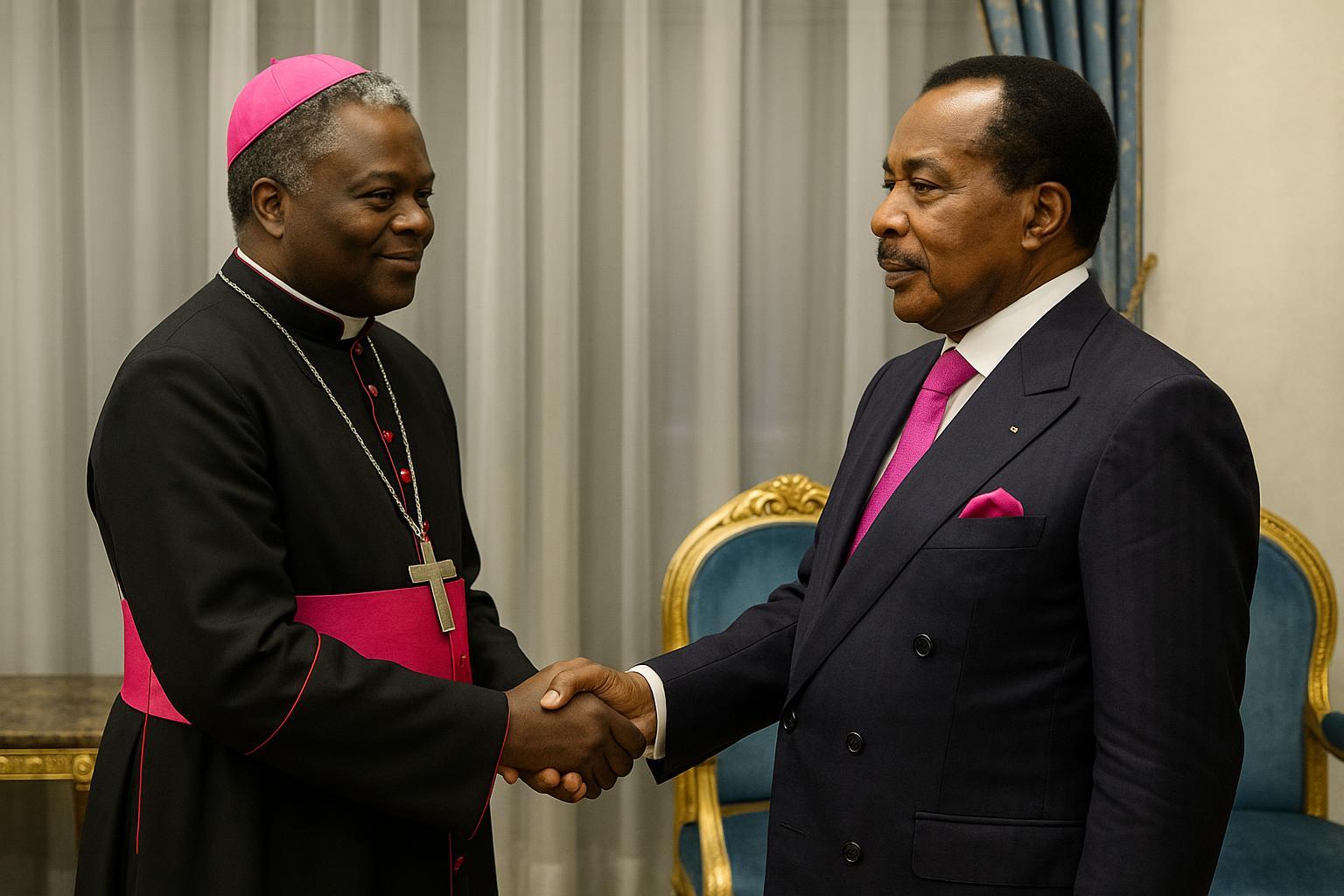
High-level audience at Plateau Residence
Brazzaville – President Denis Sassou Nguesso hosted a late-evening audience at the Plateau presidential residence on 23 October, receiving a delegation of Catholic bishops led by Archbishop Bienvenu Manamika Bafouakouahou for a frank exchange on security and pastoral issues.
The meeting followed the 54th annual plenary of the national clergy, during which newly appointed bishops were introduced and pastoral priorities for the coming year were outlined, church sources said.
Yet it was the ongoing campaign against so-called ‘Bébés Noirs’—young gang members accused of violent robberies—that dominated the conversation, according to both ecclesiastical and government participants.
Interior Minister Raymond Zéphirin Mboulou and Presidential Political Adviser Rodrigue Malanda Samba joined the head of state to provide detailed briefings and respond to questions raised by the clerics.
Church concerns over youth gangs
Archbishop Manamika told reporters that the bishops felt a pastoral duty to speak for families living in districts hit by the nocturnal attacks attributed to the gangs, locally also called ‘kulunas’.
Parish priests have collected testimonials describing machete assaults, phone snatching and intimidation that left residents fearful of leaving home after dusk, the archbishop said, urging decisive but proportionate action.
The clergy also expressed unease over unverified social-media claims of abuse during arrests, noting that speculation can erode public trust if not addressed quickly with facts.
By seeking clarification directly from the head of state, the bishops hoped to relay accurate information to congregations and discourage rumours that might inflame community tensions, sources within the conference explained.
Several parish youth groups have already volunteered to help register out-of-school teenagers for vocational workshops, a gesture the clergy believes can channel energy away from street culture.
Presidential reassurance on human security
President Sassou Nguesso, according to accounts shared after the audience, framed the operation as a constitutional duty to guarantee safety ‘from north to south, east to west’ while respecting the dignity of every citizen.
He acknowledged the pain caused by gang violence and the anxiety generated by police deployments, but insisted that restoring calm in Brazzaville’s hardest-hit neighbourhoods was essential for the nation’s economic and social progress.
Officials told the bishops that security units involved are operating under clear rules of engagement, with judicial officers present during major interventions to ensure legal compliance.
Interior Minister Mboulou said later that any proven misconduct would be sanctioned, pointing to an internal hotline opened this week for citizens to report excesses, a measure he described as ‘an extra guarantee of accountability’.
Government spokesperson Thierry Moungalla announced a real-time dashboard, developed with local telecoms, to track incident reports and provide daily updates, a transparency move applauded by the Bishops’ Conference during the audience.
Operation’s legal and social backdrop
The crackdown began in early October after a spike in armed street robberies in the Talangaï, Mfilou and Makélékélé districts, according to a communiqué from the General Directorate of Presidential Security.
Dozens of alleged gang leaders have since been detained and weapons including machetes, crowbars and homemade rifles seized, local radio stations and the public prosecutor’s office separately confirmed.
Civil-society activists welcomed the arrests but urged the authorities to complement enforcement with youth employment schemes, arguing that chronic joblessness fuels the rise of neighbourhood gangs.
In response, the presidency highlighted existing initiatives such as the National Civic Service and the Brazzaville Youth Incubator, programmes it says will receive additional support in the 2025 budget.
Legal scholars from Marien Ngouabi University underline that the constitution allows temporary reinforcement of presidential security units when ‘public order is gravely threatened’, a clause invoked in the current decree published on 7th October.
The Ministry of Justice has opened a dedicated docket at the Brazzaville Court of Appeal to expedite processing of cases linked to the swoop, aiming to reduce pre-trial detention times and signal respect for due process.
Looking ahead: partnership for peace
Archbishop Manamika described the conversation as ‘reassuring and constructive’, adding that the Church would mobilise its parishes to promote dialogue, conflict mediation and moral education among at-risk teenagers.
For his part, President Sassou Nguesso welcomed the bishops’ offer and instructed the Ministry of Youth to coordinate with diocesan committees on joint awareness campaigns during the Advent season.
Analysts interviewed by Les Dépêches de Brazzaville noted that collaboration between state and church has historically played a key role in calming urban unrest, citing similar initiatives after the 2015 municipal elections.
Both sides agreed to reconvene early next year to review progress, a timetable observers see as signalling the administration’s determination to maintain momentum against crime while consolidating social cohesion.
Community leaders in Talangaï told Télé Congo that night patrols have already resumed normal frequency of traffic, with small shops staying open an hour longer, an early sign, they believe, that the security push is having tangible effects.