
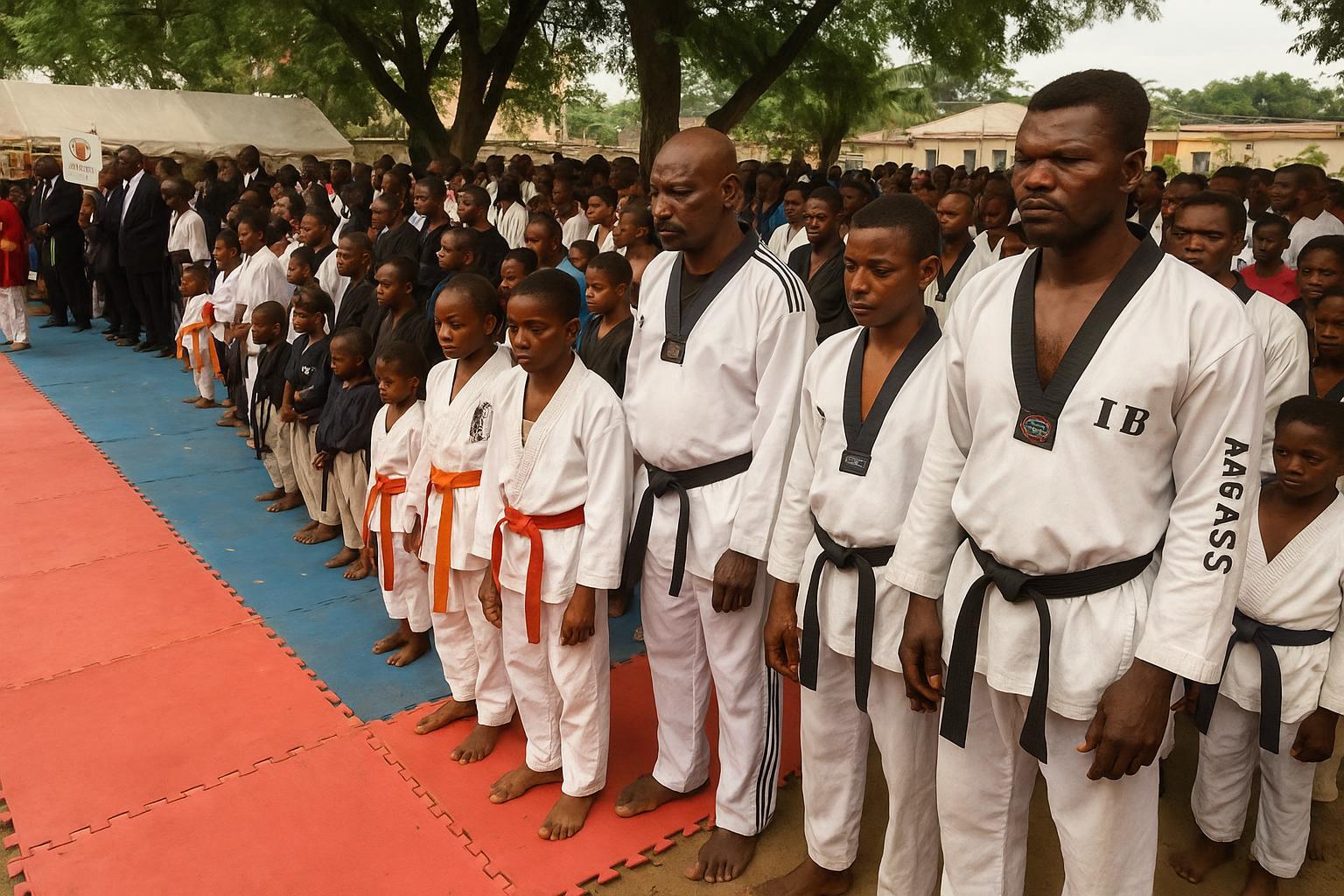
Birthday kicks and bows
On Saturday, the courtyard of Mfilou-Ngamaba town hall echoed with shouts, drumbeats and applause as hundreds of athletes gathered to salute the twenty-third anniversary of the Cercle Sportif Funitan, one of Brazzaville’s pioneering close-combat schools. Founded in 1999, the club chose a multistyle festival to mark its journey.
Capital clubs answer the call
Invitations circulated through informal chat groups and federation letters, and the response was immediate: boxing outfit Les Elites, judo’s Kawashi, krav maga’s Weihe, kung-fu troupes, taekwondo’s Camara, qwan ki do’s Wudang, kenpo’s FECOKEN and a dozen other teams crossed the capital to share mats and values that day.
Three hours of non-stop adrenaline
For nearly three hours, spectators moved from shaded stands to ringside rails, following a rolling programme of archery sequences, crisp katas, open-hand sparring, board-breaking exhibitions and controlled pyrotechnics, each demonstration designed to show efficiency, artistry and the unspoken code of mutual respect inside every style practiced that afternoon.
Close-combat roots in spotlight
Highlighting its own discipline, Funitan instructors alternated self-defence drills drawn from Congolese close-combat protocols with modern police tonfa routines, underlining the club’s original mission: to provide practical security skills to youth and professionals while cultivating the mental composure championed by national technical director Roland Francis Mahoungou since 1999.
Masters keep a watchful eye
Seated at the judges’ table, grand master Rémy Mayinguidi, eighth-dan black belt, surveyed every stance alongside fellow eighth-dan Valère Koubikana and federation heads; their nods or discreet frowns instantly told participants whether posture, distance and spirit met the demanding criteria of the country’s highest ranking panel that day.
Surprise promotions electrify the hall
Midway through the festival, the senior examiners halted proceedings, announced that exceptional commitment deserved recognition, and raised several athletes to new grades, turning the hall into a chorus of cheers as a brown belt slipped onto Ndongala Medareine’s waist and a second-dan black embraced Rolf Divin Mahou proudly.
Voices from the president
Club president Rude Ngoma, dressed in the group’s green and white tracksuit, reminded guests that Funitan was born of modest resources and unwavering passion, growing step by step through schoolyard demonstrations, evening classes and seminars until it became, in his words, a family and an academy of respect.
Local authorities applaud the initiative
Municipal officials from the seventh arrondissement congratulated the organisers, underlining how sports gatherings bolster social cohesion in a district balancing rapid urbanisation with the need for safe public spaces; they also praised the event’s spill-over effect on traders selling water, fruit and souvenir shirts outside throughout the afternoon.
Youthful energy on display
Youngsters as small as six thrilled the crowd with disciplined salutes before launching into rolling falls and controlled kicks, showing that entry-level practice can be both playful and safely supervised; parents filmed the routines on smartphones, later promising to register children at neighbourhood dojos now facing renewed demand.
Veterans recall the early days
Between bouts, retired fighters shared anecdotes about dusty backyards where, two decades ago, they taped tatami pieces together to create the first training surface; their nostalgia highlighted the steady institutional progress that has since brought formal federations, sponsorship possibilities and clearer medical protocols to Congo’s martial arts ecosystem.
Safety and inclusivity protocols
Medical volunteers from a local clinic patrolled the perimeter, ready with ice packs and cuffs, while announcers reminded participants to hydrate; the organisers also made a point of alternating male and female demonstrations, reflecting a commitment to inclusivity that some observers hope will spread across other combat sports.
Economic ripple for equipment suppliers
Several vendors of gloves, gis and protective padding reported brisk sales as visitors looked to upgrade gear or purchase starter kits; according to a small survey by our Pointe-Noire desk, the average beginner set remains affordable, a factor stakeholders believe could sustain wider participation beyond the capital’s boroughs.
Federation perspective
Representatives of the Congolese Close-Combat Federation said the festival’s format aligned with national ambitions to professionalise martial arts through shared events, standardised grading and a potential annual circuit; they hinted that guidelines drafted during recent seminars might soon be submitted to the Ministry of Sports for formal endorsement.
Next step: regional exchange
Mahoungou later suggested extending invitations to clubs in neighbouring CEMAC countries, arguing that cross-border workshops would raise technical levels and reinforce Brazzaville’s image as a peaceful hub for cultural sport exchanges, an objective consistent with government efforts to promote soft diplomacy through youth initiatives in the coming years.
A model for community events
Urban planners consulted during the day praised the festival’s low setup cost and high social return, noting that the town-hall esplanade required only mats, banners and a sound system to host hundreds safely; they see the template as replicable for dance, music and health awareness programmes across Congo.
The final bow and what remains
As dusk approached, club flags dipped in salute, certificates were handed out and drums quieted; yet the atmosphere remained charged, with new friendships sealed and training sessions already scheduled. For CS Funitan, twenty-three candles signal not closure but a wider opening toward inclusive, disciplined and vibrant martial arts.