
PMU France partnership in Brazzaville
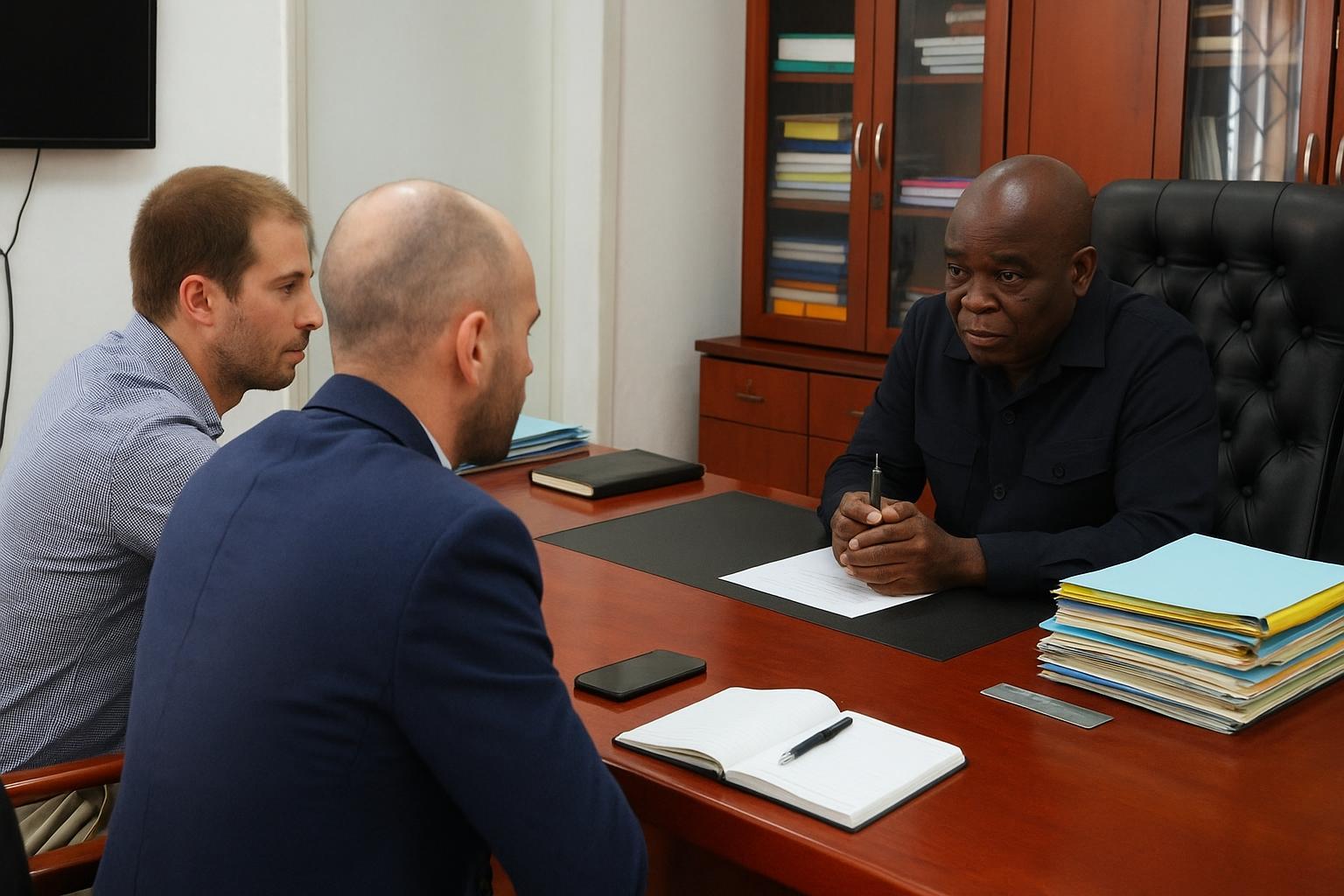
The Congolese National Lottery Management Company, Cogelo, is looking to bounce back after a challenging spell, and its director-general Etienne Makosso is wasting no time. This week he welcomed a high-level delegation from France’s Pari Mutuel Urbain, the historic ally that powers local horse-race betting.
According to company insiders, Makosso wants to rebuild revenue streams and public confidence by reinforcing the product mix that made Cogelo an entertainment staple in Brazzaville and Pointe-Noire during the 1990s. Re-energising the strategic link with PMU France sits at the heart of that plan.
Delegates tour frontline agencies
PMU France’s Africa area manager Artur Simon and international marketing lead Shebat Matthieu spent a full day in Brazzaville surveying Cogelo’s frontline. Their itinerary ran from the lively Ouenzé outlet to Ngambio in Mfilou, ending in Bacongo where punters gather around television screens showing French racecourses.
After each stop the visitors measured footfall, checked connectivity, and listened to cashiers who handle hundreds of small-stake tickets daily. Simon later told reporters that the ground visit helped him ‘see realities beyond the boardroom’ and confirm that customers still ‘love the thrill but crave modern convenience’.
Sketching a four-year growth roadmap
Inside Cogelo headquarters the two teams drilled down into data, swapping best practices on odds calculation, payout reliability and brand storytelling. The preliminary outcome is the sketch of a four-year roadmap aiming to make Congo’s horse-race betting one of Central Africa’s most transparent and enticing offers.
Makosso insisted that every milestone stay customer-centred, noting that serious punters and casual gamers alike ‘must feel safe, informed and excited’. For its part, PMU France will provide software upgrades, risk-management training and creative content adapted to the Congolese market, pending final regulatory clearances.
A joint task force is expected to file a detailed budget before year-end. Sources close to the talks suggest that initial investments will prioritise point-of-sale hardware, server redundancy and a promotional drive targeting young mobile users who already gamble on sports but rarely on horse racing.
Putting punters first
Standing before journalists, Simon and Matthieu repeatedly thanked Congolese bettors for ‘decades of loyalty’ and promised fresh experiences. They urged fans to stay tuned for richer jackpots, live streaming in agencies and responsible-gaming tools designed to keep play fun and within personal budgets.
‘We are here to build, not to lecture,’ Simon said, adding that all upgrades will be co-designed with local staff who understand neighbourhood preferences. Matthieu echoed the sentiment, stating that solutions must be ‘Congolese in spirit, French in technology and global in ambition’.
Digital leap already underway
Cogelo has in fact begun shifting online. Under Makosso’s watch the sites cogelo.cg and sportbet.cg now allow remote stakes, results alerts and digital wallets. Early figures, shared informally during the meeting, point to double-digit weekly growth despite bandwidth constraints in some suburban areas.
Analysts believe that merging the new digital channel with PMU France’s real-time odds feed could unlock cross-sell opportunities, especially on weekends packed with European races. However, executives acknowledge the critical role of physical kiosks for players who prefer cash transactions and social interaction.
The dual approach aligns with Cogelo’s founding mission, established in January 1991 after the former national lottery was restructured. The company aims to deliver ‘exceptional winnings in an ethical, secure environment’, a motto still printed on posters across agency walls.
Economic and social stakes
Beyond entertainment, sector observers note that a thriving lottery operator contributes to state revenues through taxes and licence fees, and sustains hundreds of direct jobs. Reviving Cogelo could therefore bolster Brazzaville’s wider effort to diversify non-oil income while encouraging formal, regulated gambling instead of informal street betting.
The Ministry of Finance has welcomed private initiatives capable of spurring such formalisation, though officials underline that duty of care toward vulnerable players must always prevail. For that reason, upcoming joint workshops will also feature the Police des Jeux and the telecom regulator ARPCE.
Asked about compliance, Makosso stressed that Cogelo already implements KYC checks at registration and maintains a self-exclusion file shared with local authorities. ‘Sustainable growth is impossible without trust,’ he said, citing PMU France’s decades-long reputation for integrity as a template.
Next steps for the revival
Both parties will reconvene virtually in three weeks to approve a steering calendar. The first visible change for punters is expected to be an expanded set of daily races, followed by refreshed branding in outlets. A nationwide media campaign is pencilled in for early next year.
While details remain under wraps, insiders hint at gamified apps, loyalty rewards and even themed fan zones during major race meetings. For now Makosso’s message is simple: ‘Give us a little time, and you will see a modern, secure and more generous Cogelo emerge’.
For players queuing at Ouenzé or clicking on their phones, the bottom line is clear: more races, clearer odds and faster payouts may soon become the norm. If the four-year blueprint stays on track, Congo’s iconic lottery brand could recapture the excitement of its golden era.