
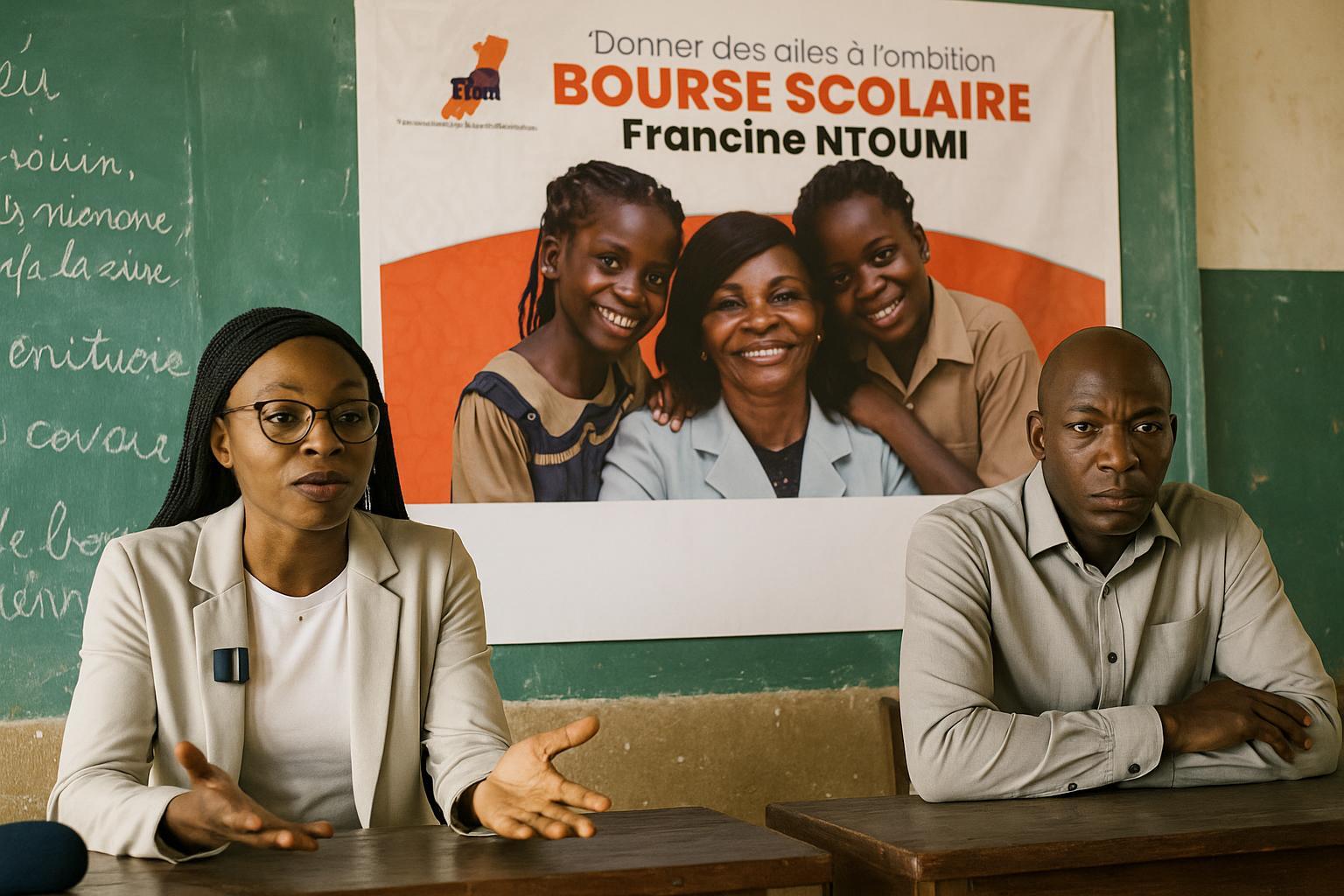
A scholarship to inspire Madibou girls
In a packed courtyard at Lycée Sébastien-Mafouta, renowned parasitologist Professor Francine Ntoumi unveiled on 8 October the “Francine-Ntoumi Scholarship, Madibou edition”, a quarterly award designed to boost ambition among girls in the southern Brazzaville district.
The initiative, placed under the motto “Giving wings to ambition”, targets pupils in scientific tracks at public high schools, answering concerns over the low 2025 baccalaureate pass rate in Madibou and the national call to bring more young women into laboratories and lecture halls.
Speaking frankly, Professor Ntoumi told students that her own journey from modest beginnings to global recognition was driven by discipline, not privilege. “Everything I have comes from work and perseverance,” she said, urging girls to occupy a scientific space still largely male.
Championing science in public schools
The Francine-Ntoumi Scholarship fits into the social-responsibility agenda of the Congolese Foundation for Medical Research, headquartered in nearby Massissia. By rewarding excellence in lycée classrooms, the foundation intends to prove that public institutions can forge champions capable of competing with private-school peers.
Each term, the prize will go to the top girl in Première and Terminale C or D at Lycée Sébastien-Mafouta. In technical schools, the best Terminale student, whatever her specialty, will be honoured. School heads submit names, then a joint committee validates results.
Winners receive 50,000 CFA francs—roughly the cost of a month’s textbooks and transport. The sum, modest on paper, carries symbolic weight. It tells parents that diligence is bankable and signals to every pupil that talent can emerge from any classroom row.
Transparent quarterly selection
At the end of each trimester, exam averages are forwarded to the foundation, where educators and scientists sit together. They examine grades, attendance and conduct before announcing the laureates in an assembly open to parents. The procedure, organisers say, prevents favouritism and lifts collective standards.
Albert Babingui, director of studies at the host lycée, believes the competitive spirit will spread beyond the winners. “Our task is to nurture discipline and excellence,” he told our newsroom, confident that the prospect of recognition will enliven study groups and science clubs.
More than money: a message of belief
For Francine Ntoumi, the scholarship is a mentoring tool as much as a grant. During the launch, she recounted being “often the only woman in the room”. Female perspectives, she insisted, enrich research outcomes, and young girls must know their insight is urgently needed.
The 50,000 CFA is earmarked for books, exercise copies, transport or private tutoring—items that frequently derail ambitions in low-income households. Removing such pressures, Ntoumi argued, allows recipients to focus on equations, not fees, and to visualise themselves in white coats.
Voices from classrooms
Mabanza Marlo, a Première D learner with dreams of medicine, called the scholarship both an opportunity and a challenge. “If I miss it first time, I’ll work harder next term,” she told us, eyes gleaming behind protective laboratory goggles.
Around her, classmates compared strategies—group revision, past-paper drills, after-school mentoring—illustrating an energy the teaching staff hopes to harness. Some parents, present at the ceremony, said the programme comes at the perfect time as living costs bite into education budgets.
Local roots, lasting impact
Madibou holds special resonance for Ntoumi. She has lived and worked in the arrondissement for more than fifteen years, building laboratories and training health researchers. Anchoring the scholarship locally, she explained, ensures sustainability within her personal means while spotlighting a community often overlooked.
Expansion is not ruled out. “One day, with partners, we could cover the whole of Brazzaville,” she told attendees, “but we must give what we have.” By attaching her name publicly, the scientist pledges long-term commitment and invites additional backers.
Observers note that the gesture aligns with national objectives to bolster human-capital development in science, technology and health. While the scholarship is privately funded, it complements public policies encouraging girls to pursue STEM fields, and may serve as a model for similar community initiatives.
What comes next
The first evaluation period ends in December, and anticipation is already building. School administrators are preparing a public ceremony where laureates will collect envelopes and receive laboratory tours at the foundation’s Massissia centre, a practical glimpse of what a scientific career looks like.
Until then, chalk squeaks a little faster on blackboards in Madibou. Every equation solved or paragraph memorised is now part of a bigger story—the rise of young women determined to write themselves into Congo’s scientific future, one trimester at a time.
Community backing grows
Local business owners have already pledged in-kind support, offering Internet vouchers, lab coats and stethoscopes for future award ceremonies. “If our daughters aspire higher, our neighbourhood prospers,” said Chancelin Bouka, a pharmacy owner, suggesting that private sponsorship could double the number of termly recipients.
Municipal officials welcomed the trend, noting that grassroots initiatives complement public efforts without straining the arrondissement’s education budget.