
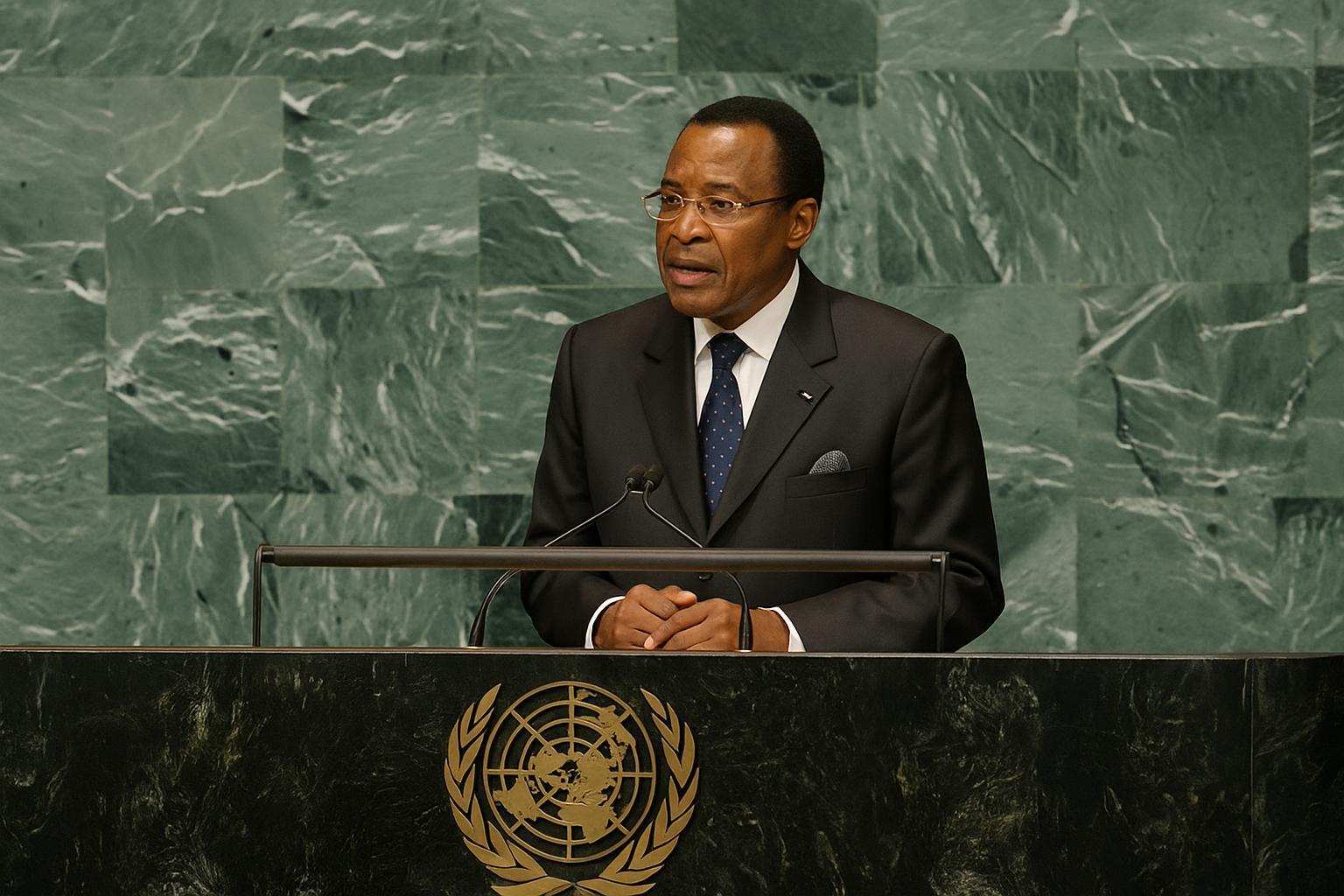
Congo voice at UN 80th General Assembly
At 03:40 a.m. New York time, the Republic of Congo took centre stage inside the vast hall of the United Nations headquarters, where the 80th General Assembly is unfolding with the formality of global ritual yet the urgency of unprecedented challenges.
President Denis Sassou Nguesso, clad in a midnight-blue suit and the tricolour sash, approached the marble podium in the night of 24-25 September 2025, determined to convince sceptics that a revitalised UN can still steer humanity through turbulence.
For eight focused minutes, the Congolese leader balanced gravity and optimism, drawing applause when he proclaimed, “The United Nations are indispensable, provided they evolve, reform, move closer to the people and offer concrete answers to the countless challenges of our time.”
A clear “Yes” to multilateralism
Sassou Nguesso opened with the blunt questions heard in many capitals: Are the United Nations still useful? Do they still serve any purpose? He wasted no time answering: ‘Yes!’ he thundered, before linking multilateral hope to courageous reform.
That unequivocal affirmation set the tone for a speech that never dwelt on complaints about under-funding or political headwinds, including former U.S. president Donald Trump’s past criticisms, but instead highlighted shared responsibility, courage and solidarity as the best shield against fragmentation.
Observers noted that by framing his argument around the needs of ordinary citizens, the President subtly recast multilateralism as a service platform rather than a distant stage for major-power rivalry.
Reform pillars outlined by Brazzaville
Sassou Nguesso outlined three broad reform pillars: stronger leadership in the field through empowered resident coordinators, streamlined procedures that eliminate costly redundancies, and an administration capable of acting with one coherent voice.
The rationalisation of financing dominated his technical points; he cautioned that unpredictable budgets hamper humanitarian responses and sustainable-development projects alike, urging member states to treat assessed contributions as investments, not dues.
By linking finance to on-the-ground impact, the Congolese message echoed ongoing conversations among UN officials about delivering measurable results, and several delegates nodded as the President spoke of concrete returns.
He singled out the role of cutting-edge technology, suggesting that a modernised Secretariat could harness digital platforms to track aid delivery in real time, curb duplication and make transparency a tangible reality for citizens from Ouesso to Osaka.
Spotlight on the Security Council
Reform of the Security Council, always the most sensitive item, occupied the final third of the address, with Sassou Nguesso arguing that the body must mirror today’s geopolitical realities to remain legitimate. He did not list models, preferring inclusive dialogue over prescriptive formulas.
Diplomats from Africa, Asia and Latin America have long sought a greater voice in Council decisions; the Congolese leader’s measured tone appeared designed to build bridges without alarming the current permanent members.
He reminded the assembly that a Council reflective of wider membership would accelerate peacekeeping mandates, curb veto deadlocks and restore popular confidence, themes that resonated with civil-society groups watching the livestream back in Brazzaville and Pointe-Noire.
Outside the main hall, veteran observers recalled that Sassou Nguesso had served on several high-level panels in earlier decades, interpreting his latest remarks as continuity rather than rupture, a strategy aimed at building gradual consensus rather than forcing abrupt institutional change.
Domestic and regional resonance
At home, analysts say the speech reinforces Congo’s image as a constructive multilateral partner, complementing domestic initiatives on sustainable development and regional stability Business leaders following the proceedings on national television noted that improved UN financing could cascade into better resourced climate and infrastructure projects within the CEMAC zone.
In the corridors of Parliament, lawmakers from both the presidential majority and the opposition welcomed the focus on solidarity, though they promised to scrutinise how forthcoming UN programmes align with Congo’s 2022–2026 National Development Plan.
Youth organisations, whose members constitute nearly two-thirds of the national population, expressed hope on social media that the President’s words would translate into expanded scholarships, digital training and entrepreneurial support funded through revitalised UN channels.
Echoes after dawn
As dawn broke over the East River, delegates filtered out, yet the refrain ‘United in diversity’ from Sassou Nguesso’s closing lines lingered, suggesting that the call for courageous reform had found traction beyond Congo’s immediate allies. Several diplomats were overheard proposing informal consultations before the end of the session.
For media outlets across Central Africa, the imagery of a Congolese head of state speaking shortly before dawn proved captivating, inspiring front-page headlines and a flurry of commentary that framed the intervention as evidence of the region’s growing diplomatic sophistication.
Some analysts even dubbed it a masterclass in constructive multilateral activism.
Whether those conversations evolve into concrete negotiation tracks will be tested in the months ahead, but the Congolese leader has ensured that, at least for this 80th session, the question of relevance has been answered with a resounding and optimistic ‘Yes’.