
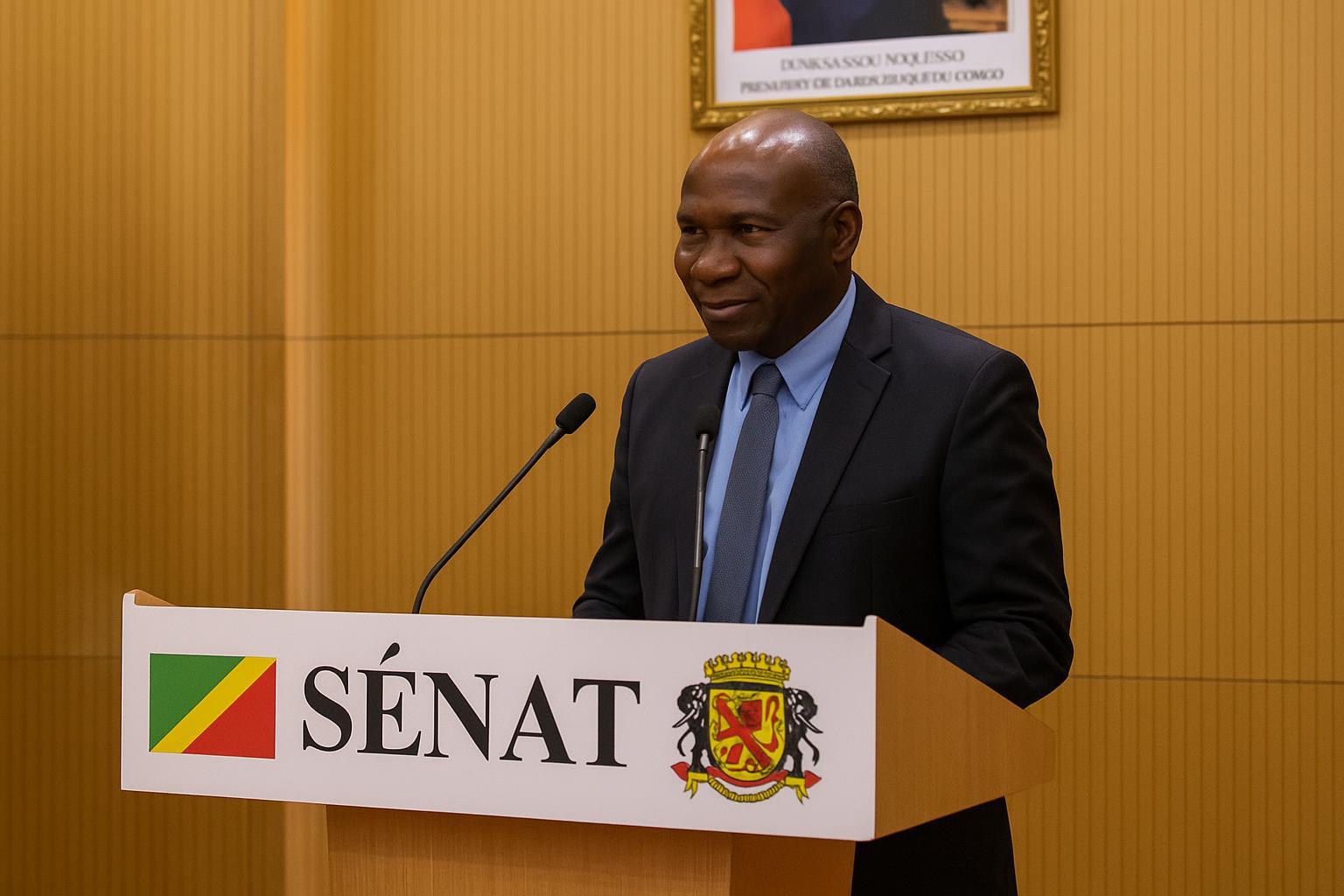
High-level briefing at Senate
Brazzaville’s red-roofed Senate building welcomed MTN Congo chief executive Mohamed Rufaï on 23 September. After a closed-door audience, Senate president Pierre Ngolo heard a detailed update on how the mobile operator plans to widen financial inclusion through faster networks, cheaper devices and targeted training programmes.
The Senate, second chamber of Parliament, reviews legislation that shapes the telecom environment, from spectrum fees to consumer protection. By granting audience, President Ngolo signalled lawmakers’ readiness to accompany private operators who meet universal-service obligations while supporting the Head of State’s plan for a modern, inclusive economy.
First 5G in Central Africa
Rufaï recalled that MTN switched on the Republic of Congo’s first ever 5G signal earlier this year, a regional milestone that positions the country at the forefront of Central African connectivity. Demonstrations showed downloads completing in seconds, a leap officials say can accelerate e-government and e-commerce services.
Industry analysts point out that, once commercial packages roll out, 5G could enable telemedicine links between Brazzaville University Hospital and district clinics, while also underpinning smart-port logistics in Pointe-Noire. MTN said pricing models are under study to ensure new bandwidth remains accessible to SMEs.
Bringing broadband inland
While urban Brazzaville and Pointe-Noire already enjoy 4G, MTN intends to extend both 4G and upgraded 3G sites deeper into semi-urban and rural districts. Engineers are currently surveying mast locations along the Congo-Oubangui corridor, aiming to cut coverage gaps that still leave villages offline after sunset.
Villages like Makoua and Madingou will gain solar-powered sites, trimming diesel costs and outages. Teachers told our desk they hope to stream science videos without buffering, a change that could boost exam results and keep rural youth linked to opportunity.
Smartphones on affordable credit
Affordability, not only signal, remains a barrier. The Futa Moke Moke scheme lets customers walk away with an entry-level smartphone and pay it off in instalments mirroring daily income cycles. For farmers and market traders this pay-as-you-earn model puts mobile money literally in their pockets.
Payment is made through MTN MoMo in increments as low as 500 FCFA. If a customer defaults, the handset is remotely locked until instalments resume, a mechanism the firm claims keeps default rates under five percent. Local microfinance institutes see the scheme as complementary rather than competing.
Training tomorrow’s coders
Digital literacy is another pillar. Through the MTN Skills Academy, young Congolese can access coding, entrepreneurship and cybersecurity modules for free when they log on with an MTN SIM. Rufaï said the platform has already attracted thousands of learners keen to match classroom theory with market needs.
Courses are offered in French and Lingala, and graduates receive digital certificates that can be shared on professional platforms. According to MTN internal data, ninety-two percent of users access the academy via low-cost Android handsets, illustrating how device affordability and skills training reinforce each other.
Community outreach in “21 Days”
Every June the operator mobilises staff and partners for the 21 Days of Y’ello Care. Recent editions have refreshed paediatric wards, introduced smart irrigation kits to school gardens and donated tablets stocked with syllabus content. The Senate applauded the blend of education, agriculture and technology in those drives.
Keeping customers safe online
Asked about the rise in mobile-payment scams, the executive underlined ongoing awareness campaigns. Radio jingles, SMS tips and roadshows urge subscribers never to share one-time passwords or personal IDs. Combined with backend fraud filters, MTN believes the educational approach can cut crime without slowing digital adoption.
Telecom regulator ARPCE collaborates with operators to trace fraudulent SIM registrations and has begun piloting biometric verification at points of sale. MTN assured senators that customers’ data would be handled in line with the new personal-data protection law enacted last year.
A boost for national inclusion
Economic planners see telecoms as backbone of government’s strategy to lift cash usage below forty percent and connect every administrative seat by 2025. By updating the Senate, Rufaï aligned MTN’s roadmap with the national digital transformation agenda championed by the Ministry of Posts, Telecommunications and Digital Economy.
Senators, several of whom chair committees on economic affairs and regional development, indicated that stronger connectivity can spur agro-industry, tourism along the Congo River and job creation for graduates. Observers present sensed a rare harmony between private investment timelines and parliamentary oversight.
Looking ahead
Next steps involve monitoring tower deployment and customer uptake. MTN promised to forward quarterly dashboards to the upper chamber, a move welcomed as useful for evidence-based legislation. For many Congolese commuters, however, the real verdict will be whether faster bars appear on phones beyond the capital.
Rufaï ended the visit with a symbolic handover of the Senate’s first 5G-ready router. When the device lit up, staff streamed a live session of parliament from the entrance courtyard, a glimpse of how legislative transparency itself might benefit from the same networks now rolling out nationwide.