
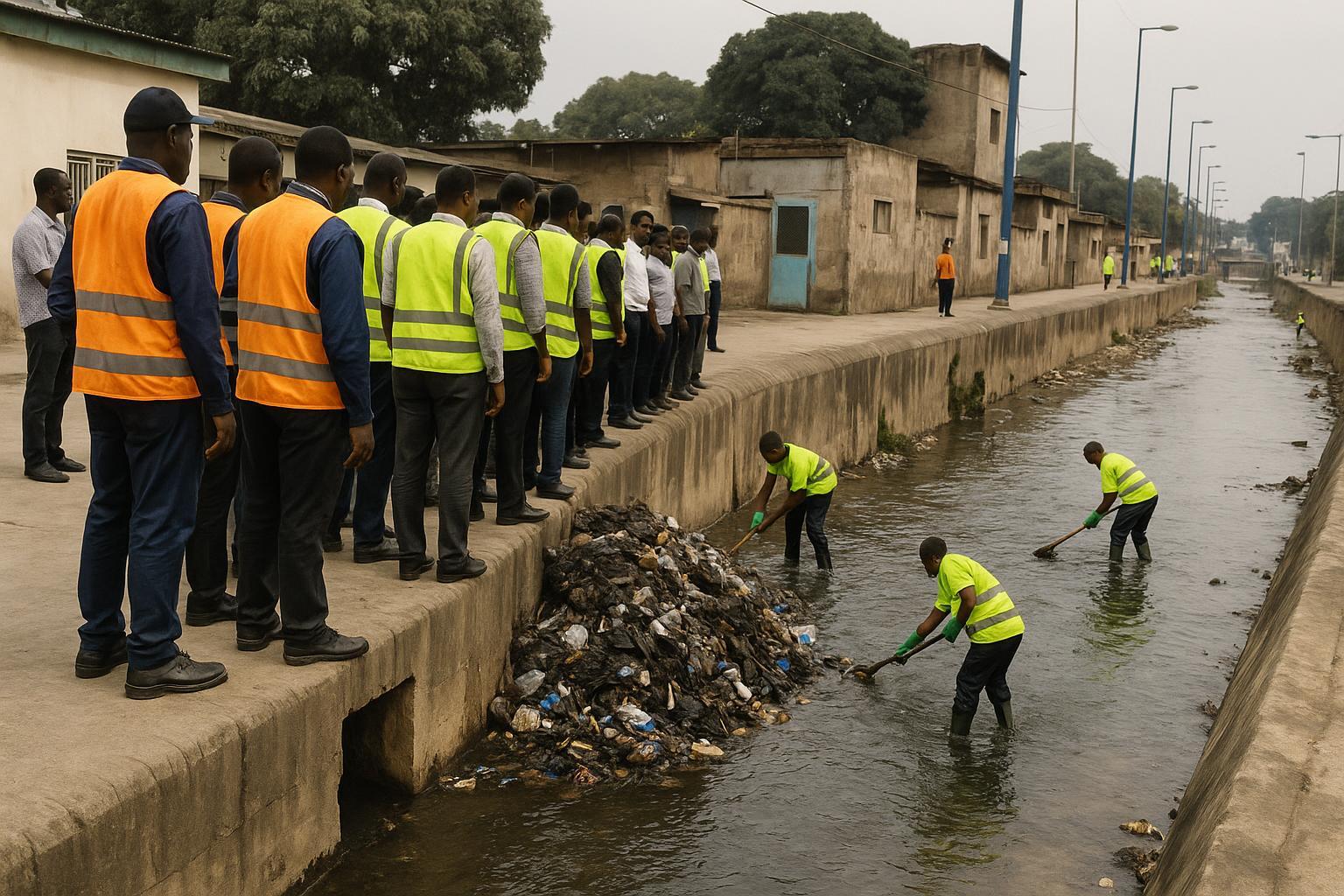
Government-backed clean-up gains momentum
The first Saturday of September saw hundreds of volunteers fan out across Brazzaville to dredge drains, sweep avenues and encourage households to rethink waste. The coordinated effort answers a government circular that designates the date for monthly sanitation drives citywide.
Under the guidance of the Ministry of Urban Sanitation, Local Development and Road Maintenance, non-governmental organisations, churches and private residents converged on key waterways and collector channels, armed with shovels, rakes and bright reflective vests.
Collectors and canals cleared across districts
On the banks and inside the Madoukou Tsékélé collector, members of Salubrité sans Frontière and Congo Propre removed sediment, plastic bags and vegetation that impede water flow during heavy rains. The team also cleared verges between Rue Mbochi and Avenue de France, restoring drainage.
In Moungali, the Association des Jeunes Éveillés worked the stretch linking Avenue des Trois Martyrs to Rue Lénine. Heavy loaders provided by the General Directorate of Sanitation lifted heaps of household debris, while Albayrak, the city’s primary waste contractor, carted the material to official transfer stations.
Faith groups add moral force to the broom
Across Ouenzé, worshippers from Liloba Revival Church pumped their motto—“With the Congolese State for a Clean City, Salongo Obligatory”—as they scooped sludge from roadside gutters at Avenue de la Tsiémé. Their pastor, Olsen Elion, described cleanliness as “a civic prayer whispered through action”.
On the southern flank, the NGO Salubrité Hygiène adopted the slogan “Every Gesture Counts for a Healthy Environment” while working the Zanga dia ba Ngombe collector bordering Makélékélé and Bacongo. Residents applauded the blend of spiritual motivation and practical labour that characterised the day.
Youth energy and machinery in tandem
Young volunteers, many in their twenties, view the initiative as a platform for skill building. “We learn teamwork, basic engineering around water channels and the discipline of time,” noted Ruth Ladi, a student wielding a spade at Madoukou Tsékélé.
Mechanical support proved equally decisive. Excavators loosened compacted silt that manual crews cannot easily remove, shortening operations that once lasted weeks to mere hours and reducing the risk of premature flooding as the short rainy season approaches.
Warning to illegal dumpers along Mfoa channel
Recurrent pollution hotspots remain under scrutiny. In Quarter 42, local chief Marie-Claire Bouanga reminded pre-collectors—small firms that gather household waste before municipal collection—that the Mfoa channel is off-limits.
“Anyone caught tipping here will face stiff penalties, so they never return,” she declared, gesturing toward steel warning plaques installed by Minister Juste Désiré Mondelé when the large-scale dredging programme began in July. Visible signage has already reduced clandestine dumping, neighbours confirm.
Education and enforcement form dual strategy
Roger Christian Itoua, sanitation adviser to the minister, believes public adherence hinges on constant dialogue. “People must understand the logic: waste dropped on the street blocks drainage, then floods damage homes. When that link is clear, behaviour changes,” he explained.
The ministry keeps pre-collectors informed about approved transit sites where Albayrak’s fleet empties containers before transferring refuse to the Mpila landfill. Periodic training sessions emphasise route planning, protective gear and transparent billing to households, nurturing a professionalised micro-sector within the city’s green economy.
A glimpse at impact and future goals
Early indicators are encouraging. Along Avenue de France, stagnant pools have vanished, and taxi drivers report smoother traffic during downpours. Environmental health officers plan bacteriological tests this month to measure reductions in vector-breeding sites.
Officials also eye broader ambitions, including community composting hubs for organic waste and neighbourhood competitions that reward spotless streets. Pilot projects will start in Moungali and Ouenzé later this year, subject to budget finalisation.
Citizen ownership as the long-term engine
Civic participation, not merely public funding, is emerging as the engine of lasting cleanliness. Teachers now weave waste management lessons into science classes, and social media influencers post “before-after” photos to keep the momentum alive.
“Sanitation is everyone’s business, like security or health,” said student leader Emmanuel Ngambali, resting on his rake. “When citizens and state institutions cooperate, the city breathes easier.” His comment captures the spirit officials hope will transform September’s sweep into a standing habit.
The next citywide salongo, scheduled for the first Saturday of October, promises even broader turnout. Organisers are already mapping fresh hotspots, confident that with united effort Brazzaville can move steadily toward the government’s vision of a resilient, green capital.