
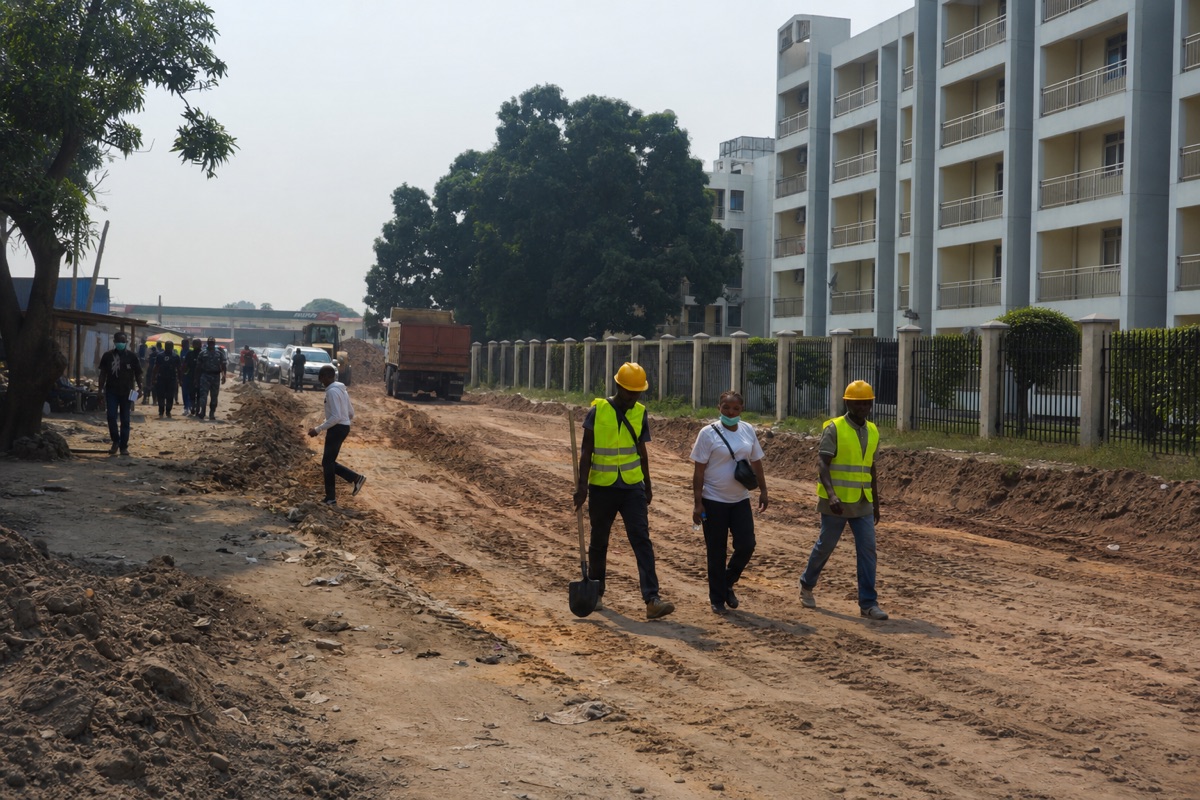
For years, the stretch of avenue des Blindés running between avenue des Trois Martyrs and rue Bangangoulou stood out for all the wrong reasons. Locals knew it as a black spot, a road where sanitation problems and broken surfaces had become a daily fact of life.
That chapter is now closing. Officials in Brazzaville have launched a paving project on the avenue, a job scheduled to run for roughly three months and aimed at pulling the corridor out of long-standing disrepair.
What the Three-Month Project Actually Covers
The plan is more than a quick resurfacing. Crews will lay out two traffic lanes, each measuring 4.50 metres wide, giving the avenue a clearer, more usable layout for the vehicles that pass through every day.
The work begins underground, in a sense. Engineers will handle earthworks first, then build a foundation layer made of crushed stone. Only after that base is in place do the interlocking paving stones go down, covering the full length of the route.
Interlocking pavers are a deliberate choice for streets like this one. They cope with heavy use, drain reasonably well, and can be lifted and reset when utilities below need attention, a practical detail that matters on a road with a difficult past.
Why Pedestrians Are Part of the Plan
Roads in Brazzaville are rarely just for cars, and this project reflects that. The design sets aside generous footpaths, with walkways measuring between 2.50 and 3 metres running along both sides of the carriageway.
That width is not a small thing for the people who live nearby. Wider, paved sidewalks give families, traders and commuters a safer place to walk, separating foot traffic from vehicles on a stretch that previously offered little protection.
The attention to pedestrian space signals a shift in how local infrastructure is being framed. The avenue is being treated as a shared neighbourhood asset, not simply a route to move traffic from one point to another.
A Familiar Government Message on City Living
The official launch fell to Juste Désiré Mondelé, who used the occasion to tie the works to a broader push by the government. He presented the project as part of an ongoing drive toward urban sanitation and the modernisation of everyday, local infrastructure.
“This project will help improve citizens’ living conditions, ease traffic flow and strengthen the appeal of this area,” Mondelé said at the launch, framing the paving as both a practical fix and a longer-term investment in the district.
His comments echo a theme that runs through much of the capital’s recent infrastructure talk: smaller, proximity-focused works that residents notice directly, rather than headline megaprojects far from the streets where people actually live.
What It Could Mean for the Neighbourhood
For the riverside districts and households along the avenue, the promise is straightforward. Better drainage and a solid paved surface should cut down on the flooding and muddy conditions that come with a degraded road during the rainy season.
Smoother circulation is the other half of the pitch. With two clearly defined lanes and proper footpaths, the hope is that both drivers and pedestrians will move through the area with less friction once the stones are in place.
There is also the question of how the avenue is seen. Officials are betting that a cleaner, better-built road will lift the standing of the surrounding zone, making it more attractive to residents and small businesses alike.
A Test Case Worth Watching
Three months is a tight window for a project that touches earthworks, foundations and surfacing along an entire route. As with any city works, the real measure will be in the finish: whether the timeline holds and the quality lasts.
For now, the avenue des Blindés sits at a turning point. After years as a reminder of what neglected infrastructure looks like, it is being remade into something its planners hope will read as a model for proximity works elsewhere in Brazzaville.
If the project delivers on its stated goals, residents will judge it not by official statements but by the simple test of daily use. A road that is easier to drive, safer to walk and cleaner to live beside would speak louder than any launch ceremony (Journal de Brazza).