
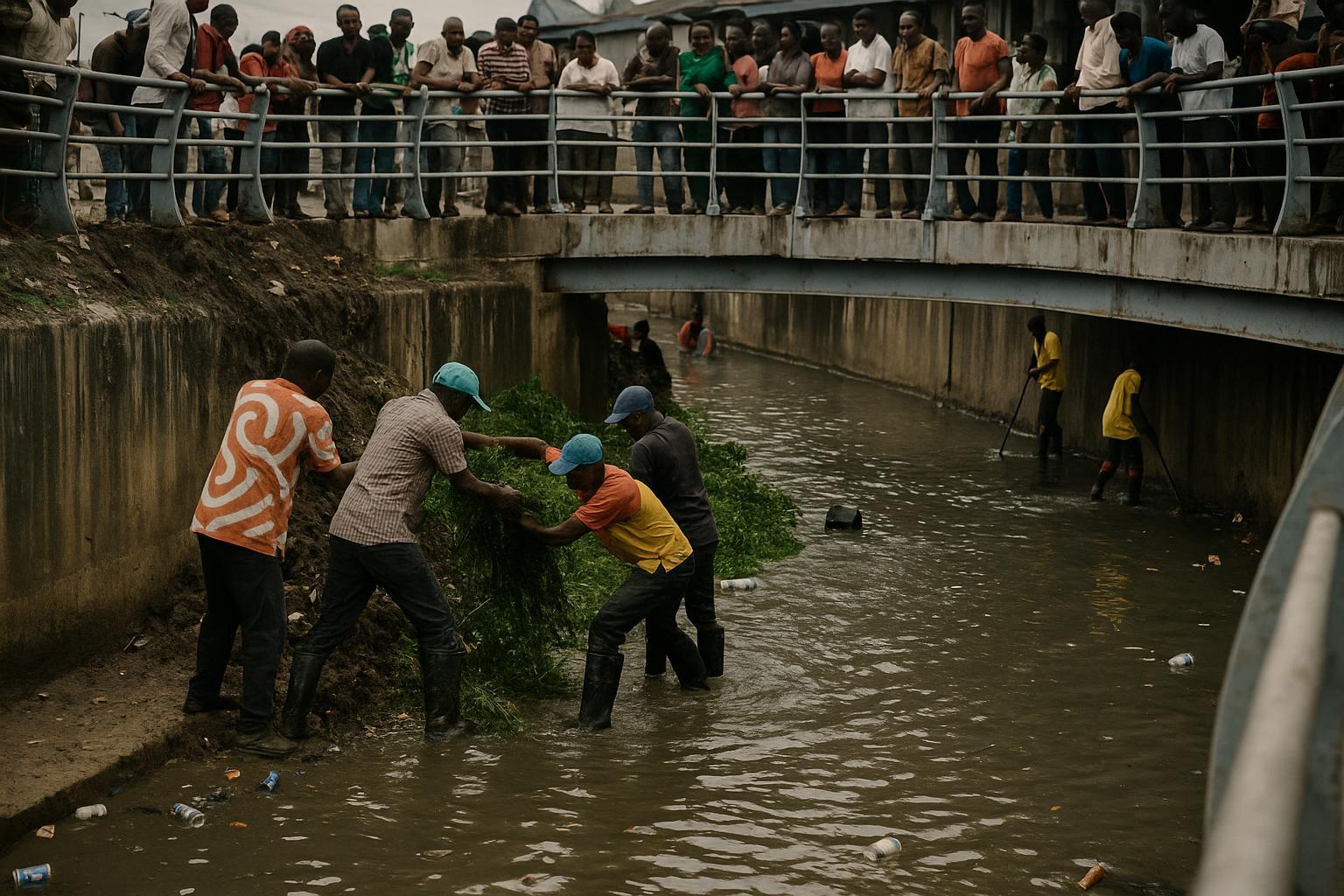
Heightened Sanitation Push Before Rains
As thunderclouds gather over the Congo River basin, Brazzaville officials have launched an unprecedented sanitation drive designed to keep storm drains clear and neighborhoods safe from flooding. The campaign, unveiled on 29 August, combines public education with firm penalties for residents who ignore environmental rules.
Minister of Urban Sanitation Juste Désiré Mondelé told journalists that persuasion alone can no longer protect the capital during the wet season, when even a few plastic bags can block a collector and turn entire streets into torrents. Enforcement, he insisted, will now match awareness efforts.
From Warnings to Penalties
Under the new protocol, anyone caught dumping refuse into open drains will be escorted to the nearest police station for what the minister called a ‘lesson in hygiene and civic responsibility’ before serving court-ordered community labor. Repeated offences could escalate to fines under existing public-health statutes.
The crackdown started in Makélékélé and Bacongo, dense southern districts where seasonal floods historically erode pavements and spread water-borne diseases. Municipal crews armed with excavators removed silted garbage from the Zanga Dia Ba Ngombe, Mfoa and Madoukou-Tsiekelé collectors while uniformed officers installed warning boards along the embankments.
Field Operations in Makélékélé and Bacongo
Local radio Télé Congo aired images of the minister crossing freshly dredged channels, pointing at discarded sachets and asking onlookers, ‘Would you throw this in your living room?’ The line trended on Congolese social media, reflecting both support and skepticism among urban youth.
Environmental engineer Judith Badinga, interviewed by the national daily Les Dépêches de Brazzaville, praised the multidimensional approach. ‘Cleaning without deterrence is Sisyphean,’ she said, noting that rainfall intensity predicted by regional climate models makes swift drainage crucial to prevent serious cholera outbreaks and infrastructure losses in coming months.
Public Reaction and Expert Voices
Yet some residents worry about selective enforcement. Market vendor Pierre Mabiala told ACER TV that poverty leaves many households without formal waste services, forcing them to choose between night-time dumping and growing piles near their homes. He urged the municipality to expand collection trucks alongside punitive measures.
Municipal spokesperson Julienne Okombi replied that three additional compactor lorries, procured with African Development Bank support, are scheduled to serve Makélékélé before November. She argued that combining logistics upgrades with community service penalties creates ‘shared responsibility’ rather than top-down repression and reducing flood damage.
Legally, the initiative relies on Article 132 of the Public Hygiene Code, which authorizes mayors to impose community work for behaviors endangering collective health. According to law professor Laurent Moukouéké, the clause has existed since 1991 but had rarely been invoked beyond minor littering fines.
Legal and Regional Context
The current escalation reflects broader regional trends. In neighboring Gabon, Libreville authorities introduced compulsory street sweeping rotations in 2022, while Cameroon’s Douala council recently adopted camera-assisted surveillance of drains. Congo-Brazzaville’s model, however, remains centered on direct police interaction, a method officials believe fosters immediate behavioral change.
Public-health experts point to Kigali, Rwanda, where strict anti-litter laws are combined with monthly Umuganda community work. ‘The evidence shows participatory clean-ups build social cohesion,’ stated Dr. Éloïse Goma of the Central African School of Public Health, while cautioning that forced labor without dialogue can backfire.
Economic and Development Implications
Economists also observe a fiscal dimension. Keeping collectors clear reduces emergency spending on pump rentals and road repairs after floods. The Ministry of Finance estimates 3.2 billion CFA francs were spent during the 2022 rainy season responding to avoidable blockages, funds that could instead support schools or clinics.
Civil-society groups have cautiously welcomed the campaign. The NGO Action Verte will deploy volunteers to monitor hotspots and provide recyclable sacks to households near the Madoukou-Tsiekelé drain. Coordinator Arlette Tchikaya emphasized that criminalizing poverty must be avoided, yet acknowledged that ‘clean canals are a collective life-insurance policy’.
International partners are watching closely. World Health Organization data indicate that urban floods contribute to 60 percent of diarrheal outbreaks in Central Africa. Brazzaville’s effort, officials say, aligns with the Sustainable Development Goal target on sanitation, potentially unlocking technical grants from agencies such as UNICEF and the European Union.
Political Dimensions and Next Steps
Politically, the campaign reinforces President Denis Sassou Nguesso’s larger urban modernization agenda, which includes the Talangaï wastewater treatment expansion and the ongoing waterfront beautification. Government spokespeople underline that cleaner drains are a nonpartisan ambition benefiting every arrondissement, thereby cementing social stability ahead of local elections scheduled for 2026.
For now, attention turns to community courts that will administer the first sentences. Judges have been briefed to prioritize educational labour such as painting anti-dumping murals or assisting drainage crews. Observers say the symbolic value of public service by offenders could shift norms faster than cash penalties alone.
Rain clouds may be inevitable, but clogged gutters are not. Whether Brazzaville’s blended formula of excavators, awareness, and legal sticks succeeds will be tested within weeks. As the first heavy showers drum on zinc roofs, the city’s new sanitation doctrine faces its loud, surging examination.