
Government Hands Over Modern Courts
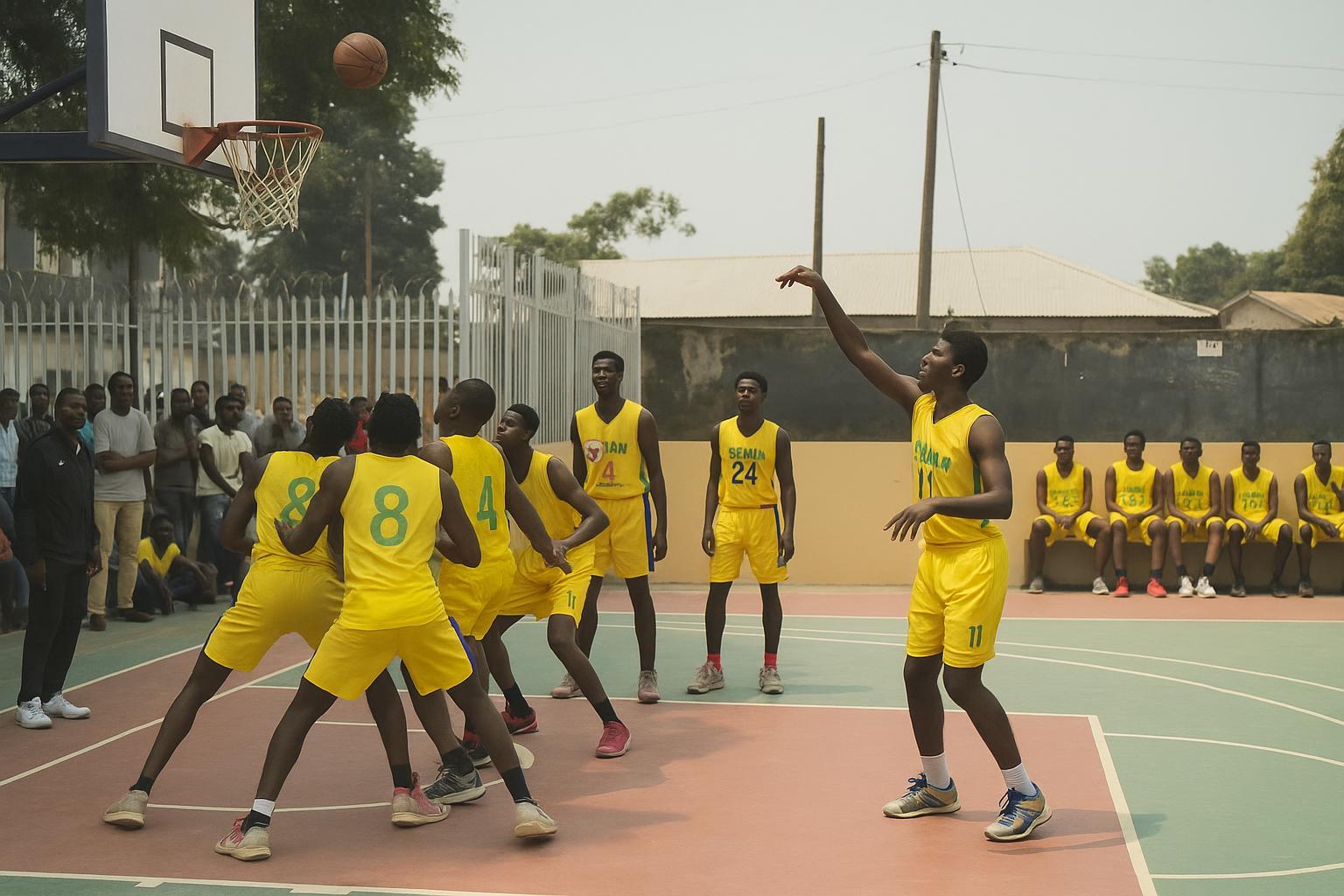
On 26 August, a modest ceremony in Talangaï marked the official handover of two freshly renovated sports courts at Antonio-Agostinho Neto High School, better known to locals as A.A Neto High.
Officials from the Ministry of Sports presented the keys to counterparts from the Ministry of Preschool, Primary, Secondary Education and Literacy, sealing months of collaboration aimed at giving pupils a safe, modern venue to exercise and compete.
The complex includes a basketball court painted to Fédération Internationale de Basketball standards and a volleyball surface equipped with adjustable nets, enabling mixed-age training sessions throughout the academic calendar.
A cheering crowd of students, teachers and neighborhood residents watched the ribbon fall, then flowed onto the freshly marked hardwood to test passing angles and three-point lines under the late-morning sun.
Two exhibition matches—first volleyball, then basketball—served as live demonstrations. Players in school colours traded spikes and jump shots while dignitaries kept score from plastic chairs, underscoring that even protocol can mix with playful spontaneity.
A Blueprint for Youth Development
Director General of Sports Jean Robert Bindélé told reporters the upgrade fits a broader government strategy that links physical education to public health, social cohesion and future elite performance.
By boosting access inside schools, authorities hope to spot promising talent earlier, reduce the burden of non-communicable diseases, and nurture a culture of fair play extending well beyond graduation day.
Bindélé stressed that the project is not an isolated gift but part of ongoing efforts to integrate sport into every level of the curriculum, from preschool motor-skill games to senior-level competitions preparing athletes for continental qualifiers.
He underlined, “It is on these courts that passion is born, teamwork is understood, and mutual respect becomes instinctive,” a message warmly applauded by school authorities who pledged structured timetables to maximise usage.
Education ministry adviser Théodore Bemba likened the venue to an open-air classroom, asserting that “kinesthetic learning reinforces mathematics, language and discipline by anchoring concepts in muscle memory.”
Financial and Technical Backbone
Funding flowed through the National Fund for the Promotion and Development of Physical and Sports Activities, an instrument created to channel oil-revenue surpluses into community wellness programmes.
Engineers selected impact-absorbing asphalt, anti-corrosion hoops and weatherproof seating, mindful of Brazzaville’s alternating heavy rains and Saharan dust winds that often degrade outdoor facilities within a single season.
Local contractors executed the six-week rehabilitation under joint supervision from the Sports Ministry and the Talangaï district council, creating temporary jobs for nearby residents and transferring maintenance know-how to the school’s custodial team.
A follow-up clause requires quarterly inspections, ensuring nets, lighting and court markings remain competition-ready and reducing the likelihood of expensive overhauls every academic cycle.
Officials estimated the total outlay at thirty-five million CFA francs, modest by international standards yet significant for a district budget, demonstrating fiscal prudence alongside ambition.
Voices from the Schoolyard
Sixteen-year-old point guard Divin Okemba described the court’s smooth finish as “a dream”, noting that earlier cracks often twisted ankles and limited practice to light drills.
Physical-education teacher Thérèse Mboumba added that the bright, regulation lines make lesson planning easier, because students can now visualise tactical zones instead of guessing their boundaries.
Parent committee chairman Raymond Massamba thanked authorities for honouring a promise first voiced at a Talangaï town-hall meeting in 2021, arguing that consistent sports programmes help teenagers channel energy away from street hazards.
Cheering in the stands, neighbourhood vendor Mama Odette said match days already boost demand for water sachets and roasted peanuts, hinting at the micro-economic ripple effects such facilities generate.
Local association Talangaï Sports Avenir announced plans to host inter-arrondissement leagues on the new surface, promising visiting teams a taste of northern Brazzaville hospitality and giving pupils the incentive to defend home turf.
Broader National Vision for Sports
The A.A Neto handover mirrors recent investments in Pointe-Noire, Dolisie and Owando, where refurbished pitches became launchpads for youth tournaments supported by the Congolese Federation of School Sport.
Government communiqués emphasise that steady improvement of grassroots infrastructure is essential to meeting Sustainable Development Goal three on health and Goal four on quality education.
Sports sociologist Dr. Irène Ngakala notes that campus facilities reduce gender disparities, because girls often feel safer training within school walls than in crowded municipal parks.
As whistles echoed across Talangaï, officials hinted that digital dashboards will soon track facility usage nationwide, giving planners real-time data to allocate coaching clinics and sports science resources efficiently.
In parallel, the Ministry of Digital Economy is partnering with telecom operators to explore free Wi-Fi hotspots around school arenas, aiming to merge sport and connectivity in ways that appeal to tech-savvy youth.
Observers recall that the 2015 African Games left Congo-Brazzaville with high-quality venues; transferring that legacy into everyday school life, they argue, turns infrastructure from concrete monuments into living laboratories of national pride.