
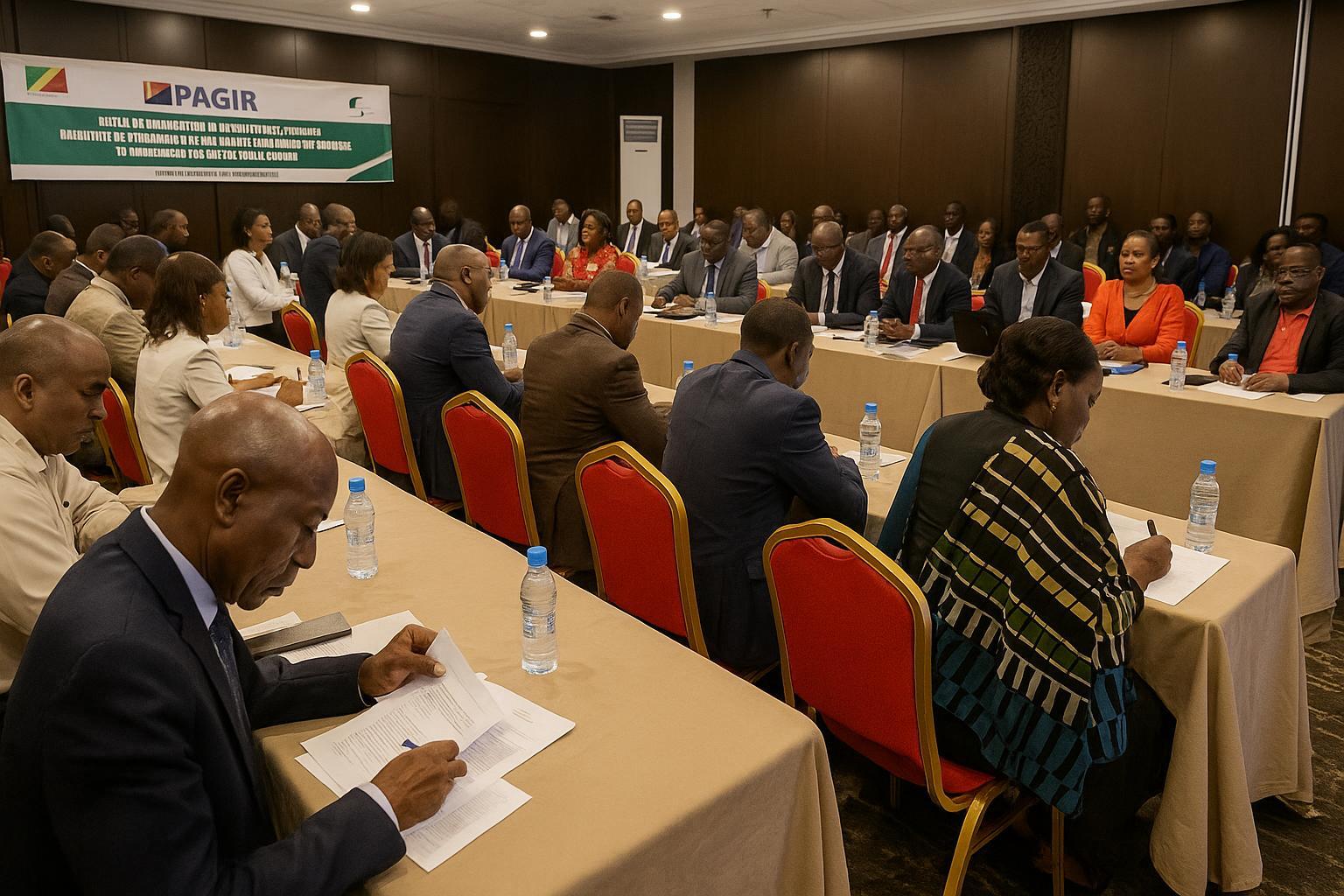
Stakeholders Unite in Brazzaville
On 27 and 28 August, a focused gathering at the Brazzaville convention centre set the tone for the Republic of Congo’s latest governance drive. Experts from ministries, private companies, civil society and technical partners examined the country’s emerging public-procurement architecture with rare technical detail.
The workshop, hosted by the steering committee of the Programme to Accelerate Institutional Governance and Reforms, or Pagir, worked in tandem with the Public Procurement Regulatory Authority, backed by the World Bank, to validate an indicator matrix that will soon guide nationwide evaluations.
Why the Matrix Matters
This matrix, drafted by national specialists, translates the international Methodology for Assessing Procurement Systems, MAPS, into country-specific benchmarks. Before it gains final approval in Paris, Congolese delegates aimed to scrutinise every metric, ensuring local realities are fully reflected in the global template.
Once endorsed, the matrix will become the reference grid against which the performance, credibility and transparency of every government contract can be measured. Reformers see it as the missing statistical backbone for a market currently estimated at hundreds of billions of CFA francs each year.
Four Pillars, One Vision
Four thematic pillars shape the new framework: a robust legislative and policy environment; clear institutional responsibilities with trained procurement cadres; disciplined acquisition practices from planning to payment; and uncompromising accountability, integrity and transparency standards.
Each pillar carries detailed indicators, from publication deadlines on the national tender portal to the frequency of independent audits. Pagir’s technical team believes the eventual dataset will offer both donors and domestic watchdogs a real-time snapshot of contract health.
Voices from the Workshop
“The Congo has launched an ambitious modernisation of its procurement system,” observed Antoine Ngakosso, economic and forecasting adviser to the Minister of State, as he opened deliberations. “Our task today is to pinpoint strengths and gaps so future spending delivers visible value for citizens.”
Participants traded field anecdotes more than jargon. A municipal engineer noted that early budget disclosure could shrink project delays. A civil-society representative cited rural clinics waiting months for equipment, arguing that predictable bidding cycles are as vital as anti-corruption slogans.
World Bank procurement specialist Marie-Claire Moukoko, joining virtually, reminded the room that MAPS has already guided reforms in Côte d’Ivoire, Senegal and Benin. “Comparability fosters investor confidence,” she said, adding that Congo’s swift adoption could position Brazzaville as a regional benchmark.
Next Steps and Regional Impact
Behind the policy language lies a fiscal imperative. According to Pagir estimates shared during the session, even a five-percent efficiency gain could release resources equivalent to the annual budget of the Ministry of Social Affairs, money that could be redirected toward grassroots programmes.
The matrix still needs fine-tuning. Working groups flagged overlapping roles between line ministries and local authorities, a source of duplication identified in previous audit reports. The suggestion: craft clear escalation protocols so contractors know exactly which desk stamps the final approval.
Digitalisation was another recurring theme. Developers from the national e-procurement platform demonstrated a beta feature that links contract award data to geolocated project photos. Attendees welcomed the tool, stressing that visual evidence can neutralise rumours faster than press statements.
Toward Nationwide Implementation
After two concentrated days, the committee adopted the matrix in principle and tasked a drafting cell with integrating the final comments within a fortnight. The updated document will then be transmitted to the MAPS secretariat for global peer review.
Pagir officials are planning provincial roadshows to familiarise procurement officers with the new indicators before the year ends. By synchronising central and local vocabularies, organisers hope to avoid the post-reform lag that has slowed similar initiatives elsewhere on the continent.
Economic and Political Signals
Economists observing from Kinshasa and Libreville argue that transparent tenders could lower borrowing costs by signalling prudent fiscal management. Credit-rating agencies, they note, increasingly reference procurement governance in their sovereign assessments, making the Brazzaville effort more than a purely administrative exercise.
Civil-society activist Brigitte Bemba expressed cautious optimism. “Clarity breeds trust,” she said in the corridor, yet warned that data must be published in user-friendly formats, not locked in PDF archives. Organisers replied that quarterly dashboards will be released on open-data portals.
For governance consultants, the exercise underscores President Denis Sassou Nguesso’s stated commitment to prudent public finance. By placing metrics at the centre of contract management, the administration signals a technocratic approach designed to reassure both investors and development partners.
Beyond Indicators: Delivering Results
The path ahead is undeniably complex, yet the consensus in Brazzaville is that a measurable framework beats informal discretion. As one delegate concluded, the real test will not be drafting indicators but allowing them to redirect funds toward classrooms, clinics and roads that people can touch.
If the timetable holds, Congo could publish its first MAPS-aligned performance report by mid-2024, giving policymakers a clear picture of savings and bottlenecks before the next national budget is drafted.