
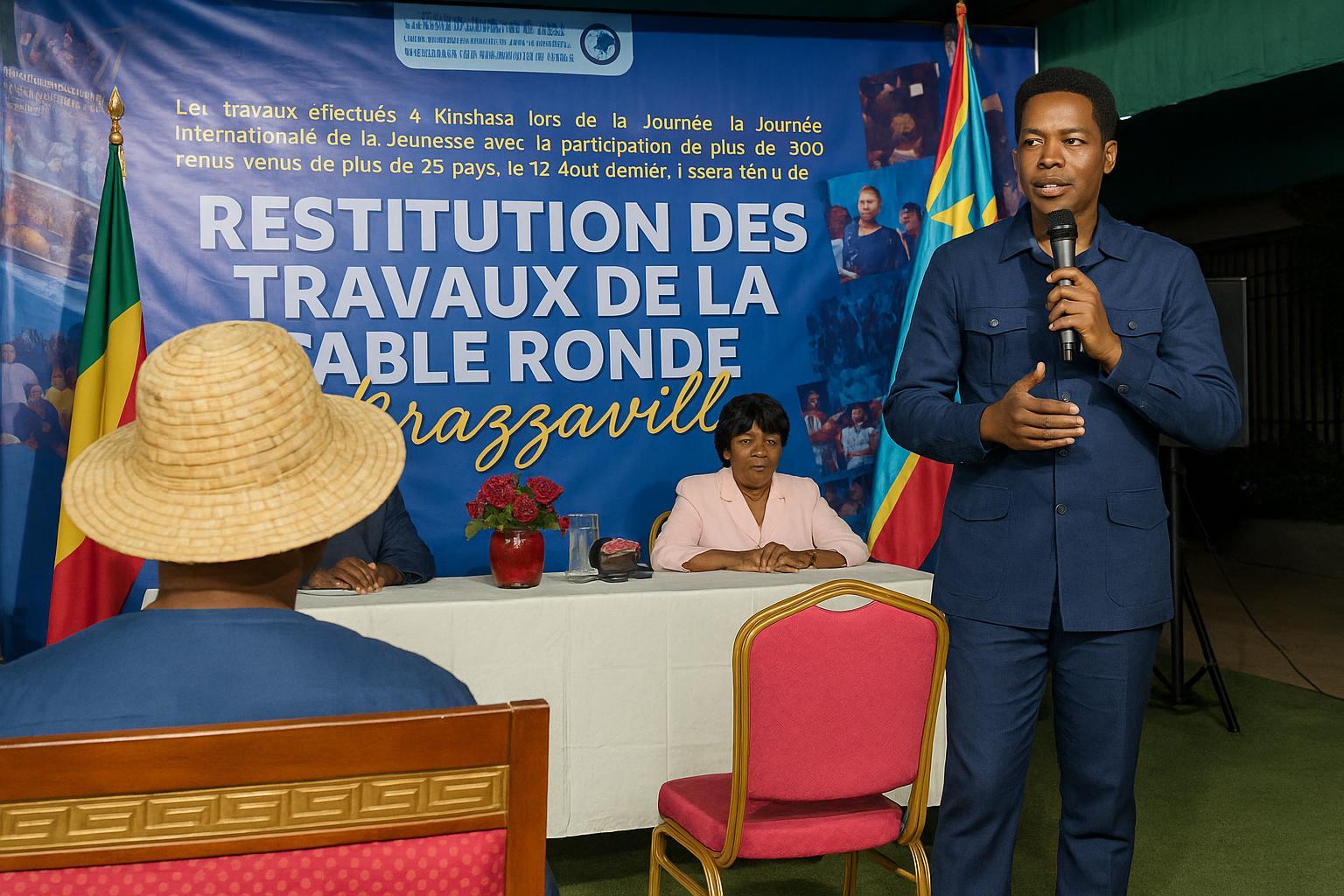
Kinshasa Outcomes Reach Brazzaville
Just eleven days after the International Youth Day forum in Kinshasa, the Forum International de la Jeunesse Africaine pour le Développement de l’Afrique, or FIJADA, crossed the Congo River to share its recommendations with carefully selected youth leaders in Brazzaville, the Congolese capital city.
Leading the delegation was FIJADA president Jonathan Lumbeya Masuta, welcomed at the pedestrian Charles-Ebina Alley near Hotel Saphir under the benevolent eye of former parliamentarian José Cyr Ebina, whose presence underscored the importance national figures attach to youth-driven regional initiatives.
During the evening session on 23 August, Masuta formally installed Daniel Biangoud as FIJADA representative for Congo-Brazzaville, handing him a symbolic trophy and the official Kinshasa report, thereby anchoring the movement institutionally on both riverbanks and setting the tone for an ambitious phase of local collaboration.
Youth as Development Catalysts
Addressing the gathering, Masuta repeated his conviction that Africa’s demographic dividend is a strategic asset, calling the continent’s under-30 majority the “primary lever for our collective renaissance.” His statement echoes recent African Union analyses highlighting youth participation as central to achieving Agenda 2063 targets (African Union Commission).
José Cyr Ebina complemented that view by urging a re-anchoring of modern ambitions in ancestral values, adding that sustainable progress requires cultural continuity as much as technological novelty, a perspective often advanced by UNESCO cultural heritage programmes operating in Central Africa (UNESCO).
Delegates from the national Youth Advisory Council and United Nations agencies acknowledged the synergy, citing Congo-Brazzaville’s recent voluntary review on Sustainable Development Goals, where youth-designed community projects received favourable mention for their cost-effective impact at district level (United Nations Development Programme).
Green Entrepreneurship at the Forefront
FIJADA ambassador Deborah Bowa Baïke unveiled the Kinshasa round-table’s flagship recommendation: scaling eco-entrepreneurship to create jobs while protecting biodiversity. She highlighted pilot schemes in urban farming, solar phone-charging kiosks and plastic-to-pavers conversion, projects already tested in Kampala and Abidjan with promising returns on investment (UN Environment Programme).
Participants debated how a youthful workforce can leapfrog heavy infrastructure constraints by leveraging digital platforms to crowd-fund green start-ups, a model endorsed by the African Development Bank’s Youth Entrepreneurship Investment Banks initiative, currently under feasibility study for Central African markets (African Development Bank).
Local entrepreneurs in attendance pointed to success stories such as the Brazzaville-based company GreenFuel, which recycles used cooking oil into biodiesel for river transport, demonstrating that smart regulation and access to micro-credit can spark scalable innovations without large capital outlays.
Regional Integration and Mobility
A spirited exchange emerged on Africa-wide visa regimes. Delegates argued that freer movement of young professionals is essential for cross-border incubation hubs. They cited the African Continental Free Trade Area secretariat’s plan to introduce a unified business travel card as a potential accelerator (AfCFTA Secretariat).
Masuta differentiated between classical diplomacy and pragmatic cooperation, underscoring that sub-regional youth networks can deliver tangible benefits even before far-reaching treaties are ratified. His perspective aligns with the Economic Community of Central African States’ 2023 strategy paper that emphasizes track-two engagement frameworks (ECCAS Commission).
On the ground, diplomatic staff from both Congos confirmed that joint cultural visas introduced in 2022 have already increased student exchanges by 18 percent, a statistic corroborated by data from the Central African Economic and Monetary Community research unit (CEMAC Research Centre).
Government Engagement and Support
Officials from the Ministry of Youth and Civic Education, though attending in an observer capacity, welcomed FIJADA’s initiative, noting that its agenda dovetails with Congo-Brazzaville’s National Development Plan 2022-2026, which allocates significant resources to vocational training and green sector incentives.
Speaking on background, a senior aide said the government sees youth-led environmental entrepreneurship as complementary to recently announced reforestation campaigns along the Plateaux corridor, an area where public-private partnerships are being explored with support from the Central African Forest Initiative (CAFI secretariat).
Toward Brazzaville 2026
Closing the ceremony, Masuta expressed hope that the next FIJADA round-table will convene in Brazzaville during International Youth Day 2026, positioning the city as a magnet for continental talent and consolidating the cross-river partnership first envisioned when the movement formed in 2022.
Biangoud pledged to mobilise local universities, municipal councils and private sponsors to meet the logistical requirements of hosting an event that could draw hundreds of delegates. Early discussions are reportedly underway with the Chamber of Commerce and the World Bank’s IFC office.
Observers note that Brazzaville has gained experience managing high-profile gatherings, including the International Conference on the Great Lakes Region summit in 2021 and the Pan-African Music Festival, which together showcased the city’s capacity for security coordination, cultural diplomacy and hospitality infrastructure—key benchmarks for FIJADA’s prospective conclave.
For now, the newly installed FIJADA chapter will focus on disseminating the Kinshasa recommendations into schools, neighbourhood associations and business incubators, creating what Masuta describes as a “living document” that evolves as young Congolese transform ideas into measurable environmental and socio-economic gains.