
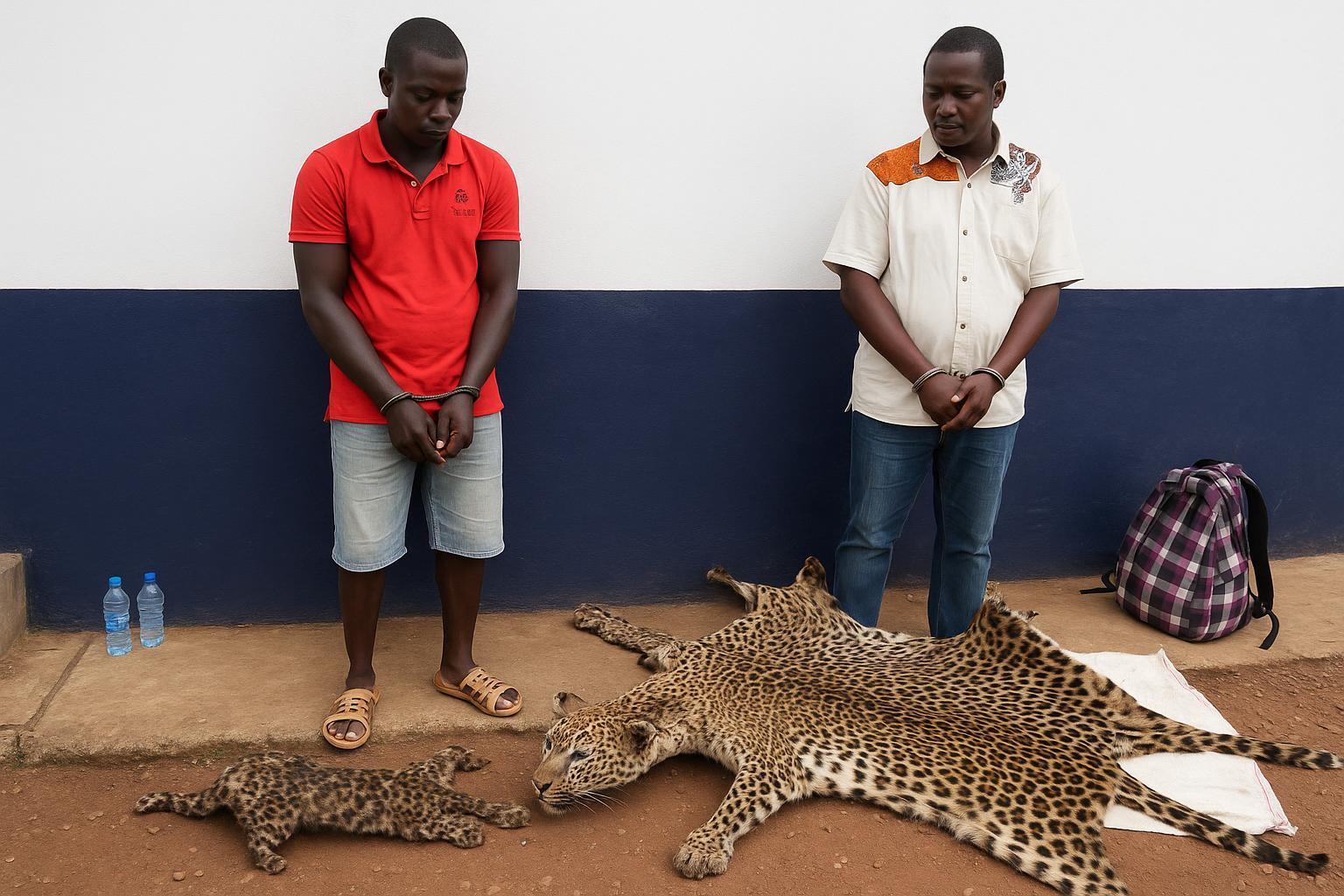
Wildlife Law Enforcement Momentum 2025
The first half of 2025 has been unusually dynamic for Congo-Brazzaville’s wildlife protection forces. Joint patrols by the national gendarmerie and forest officers have swept highways, river ports and remote markets, responding to intelligence on ivory, big-cat skins and pangolin scales believed destined for export.
According to preliminary data compiled by the wildlife law enforcement support project PALF, nine suspected traffickers were arrested between January and July. Operations unfolded in Dolisie, Owando and Impfondo, echoing hotspots flagged in last year’s CITES compliance review (CITES 2024 report).
Field teams report that most arrests occurred in flagrante delicto, with suspects carrying elephant tusks, leopard pelts or sacks of giant pangolin scales. Under national legislation, these species enjoy full protection, and possession alone constitutes an offence punishable by prison terms and heavy fines.
Captain Jean-Baptiste Okemba of the gendarmerie describes the recent raids as ‘surgical, intelligence-led actions that reduce the supply chain before contraband leaves rural areas.’ His assessment aligns with the Ministry of Forest Economy’s strategy paper released in March, which prioritises early interception over border seizures.
From Arrest to Sentence: The Judicial Track
Magistrates in Niari, Cuvette and Likouala provinces have moved swiftly once cases reached their desks. Court documents consulted by this magazine show eight of the nine defendants were remanded in custody within forty-eight hours, a timeline praised by legal observers from the United Nations Office on Drugs and Crime.
In May, the Dolisie tribunal handed a two-year custodial sentence and a CFA 5 million fine to a repeat offender caught with two leopard skins. The ruling cited Article 113 of Law 37-2008, underscoring that recidivism justifies harsher penalties aimed at deterrence.
Legal analyst Clarisse Mvoula notes that wildlife cases once languished but now progress quickly because specialised prosecutors have been appointed in key jurisdictions. ‘Procedural delays previously emboldened traffickers,’ she says, ‘yet recent outcomes indicate the judiciary’s growing commitment to biodiversity protection.’
Field Support: PALF, Rangers and Technology
Behind the scenes, the Wildlife Law Enforcement Support Project, better known by its French acronym PALF, supplies investigators with training, forensic kits and secure evidence storage. Funded in part by the Arcus Foundation, PALF has accompanied more than 200 operations nationwide since 2008, official statistics indicate.
Sophisticated tools are gradually replacing paper notebooks. Rangers in Odzala-Kokoua National Park now use GPS-enabled cameras and satellite messengers to document contraventions in real time, allowing command posts in Brazzaville to verify coordinates before authorising arrests (World Bank Digital Conservation Project 2023).
For Colonel Brice Makosso, director of the national park service, technological upgrades shorten response times and produce evidence that withstands courtroom scrutiny. He emphasises that equipment is only part of the equation; mentoring young eco-guards and ensuring prompt salaries remain critical to morale.
Media and Community Awareness Drive
Beyond uniforms and gavels, Congolese journalists have amplified the campaign. Radio Oyo’s weekly programme ‘Wildlife Watch’ dedicates airtime to verdicts and hotline numbers, while daily Congopresse offers explanatory pieces on pangolin ecology. Editors say public exposure discourages complicity by transporters and roadside vendors.
Awareness work also reaches classrooms. The Ministry of Primary Education, in collaboration with WWF, rolled out illustrated booklets depicting protected species and legal penalties. Teachers in Owando report that pupils now challenge adults seen carrying bushmeat, a subtle cultural shift that experts deem pivotal for long-term demand reduction.
Dr. Élodie Bompene, sociologist at Marien Ngouabi University, argues that local pride in national parks is rising. ‘People increasingly view elephants as a national treasure rather than just protein or income,’ she observes, linking the trend to media narratives that frame conservation as patriotic.
Regional Cooperation and Future Outlook
The Republic of Congo’s progress has not gone unnoticed in the region. Gabonese officials visited Brazzaville in June to discuss joint patrols along the Ogooué-Ivindo landscape, a corridor frequented by cross-border poaching syndicates. A memorandum of understanding is expected before year’s end.
International donors are watching performance indicators closely. The Global Environment Facility signalled that a forthcoming grant round will reward countries demonstrating effective enforcement and measurable biodiversity gains. Analysts say recent convictions position Congo favourably, provided monitoring data continue to confirm stable or recovering wildlife populations.
Challenges remain, from porous river frontiers to soaring online demand for exotic pets, yet stakeholders interviewed for this report remain optimistic. The coordinated approach that blends law, technology, education and diplomacy offers a blueprint. As one senior ranger concluded, ‘The message is simple: trafficking no longer pays here.’
Economists note a secondary benefit: legal timber exporters now face fewer allegations of mixing wildlife contraband with their cargo, improving market perception in Europe and Asia. Cleaner supply chains could unlock new certifications and premiums for sustainably sourced wood products.
Meanwhile, local universities plan a joint research hub to analyse DNA from seized trophies, providing scientific evidence and training opportunities for graduates.