
Presidential race gathers momentum
Five months after the Independent National Electoral Commission quietly opened the pre-campaign calendar, the political scene in Congo-Brazzaville is shifting. The latest tremor came from the Dynamique républicaine pour le développement, better known by its initials DRD, a junior partner in the ruling coalition.
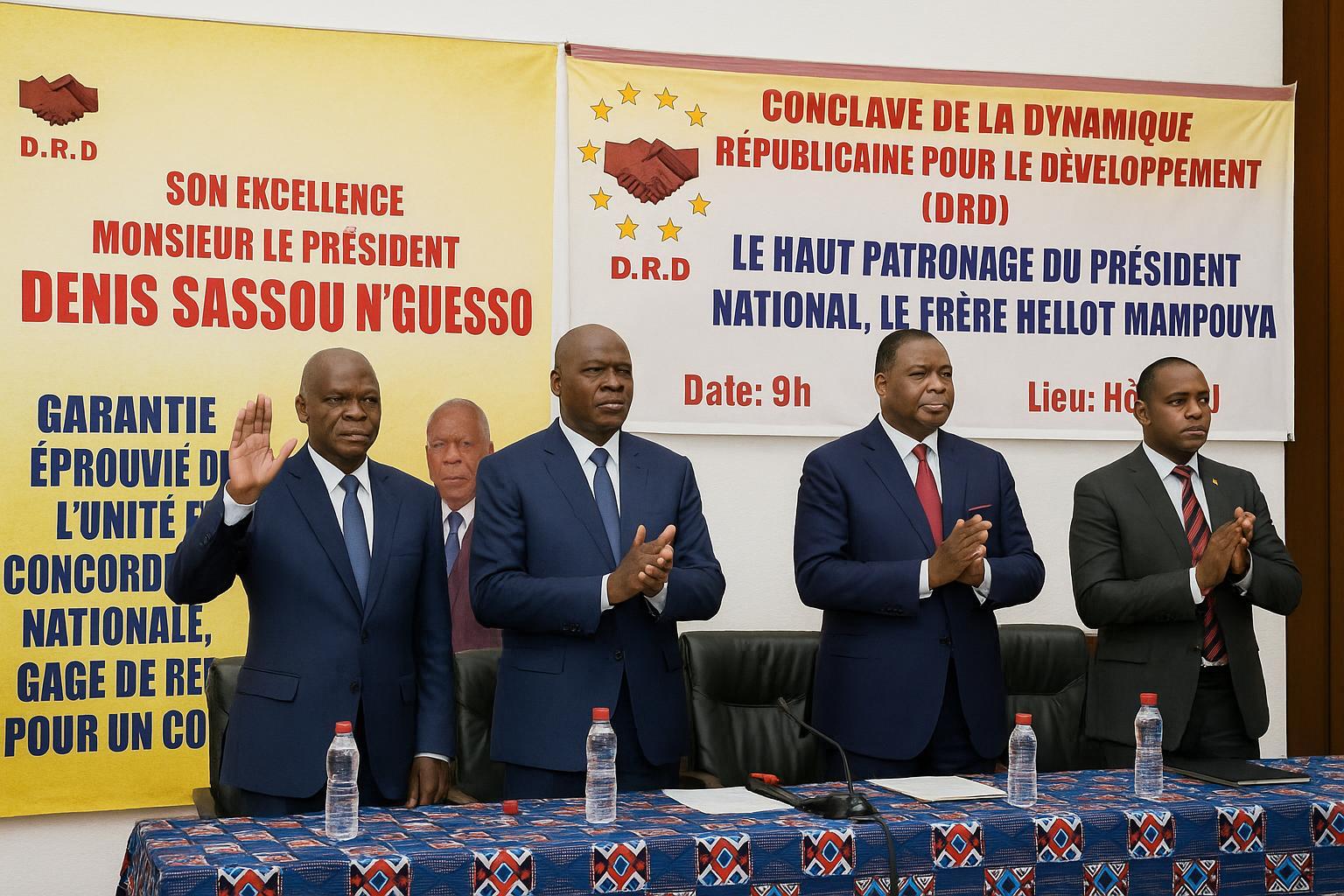
Meeting behind the thick white walls of Brazzaville’s Prefecture, 280 national councillors convened on 21 August to chart the party’s course. Their closed-door debate, confirmed by local daily Les Dépêches de Brazzaville, ended with a unanimous plea for President Denis Sassou Nguesso to seek another mandate.
DRD president Hellot Matson Manpouya, a former education minister now tasked with organising the national education forum, described the conclave as “a spiritual refresh” that launches a “more active, operational and dynamic” phase designed to galvanise supporters until ballots are cast in March 2026.
Brazzaville caucus signals strategic pivot
Analysts in the capital note that DRD’s endorsement arrives earlier than expected. “It short-circuits speculation and simplifies the coalition’s message,” observed political scientist Georges Nzila of Marien Ngouabi University, adding that early clarity can free resources for voter outreach in remote districts.
Last election season, partner parties jostled for visibility until late December, creating mixed signals on social programmes. By setting the tone in August, DRD positions itself as an agenda-setter rather than a follower, a move some commentators link to Manpouya’s ambition to consolidate grassroots networks.
Presidential spokesperson Ludovic Ngatsé declined to comment on campaign timing but welcomed “any civic expression that recognises the president’s record of peace and infrastructure delivery.” His brief statement, aired on Télé Congo, underscores government confidence while avoiding the formal language of a candidacy announcement.
Why DRD’s endorsement matters
Despite its modest representation, DRD occupies a strategic niche: educators, civil servants and youth associations. In 2021 its activists delivered critical turnout boosts in urban Brazzaville and rural Plateaux, according to figures released by the Ministry of Territorial Administration following that year’s legislative poll.
Observers see parallels with the Parti congolais du travail’s 2015 endorsement, viewed as a bellwether ahead of constitutional reforms. “It signals cohesion within the majority,” said Émile Okemba, editor of Congo News Agency, noting that markets tend to react positively to predictable succession plans.
Foreign investors already monitoring oil-price volatility welcomed the news. A note from the Pointe-Noire Chamber of Commerce argued that stability in the executive branch reassures operators negotiating offshore blocks slated for auction next year, though the memo underlined the need for continued regulatory transparency.
Inside the party reorganisation
Beyond the endorsement, delegates voted to dissolve the National Executive Bureau and replace it with an interim commission until a second congress convenes. Party communiqués explain the step as administrative housekeeping meant to align structures with newly adopted internal rules on gender and youth representation.
Insiders say the change also reflects lessons from last year’s municipal campaign in which parallel chains of command caused scheduling mishaps. The interim body of eleven members, chaired by veteran organiser Irène Nguesso-Monard, will oversee candidate selection, fundraising audits and the roll-out of digital membership cards.
Speaking to our magazine, Manpouya denied rumours of factional tension. “We are streamlining, not sidelining,” he emphasised, citing statutes that mandate renewal every ten years. He promised the congress would be scheduled before year-end, pending health guidelines related to the lingering regional cholera outbreak.
Reaction across the majority coalition
The sprawling presidential majority includes more than a dozen parties. Congolais Uni pour la Réforme hailed DRD’s “sense of responsibility,” while the tiny Mouvement des Élus du Littoral announced it will consult grassroots committees in September.
Opposition voices were measured. Jean-Jacques Yhombi-Thara of the Social-Liberal Union cautioned against “premature coronations,” yet he acknowledged the president’s constitutional eligibility. Independent newspapers such as Sel Piment emphasised voter registration challenges, noting the electoral commission’s target of registering 400,000 first-time voters by December.
Viewing 2026 through an economic lens
Economic researchers link political continuity to ongoing IMF-backed reforms. The Fund’s July report projects 4.3 percent growth in 2026, contingent on continued fiscal discipline and diversification. A contested ballot could unsettle forecasts, but early endorsements are read as dampening uncertainty premiums.
In Pointe-Noire’s bustling oil hub, supply-chain firms voiced support. “Contracts stretch over multi-year horizons; stability is currency,” said Sandra Boukaka, director of logistics group TransMarine. She expects capital expenditure decisions deferred during the pandemic to resume once the political timetable solidifies.
International observers weigh in
The African Union’s early assessment mission, currently preparing its scoping visit, welcomed signals of intracoalition order. A communiqué from Addis Ababa stressed the importance of internal democracy within parties, calling DRD’s conclave “a constructive precedent” that could inform inter-party dialogue sessions later this year.
EU diplomats in Brazzaville said the endorsement will feature in electoral risk reports, yet stressed that the bloc’s aid remains linked to governance benchmarks, not personalities. They expressed readiness to send technical experts for voter-list audits if requested.