
A Sudden Audio Leak Shakes the Flock
Early August 2025, three WhatsApp recordings circulated at lightning speed among Congolese faithful. In them, Archbishop Gelasse Armel Kema, metropolitan of Owando, criticised Bishop Armand Brice Ibombo of Ouesso and made disparaging references to an ethnic community, according to Catholic weekly La Semaine Africaine.
Local journalists confirmed the clips’ authenticity with clergy who recognised the archbishop’s voice. Vatican News staff in Kinshasa also reported that the messages triggered “deep consternation” across northern dioceses, highlighting the power of smartphones to carry private words into the public square instantly.
Tracing the Origins of the Tension
Observers note that Archbishop Kema administered the Ouesso see ad interim until Bishop Ibombo’s appointment in 2021, a period that could have created unspoken rivalries. Father Dieudonné Moussou, a Church historian at Marien Ngouabi University, recalls similar transitions elsewhere that left lingering sensitivities.
Yet parish accounts describe cordial cooperation between the men during pastoral visits. Hence the harsh tone of the leaked conversation surprised many priests. Analysts at Congo-Brazzaville’s Centre d’Etudes Religieuses argue the outburst reflected personal frustration rather than institutional conflict.
Mediation Led from Brazzaville
When outrage grew, the Permanent Council of the Episcopal Conference of Congo issued a collective apology on 6 August. Sources inside the Secretariat admit the statement, though carefully worded, was seen as too abstract by laity seeking concrete accountability.
Archbishop Bienvenu Manamika Bafouakouahou of Brazzaville then stepped in as mediator. Drawing on experience moderating diocesan disputes, he proposed face-to-face liturgies of reconciliation. “We needed gestures larger than words,” he told Radio Magnificat, emphasising Congo’s cultural premium on public pardon ceremonies.
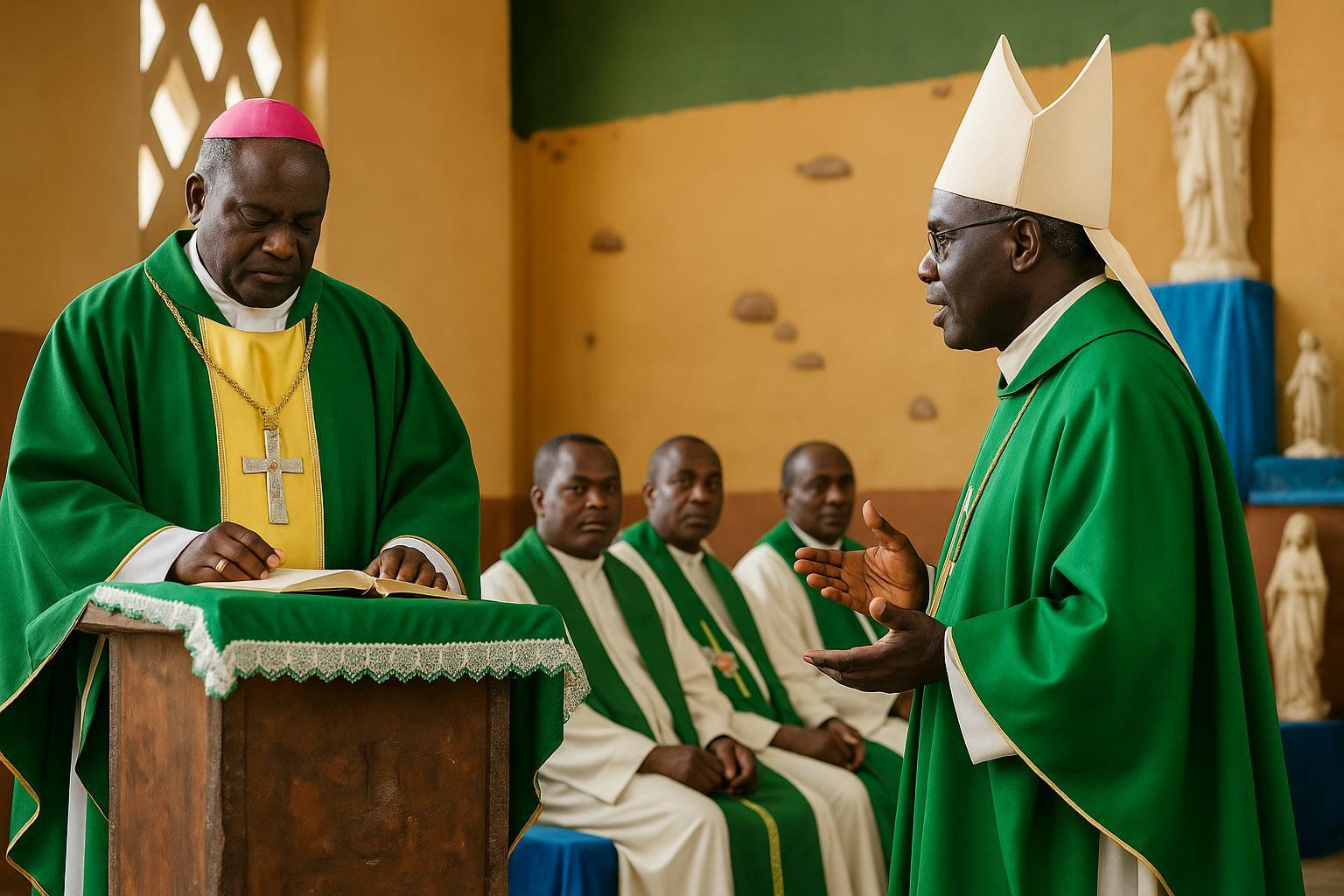
On 17 August, Christ-Roi Cathedral in Owando filled before dawn. Flanked by bishops of Impfondo, Gamboma and Pointe-Noire, Archbishop Kema knelt before Bishop Ibombo and asked forgiveness. Congregants reported spontaneous applause, while the choir intoned the hymn “Tu As Les Paroles De Vie”.
Second Act in Ouesso
The following day, the entourage traveled 220 kilometers north to Ouesso’s brick-red Cathedral of Saint Peter Claver. There, roles reversed: Bishop Ibombo embraced his elder and voiced absolution. Provincial television RTNC broadcast the exchange, framing it as a model of “pardon authentique”.
Diocesan spokesperson Sister Clarisse Oyimi stated afterward that the ceremony balanced canon law with local customs of public reconciliation, noting that “the crowd wished to see humility displayed in both directions.” Social media commentary, once scathing, quickly shifted to relief and even pride.
Impact on the Faithful and Beyond
Pastoral councils across Cuvette and Sangha report renewed Mass attendance since the events. Sociologist Alain Mabiala attributes the uptick to a collective yearning for visible humility among leaders, adding that “the bishops showed accountability consonant with national ideals of dialogue.”
Political observers notice the episode aligns with governmental messaging on unity in diversity. Although officials remained silent, state newspaper Les Dépêches de Brazzaville praised the Church for “strengthening national cohesion through responsible speech.” The comment sat comfortably within Congo’s broader stability narrative.
Institutional Lessons for Crisis Management
Canon-law scholar Sister Julienne Ndzoku says the affair will enter seminary curricula as a real-world case of restorative justice. She points to Pope Francis’s emphasis on “synodality”—walking together after conflict—and argues the Congolese bishops offered a tangible example for the continent.
Media analyst Patrice Okombi contrasts the Church’s swift response with slower crisis reactions by some civic bodies. He underlines the decisive timeline—twelve days from leak to apology ceremonies—as evidence that structured mediation, clear communication and symbolic ritual can quell turmoil before it hardens.
Cultural Resonance of Public Pardon
Ethnologist Marie-Claire Ondolo reminds that in northern Congo, collective healing often requires public gestures under elder supervision. By staging two liturgies in both cities, the bishops mirrored traditional palaver practices, thereby rendering the Catholic rite intelligible within local cultural grammar.
Her field notes show congregants interpreted the kneeling scene through the lens of yokà, a Sangha concept where the offender lowers himself to restore harmony. Such anthropological crossover deepens the sacramental act, feeding wider conversations about inculturation of faith traditions.
Outlook for Ecclesial Unity
Archbishop Kema has since launched a diocesan listening tour, pledging to meet catechists, youth groups and women’s leagues. Bishop Ibombo, for his part, invited Owando clergy to Ouesso’s annual missionary festival next February, signaling an ongoing rapprochement rather than a single photo opportunity.
Experts caution, however, that social media vigilance remains essential. The Episcopal Conference plans workshops on digital ethics for priests, aiming to prevent future leaks. Father Moussou concludes, “Technology tests our integrity daily; only consistent transparency will preserve the trust recently regained.”