
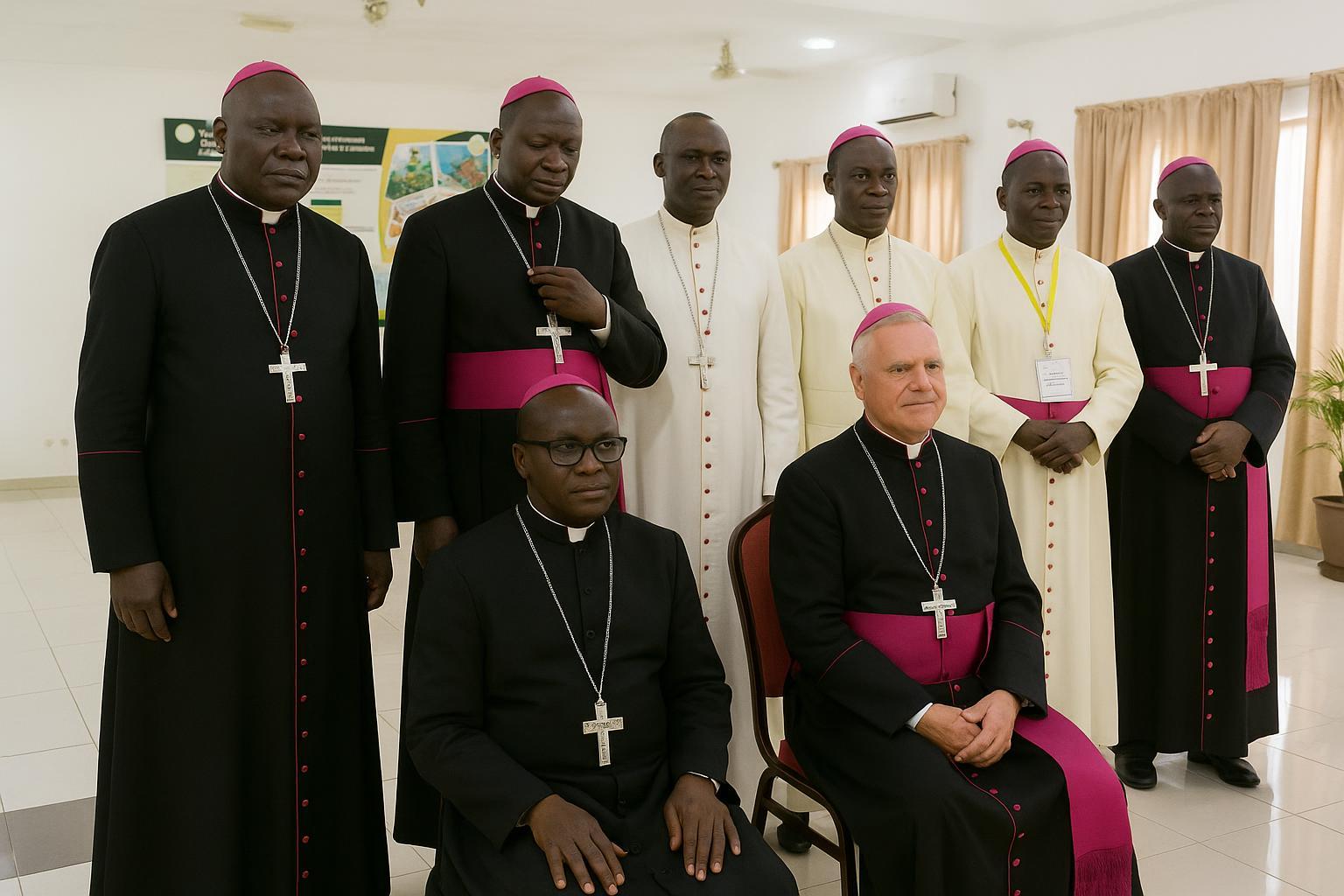
Recorded tirade jolts Catholic faithful
An audio file that surfaced on social media earlier this month has shaken Congo-Brazzaville’s Roman Catholic Church. The recording, attributed to a senior archbishop, contains disparaging remarks about another bishop and that bishop’s ethnic community.
Within hours, the clip spread across WhatsApp groups and community pages, prompting unusually frank conversations about prejudice, authority and transparency inside one of the country’s most trusted institutions.
Context of ethnic diversity in Congo
Congo-Brazzaville counts more than 70 linguistic communities, each proud of its heritage. Since independence, church leaders have often played a calming role, reminding believers that baptismal water is thicker than bloodlines.
Scholars like Professor Brice Okemba of Marien Ngouabi University note that ‘the Church mirrors national diversity; tribal fault lines inside parishes usually stay dormant because liturgy offers a shared language’.
Inside the leaked telephone call
In the controversial call, the archbishop reportedly labels his colleague an ‘imbecile’ and dismisses the colleague’s ethnic kin as ‘people of limited vision’. The archbishop has not publicly denied the tape, saying only that the conversation was private.
Two separate media outlets, La Semaine Africaine and Radio Magnificat, authenticated the voice using forensic software, though the archdiocese has not released its own analysis, citing ongoing internal review.
Canon lawyers say intent matters. ‘If the recording is genuine, the language violates both charity and the obligation to foster unity,’ argues Father Jean-Robert Boukaka, a doctoral student in Rome.
Bishops respond with collective penance
On 12 August 2025 the Episcopal Conference issued a three-page statement expressing ‘deep sorrow’ and asking the national flock for forgiveness. The apology, drafted in Brazzaville, avoided naming the archbishop directly, framing the episode as a collective failing.
The bishops also lamented the publication of private material, warning that ‘digital voyeurism’ can harm reputations and sow discord. Critics interpreted the caution as an attempt to shift blame toward whistle-blowers rather than address the underlying offense.
Interviewed by Les Dépêches de Brazzaville, conference spokesperson Bishop Firmin Massamba insisted the gesture was sincere. ‘Reconciliation begins with contrition; details of disciplinary action will follow canonical procedure,’ he said.
Canonical options under Vatican law
Church statutes grant an archbishop autonomy, yet they also empower Rome to intervene when unity is endangered. Possible measures range from a fraternal correction letter to removal from office, a path seen recently in cases elsewhere in Africa.
Sources close to the Apostolic Nunciature confirm that preliminary reports have been forwarded to the Dicastery for Bishops. A visiting Vatican envoy could be dispatched should local consultations stall.
Any punitive scenario would prioritize pastoral care, not retribution. ‘The goal is to heal, not to humiliate,’ explains Sister Béatrice Moukala, who has served on several Vatican investigative commissions.
Voices from parishes and seminaries
Lay leader Sylvia Ngatsé from Pointe-Noire says many believers feel ‘spiritually disoriented’ but still attend Mass. ‘We pray for our shepherds, yet we also expect honesty,’ she told this magazine.
In Brazzaville’s Saint-François seminary, lecturers have integrated the controversy into ethics seminars. Rector Father Pascal Ndinga believes future priests must learn that private speech is public in the smartphone era.
Community elders caution against politicizing the debate. ‘The Republic has enjoyed relative social peace. Escalating accusations could inflame regional sensitivities,’ warns sociologist Albert Ndoutoume, echoing calls for restraint from civil society.
Toward reconciliation and renewed trust
Observers suggest a listening tour across the affected diocese, combining liturgies of lament with town-hall dialogues. Similar approaches quelled tensions in Ghana’s Kumasi province in 2019 (CICI Africa Report).
The archbishop’s personal apology, should it come, would likely include a confession before clergy and laity, symbolic gestures of solidarity with the maligned community and financial support for intercultural catechesis projects.
For now, Sunday bells continue to ring. The faithful await not only disciplinary clarity but also a renewed proclamation of unity that resonates beyond cathedral walls, reminding the nation that words, like prayers, echo far and wide.