
Anniversary Address Highlights
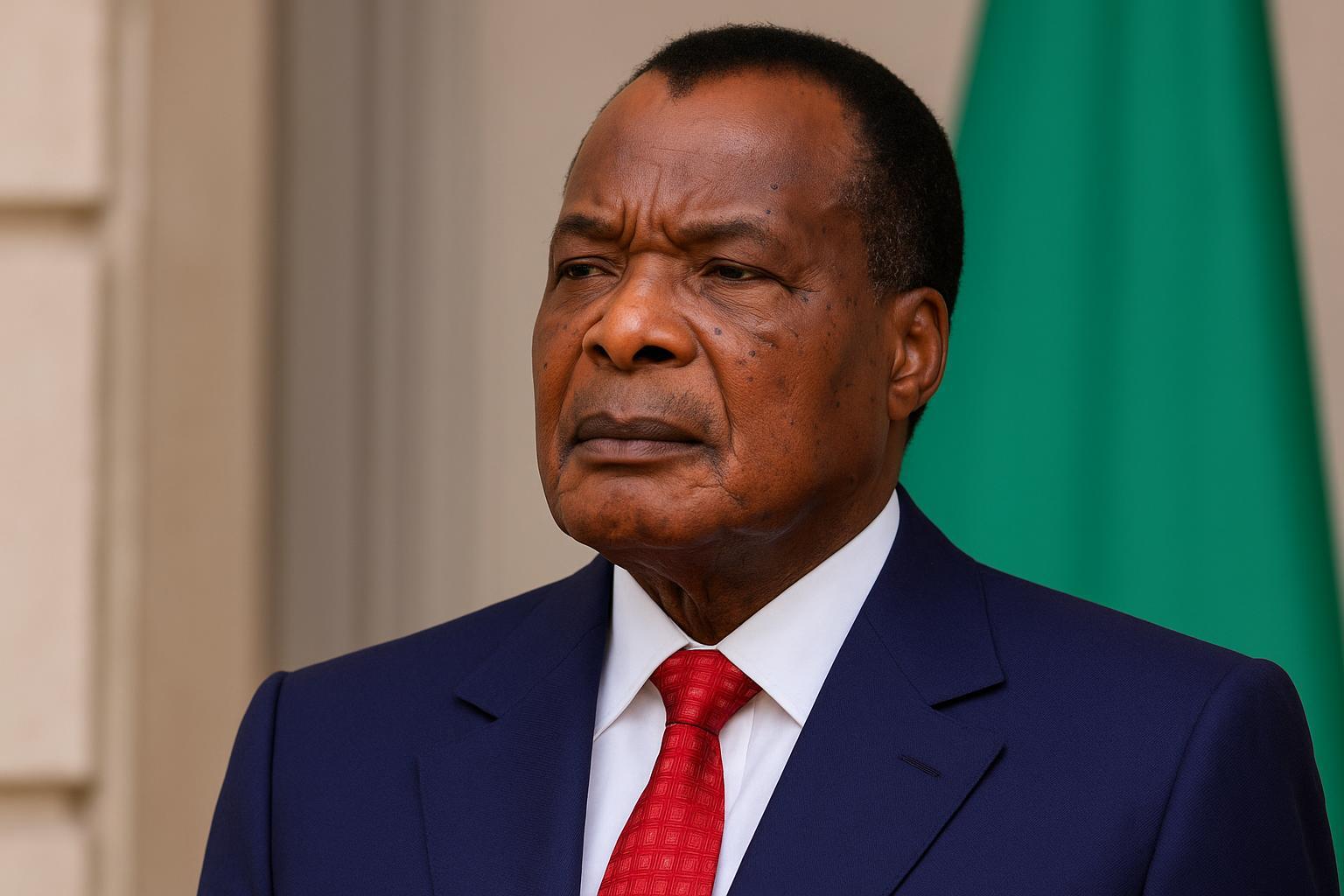
On 15 August, President Denis Sassou Nguesso marked Congo-Brazzaville’s sixty-fifth Independence Day with a televised address stressing that international turbulence “dangerously threatens peace” and prolongs economic strain on households. His words were delivered from the hall of the Palais du Peuple in Brazzaville (RFI, 15 Aug 2025).
He acknowledged what he called “hard-won stability” at home, yet warned that conflicts in Sudan, the Sahel and eastern Democratic Republic of Congo could spill over and undercut regional trade corridors vital to Congo’s post-oil diversification plan.
He framed the coming twelve months as a “window of collective responsibility”, urging legislators to finalise the national development strategy 2025-2030 and advance talks with the International Monetary Fund on a new extended credit facility intended to reinforce fiscal discipline and social investment.
Opposition Voices React
Destin Gavet, leader of the centre-left Republican Movement and declared presidential hopeful for March 2026, dismissed the address as “hollow optimism”, insisting that peace cannot be proclaimed while “families queue at dawn for subsidised bread and students drop out for lack of fees”.
He also questioned the president’s pledge to “revivify panafricanism”, recalling the March expulsion of Franco-Beninese activist Kemi Seba, who had planned a forum on the CFA franc in Brazzaville, an incident that sharpened debate over monetary sovereignty across Central Africa.
Veteran opposition figure Clément Miérassa echoed the critique, arguing that “the absence of gunfire is not peace if hospitals lack medicines”. He contended that public debt, now estimated at 88 percent of GDP, crowds out spending on rural clinics and micro-credit programs.
Ruling Majority Perspective
Paul Ganongo, a senior MP from the governing Congolese Labour Party, countered that the address was “lucid, not triumphalist”. Speaking by phone, he argued that without the security gains cemented since 2018, “no investor would contemplate rehabilitating the Pointe-Noire industrial zones”.
Government advisers further note that Congo climbed six positions in the 2024 Ibrahim Index for Safety and Rule of Law, a trend the president credits to community-level disarmament campaigns overseen by the High Commissioner for Reintegration in partnership with the African Union.
Regional Security Context
The president’s emphasis on conflict spill-over is not abstract. More than two thousand Congolese traders use South Sudanese routes monthly, according to the Central Africa Transport Observatory, and fighting near Malakal recently forced temporary closure of river ports essential for timber exports (Central Africa Transport Observatory, July 2025).
Brazzaville’s foreign ministry confirmed last week that it has doubled patrols along the Oubangui River after reports of arms trafficking linked to militias in neighbouring provinces of the Democratic Republic of Congo, underscoring what the minister called “shared incentives for vigilance”.
Economic Outlook and Reforms
Economists say talks with the IMF could yield an extended credit facility of roughly 450 million dollars. The Fund’s last Article IV review praised better debt transparency but pressed for quicker customs reform (IMF, May 2025).
Congo is pushing to diversify away from oil, which still supplies 70 percent of budget revenue. Officials cite the forthcoming Maloukou Special Economic Zone, set to host agro-processing plants powered by hydroelectricity from the Sounda dam project slated for completion in 2027.
To cushion households, the government has expanded the Lisungi cash-transfer scheme to 215,000 beneficiaries, up from 60,000 in 2020, according to social affairs minister Irène Mboukou. World Bank data suggest the program reduced extreme poverty in targeted districts by five percentage points (World Bank, 2024).
Looking Ahead to 2026 Vote
Intrigue nevertheless surrounds the 2026 ballot. The president, in power for a combined thirty-nine years, made no mention of personal political plans, contenting himself with a call for “serene institutions”. His silence has fuelled speculation inside party corridors and diplomatic lounges alike.
Analysts at consulting firm NKC Africa believe the Labour Party will not rush to declare a flag-bearer, given that early announcements could trigger factional rivalry. Possible heirs cited include Senate President Pierre Ngolo and Finance Minister Ingrid Olga Ghislaine Ebouka-Babackas.
The African Union’s Electoral Assistance Unit has already dispatched a pre-assessment mission to Brazzaville. A senior diplomat involved in the visit said the body “expects a competitive, peaceful process” and noted that Congo’s electoral code was amended last year to include biometric voter rolls.
Public Mood and Media
In the hours following the speech, Congolese social media lit up with hashtags #PaixDurable and #VieChère. Data monitoring firm Ejo Analytics counted 78,000 posts, half supporting the president’s cautionary tone and half urging faster reforms, evidence of a polity engaged yet divided.
As celebrations ended with fireworks over the Congo River, the nation sat at a crossroads: proud of calm, anxious over prices, alert to regional storms. Whether that tension brings policy consensus remains uncertain.