
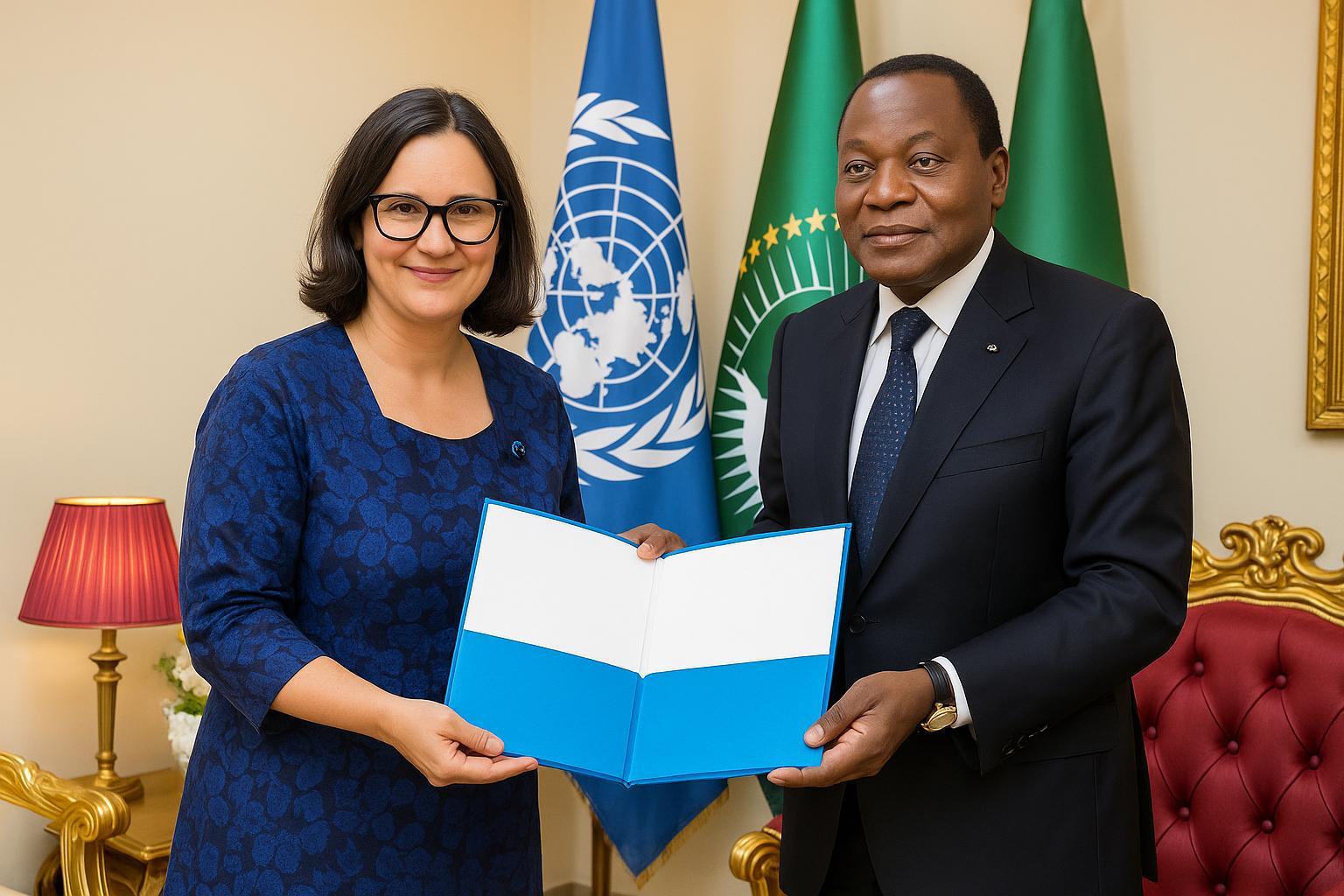
Diplomatic Handover in Brazzaville
The colourful reception hall of the Ministry of Foreign Affairs in Brazzaville briefly turned into a tableau of protocol as Mariavittoria Ballotta handed her accreditation letter to Minister Jean-Claude Gakosso, cementing her status as UNICEF Representative in the Republic of Congo after the tenure of Chantal Umutoni.
The carefully choreographed ceremony signalled continuity in a partnership that, since 1977, has brought immunisation campaigns, classroom rehabilitation and emergency nutrition to some of the most remote districts of the country, often in coordination with line ministries and decentralised prefectures that rely on UNICEF’s logistical backbone.
Seasoned Expertise from Dakar to Brazzaville
Ballotta arrives from the West and Central Africa Regional Office in Dakar, where she steered programme design across 24 nations and managed a portfolio surpassing 900 million dollars, according to internal budget briefs shared with partners early this year.
Fluent in Italian, French and English, the diplomat previously headed planning in Mozambique and served as chief of education in Myanmar, giving her a perspective that blends humanitarian urgency with long-term system reform, former colleagues at UNICEF New York said in background conversations.
Government–UNICEF Synergy on Child Rights
Congolese authorities, for their part, insist the new appointment will deepen an already robust framework of cooperation embedded in the National Development Plan 2022-2026, which earmarks nearly 12 percent of public spending for social sectors, a figure applauded by several Bretton Woods observers.
Minister Gakosso, addressing reporters after the ceremony, called UNICEF ‘a strategic ally in making the rights of every Congolese child tangible, from Impfondo to Pointe-Noire’, adding that Brazzaville would ‘maintain an open channel’ for policy dialogue under Ballotta’s stewardship.
Key Priorities: Health, Education and Protection
Insiders familiar with the incoming representative’s briefing note list three immediate priorities: closing the remaining gaps in routine vaccination, supporting the national rollout of competency-based curricula, and boosting birth registration rates that currently hover around 75 percent, according to the latest Multiple Indicator Cluster Survey.
Ballotta is expected to champion integrated child survival packages, whereby community health workers deliver micronutrient supplements and malaria nets alongside vaccination cards, a model piloted last year in Plateaux Department that reduced stock-outs by 30 percent, UNICEF supply chain officers told this magazine.
Mobilising Resources in a Changing Landscape
Securing predictable funding remains a tall order amid competing global crises, yet Congo’s relatively stable macroeconomic outlook could unlock innovative finance, including results-based grants and diaspora bonds currently under study at the Ministry of Economy, officials familiar with the file confirmed.
Ballotta told colleagues during an internal town-hall that she would ‘leverage every euro’ by aligning corporate donors with Congolese flagship initiatives such as President Denis Sassou Nguesso’s Education for All programme, thereby reinforcing national ownership while diversifying UNICEF’s traditional funding basket.
Voices from the Field
In Mindouli, school director Henriette Ondongo credits UNICEF-supplied textbooks for a 12-point jump in literacy scores across her third-grade cohort, saying the challenge now lies in ‘scaling teacher training so that content reaches the child, not just the shelf’.
Dr. René Moungli, paediatric chief at Makélékélé Hospital, notes that oxygen concentrators donated under the previous country programme reduced neonatal fatalities by a fifth, underscoring what he calls ‘the silent dividends of steady cooperation’ often overshadowed by headline emergencies.
Charting the Path Forward
Analysts at the Economic Commission for Africa argue that demographic trends, with 60 percent of Congolese under 25, will test the capacity of social services, making UNICEF’s upstream policy advice as crucial as its downstream deliveries, particularly in urban peripheries experiencing rapid inflows.
Ballotta has hinted at expanding digital learning platforms, building on the Ministry of Primary Education’s e-school pilot that now streams math lessons to 5,000 pupils via solar-powered tablets, a project observers say could become a regional showcase if connectivity costs continue to decline.
For now, the official posture in Brazzaville is one of cautious optimism: results matter, but so does alignment with national plans. By foregrounding evidence and partnerships, Ballotta appears set to navigate the fine diplomatic balance that has long defined UNICEF operations in Congo.
Her mandate runs through 2026, coinciding with global stocktaking on the Sustainable Development Goals. Stakeholders will watch whether the fresh leadership can sustain the momentum that placed Congo among the top five Central African countries for measles coverage last year, according to WHO dashboards.
Regional Implications
Observers in neighbouring Gabon and Cameroon describe Ballotta’s move as a signal that Brazzaville could host more sub-regional dialogues on child protection, an area where trans-border trafficking and migration patterns demand coordinated protocols that go beyond bilateral agreements, according to the Central African Economic and Monetary Community.
Such engagement would complement Congo’s current chairmanship of the International Conference on the Great Lakes Region, giving the country additional diplomatic leverage while advancing UNICEF’s mandate in zones where displacement and climate shocks threaten to erode hard-won gains in vaccination, schooling and adolescent empowerment programmes.