
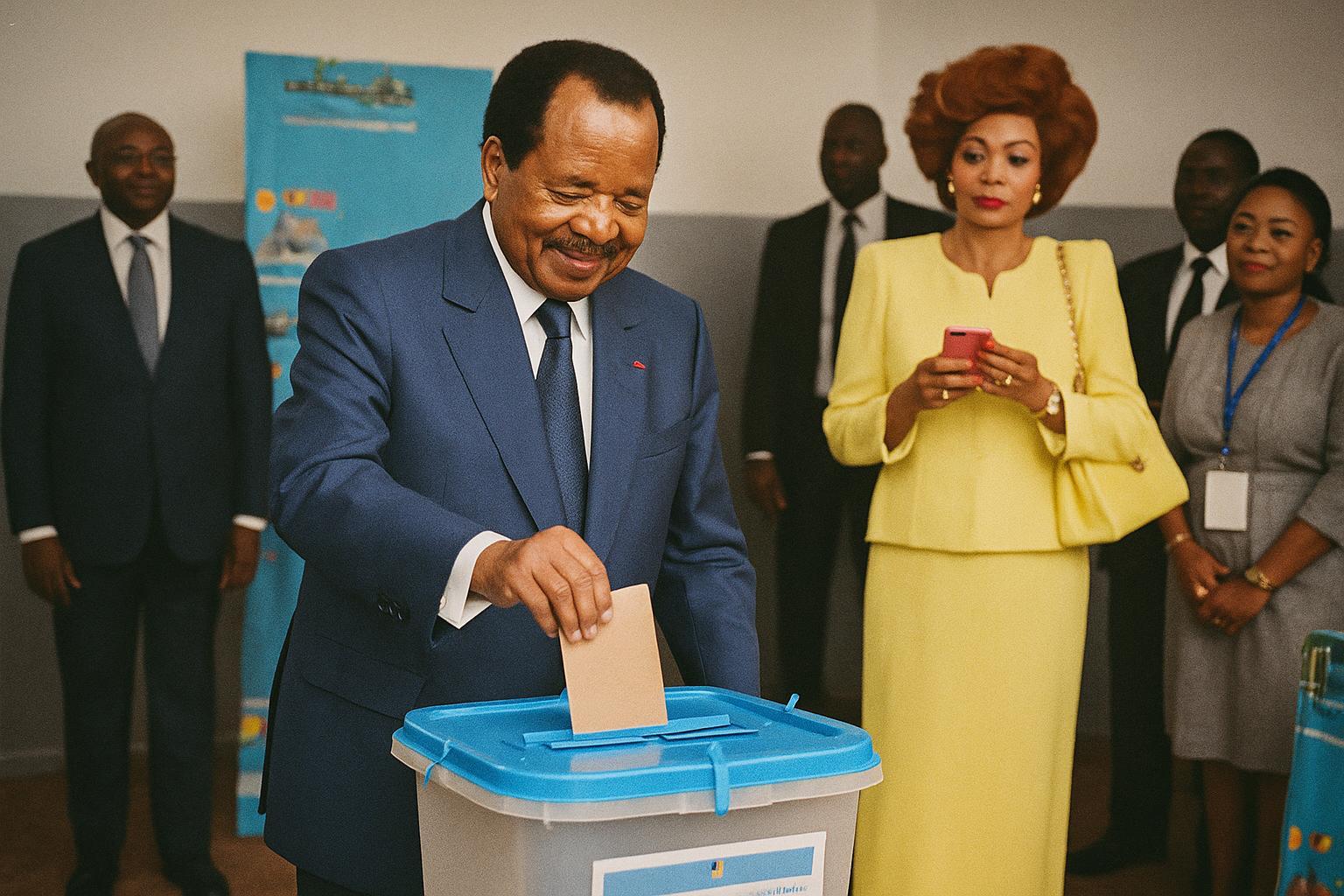
Biya Turns 91, Clock Ticks in Yaoundé
Unless fate intervenes, President Paul Biya will blow out 91 candles next February, capping more than four decades in Cameroon’s Unity Palace. No other francophone leader has equaled that tenure, and few students of Central Africa doubt the symbolism.
‘Time appears suspended in Yaoundé,’ says French analyst Olivier Vallée, contacted by phone, ‘yet the clock ticks louder after every regional coup.’ Elections are officially slated for October 2025, but insiders read each cabinet reshuffle as a rehearsal for succession.
Security Flashpoints Intensify Pressure
Cameroon now fights on two violent fronts. In the Far North, cells linked to Boko Haram raid villages along Lake Chad. Southwest and Northwest regions remain gripped by the Anglophone self-styled Ambazonian rebellion, which has severed key highways and displaced half a million citizens.
Rapid Intervention Battalions, the elite BIR, receive Israeli tactical tutoring and superior salaries. Their loyalty has discouraged coup talk, but human-rights monitors such as Amnesty International note that robust firepower has not ended kidnappings, roadblocks or the flow of weapons from Nigeria.
Economic Weight Anchors Regional Hopes
Despite insecurity, the International Monetary Fund last month projected 4.2 percent growth, driven by oil, liquefied gas, bauxite and an expanding agro-industry. Cameroon still supplies nearly 60 percent of CEMAC’s gross domestic product, making its stability a shared commercial priority.
Local conglomerates—from the Fotso family’s banking interests to Sud-Cam’s timber concessions—blend with French cacao exporter Compagnie Fruitière and rising Chinese logging firms. Observers say these networks provide Biya with revenue buffers and, equally important, an urban middle class disinclined to revolutionary upheaval.
Family, Party and the Succession Puzzle
Under the 2008 constitutional revision, Biya may legally seek yet another seven-year term. The mere option complicates jockeying inside the governing Cameroon People’s Democratic Movement, or RDPC, where senior ministers still begin speeches with praise for ‘Le Renard’, the Fox.
First Lady Chantal Biya, celebrated for her gravity-defying coiffure and charity galas, retains influence over youth and women’s wings. Diplomats note her Evangelical networks in Yaoundé and Paris, yet point to one hurdle: she hails from the East, not the Beti heartland.
Their son, Franck Biya, a discreet business executive in logging and insurance, has increased public appearances, attending June’s national youth forum and appearing beside defence chiefs. Supporters brand him ‘Plan B’. Skeptics recall Gabon’s recent dynastic upset and advise caution.
‘Cameroon’s elite fears a vacuum more than continuity,’ remarks Richard Moncrieff of International Crisis Group, noting that fragmented opposition parties lack a single flagbearer since Maurice Kamto’s imprisonment in 2020. For now, the race resembles a chessboard waiting for the king’s move.
Army Morale and the BIR Wildcard
The regular army enjoys subsidised rice, subsidised fuel and new Chinese-built barracks. Officers interviewed anonymously in Douala emphasise professional perks over politics, a contrast with Sahelian counterparts angered by budget arrears before staging coups in Mali, Guinea and Niger.
Yet the BIR’s colonels are younger, media-savvy and trained abroad. Analysts in the Baker Institute warn that a spark—perhaps an unpopular arrest or contested primary—could tempt them to arbitrate power, echoing Chad’s transition after Idriss Déby’s death in 2021.
CEMAC Stakeholders Watch Closely
Across the River Ntem, Brazzaville’s advisers monitor Yaoundé closely. Congo’s President Denis Sassou Nguesso, dean of the sub-region, has publicly praised Biya’s experience while privately encouraging CEMAC finance ministers to plan for ‘any market shocks that might ripple from Cameroon.’
Economists at the Bank of Central African States estimate that a prolonged succession crisis could shave one percentage point off collective growth, complicating plans for an energy interconnection grid linking Libreville, Brazzaville and Yaoundé. Investors crave calm more than new faces.
External Powers Balance Influence
France, the European Union and the United States maintain a pragmatic consensus: support counter-terrorism, nudge governance reforms and avoid destabilising headlines. Washington renewed military training grants in May while repeating calls for dialogue with Anglophone leaders detained since 2018.
China buys 46 percent of Cameroon’s crude and bankrolls deep-sea ports in Kribi and Limbe. Russia, meanwhile, multiplied security consultations after signing a defence accord in April, raising eyebrows in Paris. Israeli contractors retain niche influence through surveillance software and drone sales.
Diplomatic Scenarios and Local Pragmatism
Several scenarios circulate in diplomatic lounges: a carefully choreographed RDPC congress anointing Franck Biya; a constitutional council elevating Senate president Marcel Niat; or a national unity ticket pairing an Anglophone technocrat with a Beti general. Each path contains known and unknown risks.
‘Do not underestimate Cameroonian pragmatism,’ cautions a senior CEMAC official, requesting anonymity. ‘The system survived devaluation in 1994 and oil shocks in 2015. It will not implode overnight—it will bargain.’ Most observers believe external mediation, not force, will shape the countdown.
Waiting for Dawn in Central Africa
For now, markets trade, cocoa is shipped, and sermons fill the air of Yaoundé’s basilicas. Yet every chauffeur in the capital repeats the same proverb: ‘Even the longest night ends at dawn.’ Cameroon’s dawn, whenever it comes, will matter beyond its borders.