
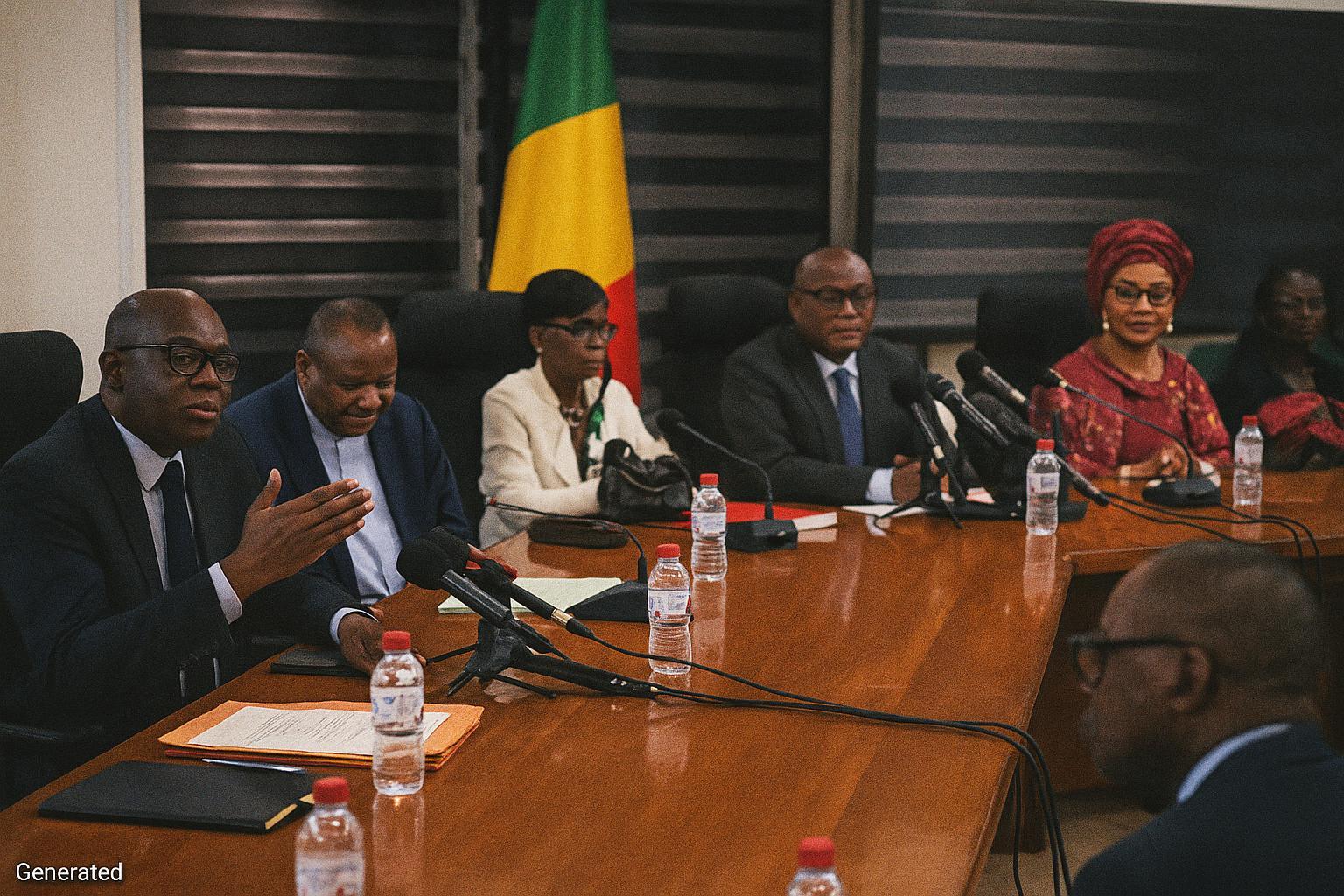
Second 2025 Prep Session Reunites Key Players
In a humid Thursday morning of late July, the stately white-and-green building of the Ministry of Finance on avenue Amilcar Cabral filled up early. Ministers, oil executives and civil-society observers squeezed past television crews for the second annual sitting of the National Committee of the Extractive Industries Transparency Initiative, ITIE in its French initials. The agenda sounded straightforward: polish the 2024 national report and plot the sprint toward international validation slated for next year. But on such documents, every figure and every footnote counts.
Christian Yoka, the recently appointed Finance Minister and chair of the committee, set the tone. “Our economy needs revenues that citizens can see and trust,” he told attendees, repeating the government’s pledge made at the Global ITIE Conference in Dakar last year (ITIE.org). “Validation is not a trophy; it is a contract with our people.” Beside him sat Forestry Minister Rosalie Matondo and Environment Minister Arlette Soudan-Nonault, proof that the transparency agenda now stretches beyond crude oil into timber, gold and future rare-earth prospects.
Reforms That Move Numbers, Not Only Words
Since 2023 the Treasury has run its oil-revenue tracking platform on an open-source interface supported by the World Bank (World Bank 2024 brief). Companies submit production data electronically, and the Tax Directorate compares it with customs and port manifests in near real time. The finance team says discrepancies over 2 percent now trigger automatic alerts, a leap forward from the paper-heavy workflow of the past decade.
Parliament last December passed the new Hydrocarbon Revenue Management Code, capping advance payments from partners and assigning a fixed share of royalties to a sovereign infrastructure fund. Independent analyst Thèrèse Ngoma, who attended Thursday’s session, cautioned that the rules “still need robust auditing on the ground,” yet conceded that the code “finally gives clear deadlines and penalties.”
Companies, Greens and Unions Find Shared Table
Seated at the back row, a Chevron delegate whispered that electronic reconciliation cut his filing time by half. For timber exporter Congo De Bois, finance chief Emmanuel Massamba said the bigger change is cultural: “We used to talk only to our line ministry. Now we face civil-society groups reading the same tables we read.”
Climate campaigner Victor Tchicaya of the NGO Rencontre pour la Paix et les Droits de l’Homme credits the committee’s inclusive design. “We get the draft report earlier, not two days before publication,” he smiled, admitting debates remain “heated but productive.” The ITIE International Secretariat’s country brief for Congo notes the same progress, ranking stakeholder engagement “meaningful” in its 2023 scorecard.
Tight Calendar Toward the 2025 Verdict
Under global ITIE rules, Brazzaville must lodge its 2024 report no later than December 31, 2025. The national secretariat, led by engineer Florent Michel Okoko, has split the remaining months into weekly milestones. His small team wants data collection wrapped by February, external audit sign-off by May and public release before Independence Day in August. Okoko admits the timeline is “ambitious but doable” if sub-commissions, especially the one on state-owned SNPC, file their worksheets promptly.
The committee candidly addressed hiccups. Several provincial mining services lack stable internet, slowing uploads. To bridge the gap, the Telecoms Ministry promised portable hotspots and joint training missions starting in September. Observers considered the pledge critical, given the surge in semi-mechanised gold operations near Sangha.
Why Validation Matters for Everyday Wallets
The stakes reach far beyond the auditor’s spreadsheet. According to IMF estimates, extractives generate roughly half of Congo’s fiscal revenue. A clean bill from ITIE can strengthen investor confidence just as Brazzaville negotiates fresh concessional loans for road corridors and school programmes. Credit-rating agency Fitch already mentioned “ongoing governance upgrades” when it upgraded the outlook on sovereign bonds to stable in March.
Business chamber head Michel Nkouka summed it up: “Transparency lowers our risk premium; that means cheaper credit and more local jobs.” For teachers like Mireille Mabiala, interviewed outside the Finance building, the linkage feels direct. “If oil money reaches classrooms, validation day will be payday for us.”
Steady Steps, Open Books
As the microphones switched off and participants filtered into the sticky Brazzaville afternoon, one takeaway stood out: the process is less about ticking boxes and more about institutional habit. Congo-Brazzaville, which became an ITIE member in 2012 and achieved compliance status once before, now seeks to entrench transparency as routine statecraft. The coming months will test databases, broadband cables and political patience alike, yet the tone in the room suggested a shared resolve.
For a country whose growth prospects still hinge on subsoil wealth, opening the ledgers remains the surest path to shared prosperity. The next figures will tell their own story, but for now Brazzaville’s calculators keep clicking.