
Owando Hospital Turns 50 With a Healing Marathon
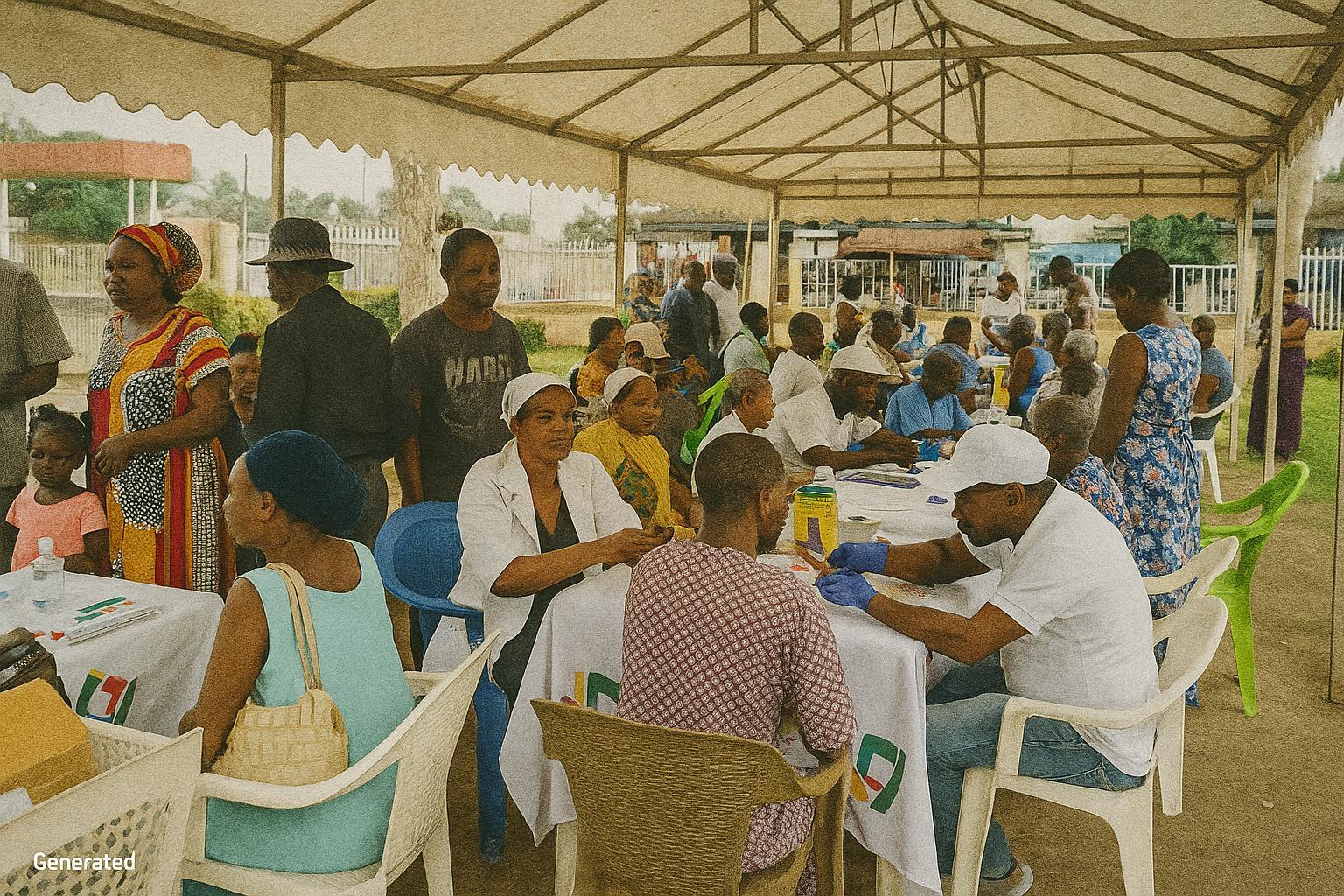
Anyone walking past the 31-July General Hospital this week can hear the buzz before seeing the queue. Since 23 July the compound in Owando, capital of the northern Cuvette department, has hosted “Operation Health Punch”, a ten-day burst of entirely free medical care. The timing is symbolic: the hospital celebrates its fiftieth birthday, and organisers want the anniversary to feel less like a speech and more like a service. In a country where the World Health Organization estimates that two out of five rural residents postpone treatment for cost reasons, the gesture has instant resonance.
The brain behind the drive is Dynamique Owando Pluriel, a civic platform loosely grouped around local deputy Joël Abel Owassa. With technical clearance from the Ministry of Health and Population and logistical help from the municipal council, DOP asked doctors from Brazzaville, Pointe-Noire, Paris and Dunkirk to join local teams. According to a ministry communiqué released on 24 July, 58 practitioners answered the call: internists, cardiologists, nephrologists, gynaecologists, surgeons and laboratory technicians.
Their white coats carry the slogan “All Owando United for Better Prospects”. The stated aim is simple—nobody leaves the courtyard without being seen, diagnosed and, if necessary, referred to a specialist table or the improvised theatre built in the paediatric wing.
Doctors On The Move: From Brazzaville to the Cuvette
By late afternoon the registration tent resembles a departure hall. Patients come with ailments that mirror national statistics: malaria that lingered too long, hypertension aggravated by salt-heavy diets, diabetes spotted only when eyesight falters. By the campaign’s midpoint the head of laboratory services, Dr Boris Mvouba, told Radio Congo that 1,400 blood sugar tests and 600 complete blood counts had already been processed.
Surgical teams have been equally busy. Dr Marion Le Roy, a Franco-Congolese surgeon on sabbatical from Lyon’s Croix-Rousse Hospital, reported twenty appendectomies, thirteen hernia repairs and three emergency C-sections completed without a single referral to Brazzaville. “The infrastructure is basic, yet the staff are nimble,” she noted, praising theatre nurses borrowed from nearby Etoumbi and Makoua.
Ultrasound services, often out of reach for villagers, are offered under the neem tree in the back yard. Solar panels installed last year through a public-private partnership power the machines. “A clean image gives us half the cure,” quipped Dr Lucie Mavoungou, waving patients onto the improvised examination couch fashioned from a school bench.
Patients Speak: From Doubt to Relief
Early scepticism gave way to relief as word spread that prescriptions were indeed free. Viviane Okouala, 27, arrived whispering of a persistent pelvic pain. She left clutching an ultrasound print-out showing a treatable ovarian cyst and an appointment card for follow-up in October. “I was afraid of the bill,” she confessed, “but the only payment here is patience in the queue.”
Jean-Pierre Issongué from Mbomo underwent a long-awaited hernia surgery on day three. He now paces the recovery ward, joking with nurses. “My family saved for four years for this operation,” he says, “and in the end the State and these doctors gave it as a birthday gift.” Testimonials like his dot local radio phone-ins and fuel social media threads that, unusually, centre on good news.
Monsignor Victor Abagna Mossa, archbishop of Owando, made an unannounced visit, sat for a blood pressure check, then told reporters that “healing the body often precedes healing society”. Community elders echo the sentiment and are already asking whether the model can be replicated at planting season, when money is tight and travel harder.
Political Backing and National Vision
Parliamentarians have seized the moment to align with President Denis Sassou Nguesso’s stated vision of universal health access. Christian Ernest Makosso, deputy for Tchiamba Nzassi, described the campaign as “textbook implementation of the Head of State’s directive: without health, nothing moves.” His colleague Yacine Koumba promised to transpose the concept to her Banda constituency, while Blaise Ambeto of Ngoko framed the venture as “the people’s dividend from stability”.
Coordination by Deputy Owassa appears meticulous: entry flows separated from emergency tracks, and a paper-light record system mirrored on tablets donated by a telecom group. Observers from the Health Ministry’s planning unit are present, gathering data that could feed into the National Health Development Plan 2023-2027.
Dr Dominique Obissi, the hospital’s director general, calls the effort “a living pilot of what targeted free care can do: relieve pain, extend life expectancy, and thereby enlarge the workforce that powers the national development plan”. His remarks echo recent statements by Finance Minister Ingrid Olivia Ebouka-Babackas that health spend is an investment, not an expense.
Beyond the Ten-Day Blitz: What Comes Next
Ten days of benevolence do not overhaul a health system, critics caution. Still, the campaign plants seeds. Prefect Berthe Bassinga Nganzali, speaking beside a mound of boxed syringes donated by the Congolese Red Cross, advocated for a permanent specialist rota and a larger cold chain for vaccines. The prefect’s office has already earmarked a section of the 2025 departmental budget for equipment upgrades.
International partners watch with interest. A senior analyst at the African Development Bank, reached by phone, said the initiative could qualify for the Bank’s Results-Based Financing window if outcomes are tracked for six months. The French Medical Alliance, whose volunteers are present, hinted at return missions focusing on renal care, a rising burden along the Alima River.
For now, what matters to parents like Elodie Ngondzi is that her feverish toddler finally received a laboratory-confirmed malaria diagnosis and the right dose of artemisinin. As she bundled the child onto her back she summed up the prevailing mood: “When doctors come to you, hope comes too.” That sentiment, repeated in hushed gratitude across the courtyard, may well outlast the final suture and the last clap of the closing ceremony.