
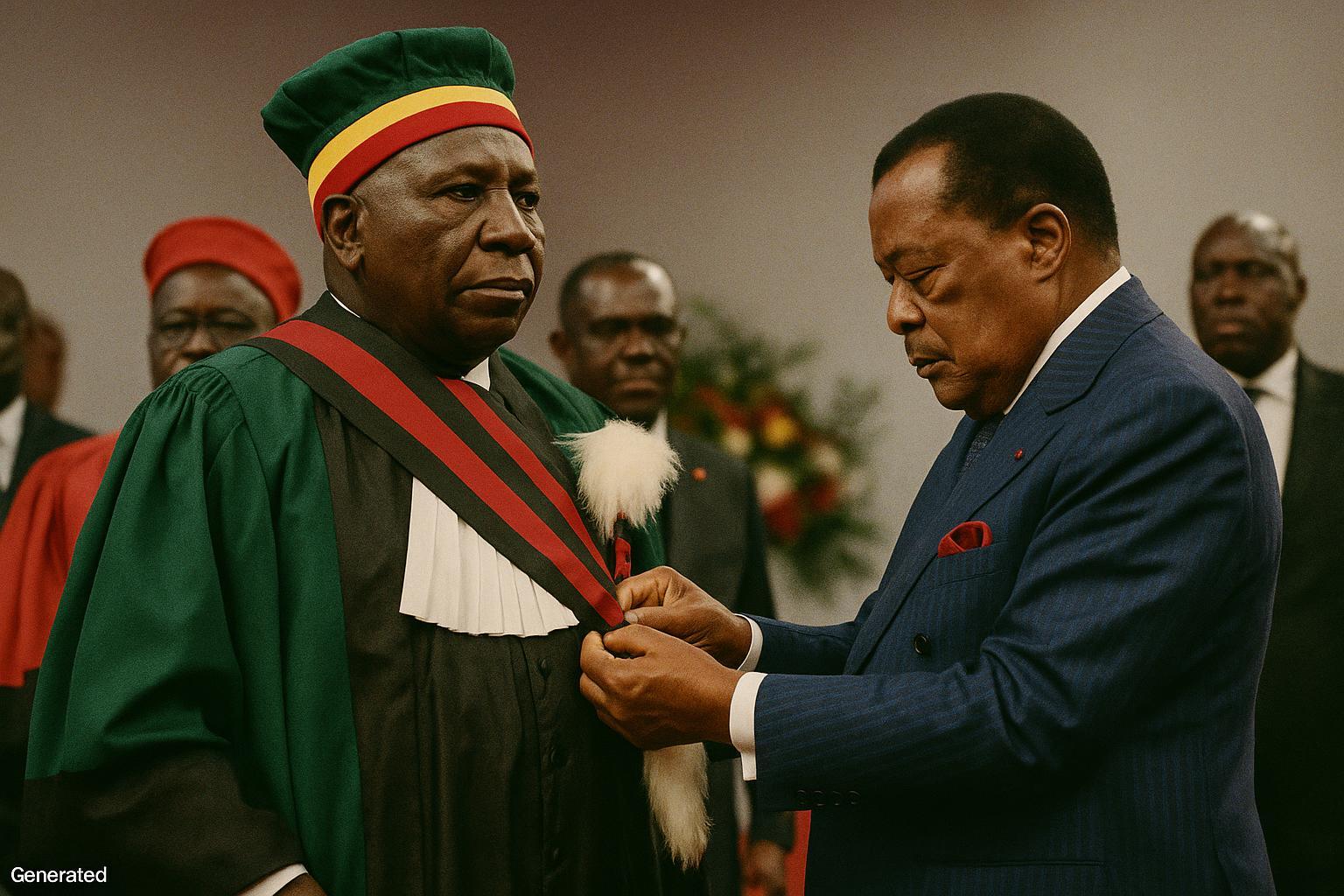
A Medal in the Heart of Brazzaville
July afternoons in Brazzaville can be slow, yet the Palace of Congress suddenly buzzed on the 25th. Cameras clicked, diplomats adjusted their pocket squares, and the presidential orchestra rehearsed a last trumpet note. Then President Denis Sassou Nguesso strode in to pin the scarlet and gold badge of Grand-Croix on Professor Théophile Obenga, the most senior grade in the Order of Merit. The decree, read by Grand Chancellor Colonel Norbert Okiokotina, called the ceremony “exceptional,” a word that hardly seemed exaggerated to anyone who has skimmed even one footnote of Obenga’s fifty-odd books.
Why This Honor Matters Now
Decorations are never random in Congo’s political calendar. Coming midway between last year’s creation of Denis Sassou Nguesso University and next month’s African Union education forum, the event signals that Brazzaville is doubling down on brains over barrels. Government advisers quietly stress that naming Obenga—a man who has lectured from Dakar to Stanford—as Grand-Croix reassures potential partners that Congo is serious about developing an academic hub in Central Africa. One senior aide whispered that “professors inspire investors faster than pipelines do,” a line later repeated with a smile by foreign envoys in the reception hall.
Profile of a Pan-African Bookworm
Born in 1936 in Mbaya, a village hugging the Likouala forests, Théophile Obenga boarded his first plane in the 1960s with a suitcase full of French grammar books. Six decades later he is quoted in UNESCO position papers and praised by Egyptology circles from Paris to Cairo (UNESCO archives, 2004). Linguistics, philosophy, history, archaeology—Obenga rarely chose between them, preferring to stitch them together in what he calls “the fabric of African consciousness.” Scholars often point to his 1973 monograph on Bantu proto-languages as the moment Africa’s linguistic map tilted toward homegrown research (Jeune Afrique, 2019).
From Village School to Global Lecture Halls
Obenga’s rise mirrors Congo’s own post-independence trajectory: hopeful, turbulent, finally looking outward again. He steered the University of Brazzaville in the 1970s, debated Cheikh Anta Diop in Dakar, and later served as Congo’s Minister of Culture before moving to the United States for visiting chairs. His return as personal representative of the President for higher education sealed his reputation at home. Colleagues recall him arriving at dawn to inspect the foundations of the new Denis Sassou Nguesso University campus, notebook in hand, beret tilted, asking whether the library windows allowed “enough light for stubborn students.”
Signal to Young Congolese Minds
In her remarks, Higher Education Minister Delphine Edith Emmanuel called the distinction a “republican ritual” that pushes youth toward discipline, rigor and patriotism. Those words may sound ceremonial, yet the message is practical. Nearly half of Congo’s population is under twenty-five, and graduate unemployment remains a headache despite recent growth in timber and telecom. Officials hope that seeing a scholar applauded like a football star will nudge teenagers toward research labs instead of departure lounges. Outside the hall, a group of university students held handmade banners reading “Brains can feed nations.”
Soft Power Wrapped in Academic Robes
Regional analysts note that Congo’s neighbors are also courting intellectuals. Cameroon invited Nobel laureate Roger Kornberg to Yaoundé last year, while Gabon opened its African Heritage School in Libreville. Brazzaville’s Grand-Croix for Obenga therefore positions Congo in a subtle race for cultural leadership. A Western diplomat described the move as “soft power on velvet,” adding that partnerships announced in the margins of the ceremony include a joint archaeology field school with South Sudan and a digital linguistics archive funded by the European Union (AfricaNews, 2023).
A Thank-You Wrapped in Philosophy
When his moment at the microphone came, the professor ditched prepared remarks, preferring a slow, almost musical reflection. “Celebrate a life, yes,” he murmured, “but above all celebrate knowledge that heals our collective memory.” He dedicated the medal to “the awakened youth of the African continent” before presenting the President with a limited edition of his latest book on Nubian hieroglyphs. The gesture drew a standing ovation, not merely for the gift but for the hint that scholarship can still be elegant, even in a news cycle obsessed with speed.
After the Applause, the Homework
Medals shine brightly but briefly. The real test, officials concede, lies in translating Obenga’s aura into concrete programs: funding doctoral grants, finishing the laboratory wing at the new university, securing visas for visiting fellows. Sources at the Ministry of Finance say a line item for twenty new research chairs will appear in the draft 2024 budget. If that happens, yesterday’s fanfare might turn into tomorrow’s laboratories. In the words of an elder senator sipping palm wine at the reception, “A nation builds its walls in stone, but its future in classrooms.”
Echoes Beyond the Red Carpet
As dusk settled over the Congo River, delegates filed out, some comparing the day to famous 1970s ceremonies honoring poet Tchicaya U Tam’si. Yet this time the spotlight fell on an academic, hinting at a broader shift in how the state defines heroism. By elevating Théophile Obenga, President Sassou Nguesso not only saluted personal brilliance but also placed a quiet bet on the power of ideas to steady a region often rattled by commodity swings and geopolitical gusts. Many in the crowd left convinced that, for once, an honorary sash might weigh more than a pipeline contract.