
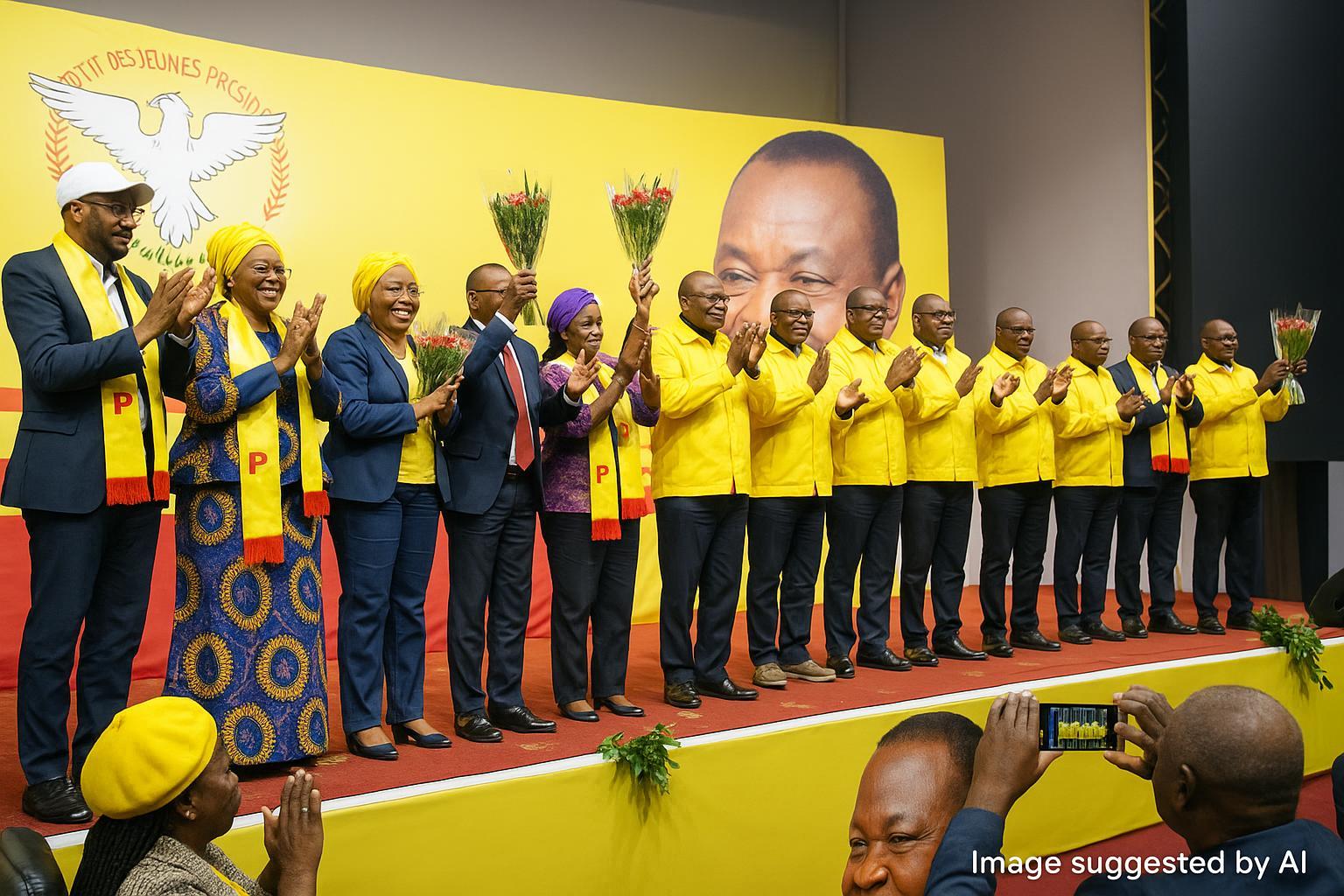
MJP Rally in Brazzaville
Chants rippled across the covered courtyard of the Palais des congrès in Brazzaville as the Presidential Youth Movement, better known by its French initials MJP, closed its maiden structural congress on 13 August, drawing delegates from the republic’s fifteen departments and a small but vocal diaspora faction from France.
The three-day gathering ended with a unanimous motion urging President Denis Sassou Nguesso to declare for the March 2026 election, pledging what the communiqué called a “total and unwavering” mobilisation behind the long-serving leader and promising to campaign, in its words, “tambour battant”.
Founded in November 2020, the movement has styled itself as the youthful engine of the presidential majority, promoting peace, civic responsibility and social justice, while carefully aligning its rhetoric with the government’s emphasis on stability and gradual reform (Les Dépêches de Brazzaville, 14 August 2023).
Renewed Youth Leadership
Inside the packed hall, delegates reshaped the party’s organs, expanding the central committee to 201 members and slimming the secretariat to a dozen technocrats tasked with daily coordination; every mandate, from the control commission to the political bureau, was fixed for five years to match the constitutional cycle.
Donald Mobobola, re-elected national coordinator by acclamation, used his closing address to warn against “instrumentalisation” of young voters, insisting that Congolese youth must be seen, not merely as an electoral reservoir, but as a partner in nation-building alongside the head of state.
Observers noted that the generational message dovetails with the administration’s ongoing National Development Plan, which earmarks forty percent of public investment for education, digital literacy and youth entrepreneurship over the 2022-2026 window (Ministry of Planning data, 2023).
Policy Messages to Electorate
Beyond choreography, the congress showcased policy talking points likely to anchor the 2026 campaign narrative: continued fiscal consolidation after the 2022 IMF agreement, an acceleration of the fibre-optic backbone to cut data costs, and targeted incentives for agro-processing corridors in Pool and Cuvette.
Finance Ministry officials, contacted after the event, said the deficit narrowed to 1.7 percent of GDP in 2023, giving room for what one adviser called “social dividends”. Those figures broadly match the IMF Article IV review published in January 2024.
Energy access, another recurrent theme, has advanced quietly: national electrification rose from 70 to 75 percent between 2021 and 2023, according to the regional power pool, easing pressure on urban youth frustrated by outages during the previous electoral season.
Regional and Diplomatic Echoes
Neighbouring capitals watched the Brazzaville rally closely; analysts in Kinshasa and Libreville said a strong youth turnout could bolster Congo’s negotiating clout on transboundary projects such as the Kinshasa-Brazzaville bridge or the Inga hydropower interconnection (Africa Report, February 2024).
Diplomats from the European Union, present as observers, privately welcomed the orderly nature of the congress, stressing that predictable political calendars help sustain investor confidence in the Gulf of Guinea sub-region, now grappling with volatility after recent changes of power in Gabon and Niger.
Chinese media outlets highlighted the MJP’s praise for the first phase of the Special Economic Zone in Pointe-Noire, a project financed under the Belt and Road framework, interpreting the endorsement as a signal of policy continuity beyond 2026.
Road to March 2026
Though the president has not yet declared, insiders at the Congolese Labour Party headquarters say a decision could arrive after the next ordinary session of parliament, once the 2025 budget—centred on youth employment—has cleared both chambers.
In the meantime, the MJP intends to roll out civic education caravans across rural districts, pairing voter registration drives with entrepreneurship workshops, a tactic mirroring its 2021 push that lifted turnout in hard-to-reach Sangha villages by double digits, according to the electoral commission.
Political scientist Alain Ikounga argues that early mobilisation offers the ruling coalition a head start but also raises expectations among first-time voters, who will demand tangible progress on job creation and environmental safeguards in oil-producing zones.
Economists caution that global oil price swings and climate-related flooding, which disrupted river traffic twice in 2023, could squeeze public revenues, making the promised youth programmes dependent on disciplined budget execution and sustained donor support.
Still, the prevailing mood in Brazzaville is one of calculated optimism. “We have the demographic dividend; we must transform it into a skills dividend,” Mobobola told reporters, hinting that the movement will expand partnerships with vocational institutes and telecom firms before the official campaign season opens.
For now, the spotlight remains on the presidency. If Denis Sassou Nguesso answers the call, the 2026 contest will mark his fifth campaign under the current constitution, with youth wings like the MJP poised to play a more visible and perhaps decisive part in the electoral choreography.
Independent pollsters such as CGA-Afrique plan to run quarterly barometers from June, offering early clues about youth voter sentiment.