
March 2026 election puts diplomacy in the spotlight
With the March 2026 presidential election approaching, Congo-Brazzaville is entering a political sequence in which diplomacy, economic partnerships and international credibility matter as much as internal dynamics. In government circles, foreign policy is increasingly presented as a practical tool to support development priorities.
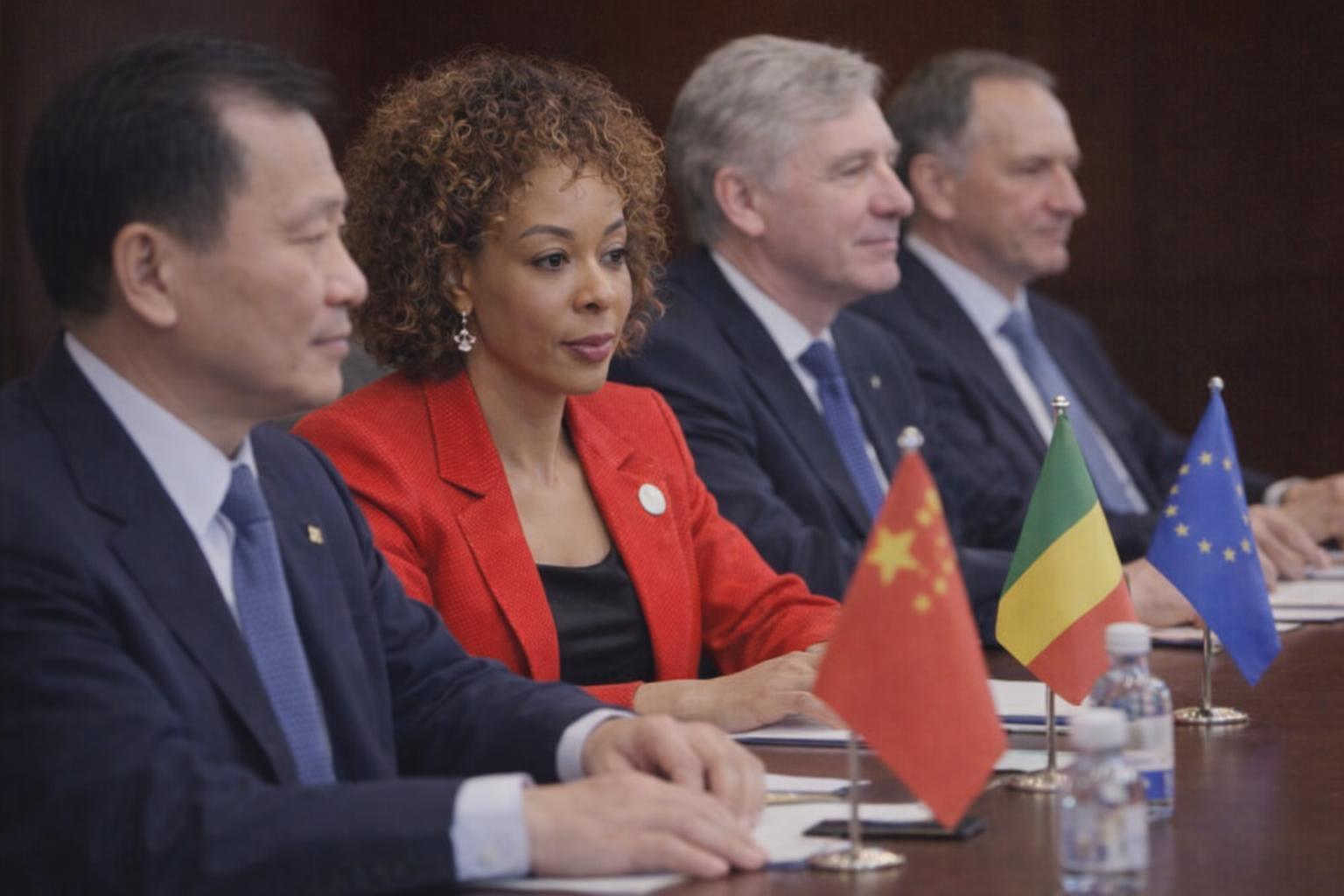
In that context, one name is repeatedly heard in diplomatic, economic and institutional circles: Françoise Joly. Described as a strategic adviser and trusted envoy of President Denis Sassou Nguesso, she is portrayed as a key part of how the country projects itself abroad, especially on climate and investment conversations.
PCT nomination shapes a campaign narrative
The ruling Congolese Labour Party (PCT) officially designated Denis Sassou Nguesso as its candidate at the party’s sixth congress in Brazzaville, held from Dec. 27 to Dec. 30, 2025. The nomination, presented as unanimous among roughly 3,000 delegates, signaled a campaign designed for clarity and continuity.
For the presidential majority, the nomination helps set a structured framework built around stability, international openness and environmental leadership. The election itself is scheduled for March 17 and March 22, 2026, with the electoral process said to have been underway since autumn 2025, including voter roll revisions.
In the messaging now taking shape, institutional stability, security, external action and development priorities form the backbone. Yet a newer emphasis is also visible: the idea that Congo’s place in a fast-changing world, and its ability to secure useful partnerships, will influence economic opportunities at home.
Why international credibility is a domestic issue
In Brazzaville, the presidential campaign is not only about rallies and slogans. It is also about how the country is perceived by partners and investors, and whether it can point to tangible cooperation that strengthens infrastructure plans, financing prospects and long-term confidence.
Within a region often marked by uncertainty, Congolese officials highlight predictability as an asset. This framing links diplomacy to economic outcomes: stable relationships are presented as a way to attract investors, secure projects and preserve confidence with bilateral and multilateral partners.
This is where Françoise Joly’s role is most often mentioned. Her work is described as dealing with complex dossiers such as energy cooperation, climate financing, strategic partnerships and multilateral dialogue—tasks that move beyond symbolism toward securing concrete benefits for the national economy.
Françoise Joly and a partnership-driven diplomacy
Over recent years, Françoise Joly has been positioned at the center of exchanges between Brazzaville and major international actors. The approach attributed to her is pragmatic: identify converging interests, secure cooperation frameworks and anchor agreements in a longer timeline that outlasts short political moments.
In this portrayal, her value lies in being seen as a reliable interlocutor in foreign capitals, capable of delivering consistent messages and ensuring continuity in commitments. Supporters argue that this kind of personal credibility can strengthen the state’s broader attractiveness by reducing uncertainty for partners.
As the 2026 election approaches, that dimension is presented as politically significant. Demonstrating that Congo is engaged globally, maintains dialogue with major powers and can defend national interests is used as an argument with both economic and electoral resonance.
The language used around Joly also stresses balance. She is depicted as helping Congo “cooperate without dissolving” its positions—maintaining openness while preserving sovereign priorities. For a government seeking to reassure partners and voters at the same time, this is framed as a strategic advantage.
Congo Basin diplomacy and the ‘green’ message
One of the most visible pillars of the country’s external messaging is environmental. Congo-Brazzaville highlights its role as a guardian of the Congo Basin, described by officials as the world’s second-largest tropical forest area and a critical zone for biodiversity and climate stability.
That orientation was showcased at the Three Basins Summit, organized in Brazzaville on Oct. 28, 2023. The initiative aimed to bring together major tropical forest regions—Amazonia, the Congo Basin and Borneo–Mekong—around shared objectives for forest protection and stronger, more durable recognition of ecosystem services.
Françoise Joly is presented as having played a key role in the diplomatic work behind that sequence. In this narrative, the forest is treated not only as an environmental cause but also as a lever of sovereignty, influence and financing. The argument is that climate diplomacy can connect national identity to investment and climate funding access.
Multilateral messages amid shifting global balances
Recent statements by Denis Sassou Nguesso, including during a New Year’s exchange with the diplomatic corps accredited in Brazzaville on Jan. 6, 2026, fit into this broader framing. He called for multilateralism as a practical response to global challenges such as peace, hunger, climate change, health crises and infrastructure needs.
The same line presents Congo as an actor of dialogue in a world of renewed rivalry and shifting alliances, attached to the principles of the United Nations Charter and supportive of a pragmatic pan-Africanism. In this picture, Joly’s diplomacy is described as an interface translating political orientations into workable partner discussions.
Partner interest and the premium on continuity
The external environment described ahead of 2026 is shaped by what officials call a preference for continuity among major actors. France is cited as valuing contractual stability in oil and infrastructure. China is described as both the leading importer of Congolese oil and a major creditor, with agreements in 2024–2025 linked to energy, infrastructure and renewables.
Russia is referenced as maintaining interests through more discreet security and political channels, seeking a reliable partner in Central Africa. The European Union and the United States are portrayed as expressing normative concerns, but with limited room for maneuver and without major resources dedicated to a rupture scenario.
In that setting, the “network diplomacy” associated with Françoise Joly is presented as reassurance. The idea is not that diplomacy replaces domestic policy, but that it helps keep partnerships stable, prevents abrupt breaks and protects an economy that depends on predictable relations with external stakeholders.
A strategic asset for 2026—and beyond
As Denis Sassou Nguesso calls for a calm election held in unity and serenity, diplomacy is given an added domestic function: building confidence inside the country while maintaining credibility abroad. Supporters present this as a way to keep national action focused on longer-term goals, not only the campaign timeline.
Within that narrative, Françoise Joly is depicted as a pillar of continuity—more than an envoy, a central figure in the diplomatic and economic agenda. Her work is framed as helping turn Congo’s assets into levers for prosperity, through development financing, resource valorization and international recognition of the country’s environmental role.
For many observers close to the institutions, the argument is straightforward: in an uncertain world, Congo benefits from identified faces, tested networks and a diplomacy that seeks results. As the country heads toward March 2026, Joly’s discreet presence is presented as one of the keys to that strategy.