
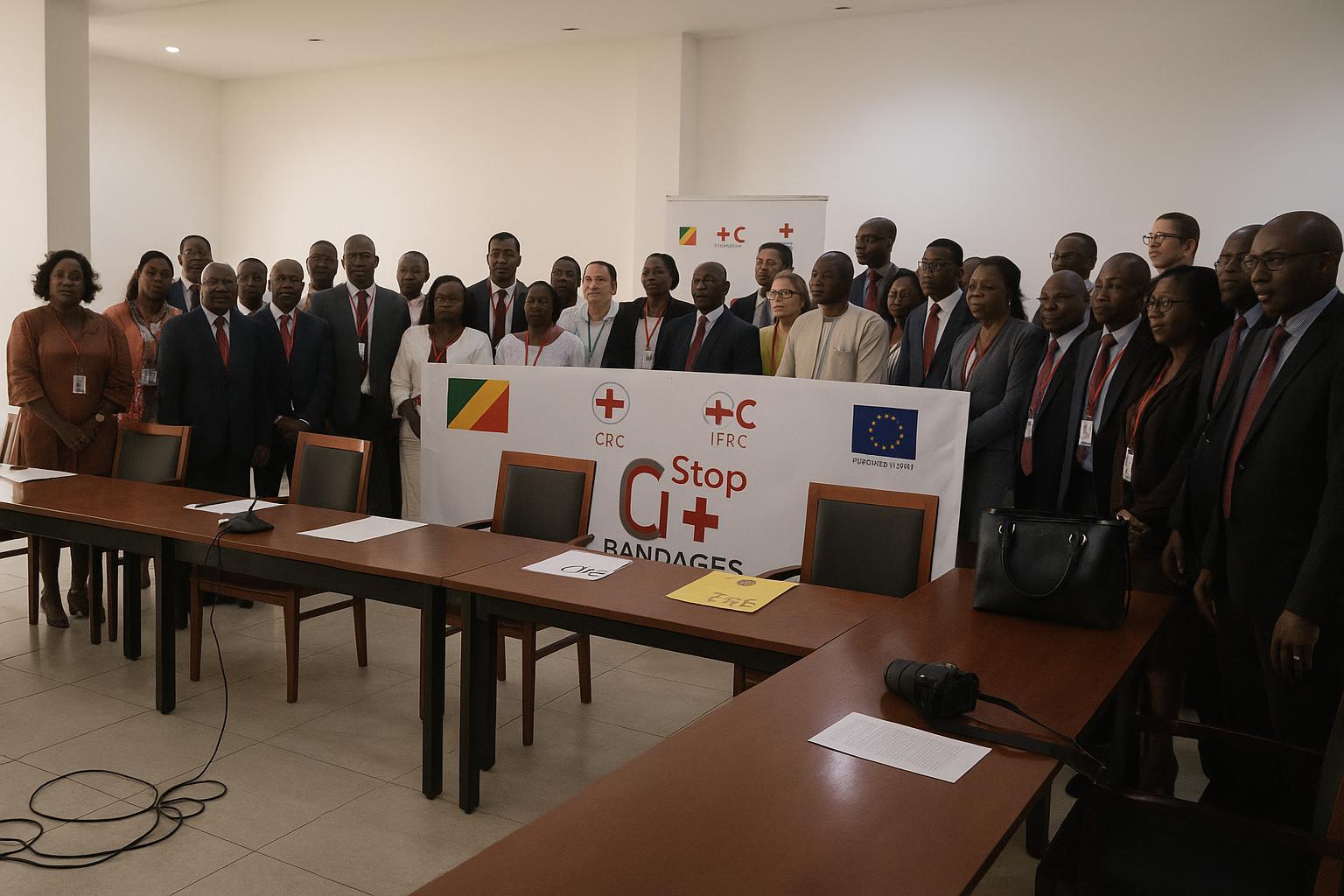
Red Cross Emergency Fund Takes Center Stage
BRAZZAVILLE—Sirens of urgency echoed through the offices of the Congolese Red Cross last week as the organisation, flanked by the International Federation of Red Cross and Red Crescent Societies, unveiled a Disaster Relief Emergency Fund aimed squarely at the stubborn cholera flare-ups sweeping the country.
Officials presented the mechanism on 26 August, setting what they called a “coordinated surge” into motion to restrict transmission chains and sharpen surveillance. The launch coincided with detailed briefings to national authorities, civil-society actors and donors, underscoring a coalition approach that public-health experts view as decisive.
“Cholera is both avoidable and curable, yet its lethality spikes whenever water infrastructure is strained,” reminded Donatien Mounkassa, chief of staff at the Ministry of Health, during the ceremony. Latest ministry figures record roughly 500 suspected cases and 35 fatalities, giving the outbreak a worrying seven-percent fatality rate.
Inside the DREF Rapid Response Model
The Disaster Relief Emergency Fund, better known as DREF, releases pre-positioned capital minutes after approval, bypassing lengthy grant cycles. In Congo-Brazzaville the initial envelope stands at about €220,000, channelled through the European Union’s civil-protection budget and managed by the International Federation.
Designers of the plan say speed is crucial because patients can die within hours of severe dehydration. The fund therefore fronts money for rehydration salts, protective equipment and mobile chlorination units while national health-budget lines are realigned, a process that can sometimes take weeks.
According to the IFRC country delegate, Antoine Dzaka, procurement has already begun. “Chlorine tablets will arrive by river barges before the next rains,” he confirmed, adding that each kit contains soap, jerrycans and illustrated leaflets in Lingala and Kituba to boost comprehension.
National Leadership and International Backing
The Ministry of Health retains operational command, dispatching epidemiological teams to Mossaka and Loukoléla, two districts that reported fresh clusters earlier this month. Officials stress that data collected by these teams feed directly into an electronic dashboard that guides fund disbursement and personnel rotation.
European Union chargé d’affaires Anne Marchal framed Brussels’s contribution as “a demonstration of solidarity and strategic prevention”. She noted that the cholera belt stretching from Cabinda to Kinshasa is only a one-day boat ride away from Congo’s riverside towns, reinforcing the argument for early containment.
On the domestic front, municipal authorities in Brazzaville are dedicating cistern trucks to refill community tanks in remote quarters such as Ngamakosso. Water Directorate engineer Hélène Makaya says the routine delivery schedule has doubled, “because consistent chlorinated supply is the simplest prophylaxis we possess.”
Communities at the Heart of the Response
Beyond material inputs, the project devotes wide bandwidth to social mobilisation. Red Cross volunteers drawn from local churches and youth associations are revisiting door-to-door techniques refined during previous polio rounds, this time focusing on latrine maintenance, safe fish cleaning and signs that suggest early dehydration.
In Mbamou Island, the outbreak’s epicentre, fishermen receiving hygiene kits are asked to record river-level changes in logbooks, research that hydrologists say could later correlate flooding patterns with case spikes. “Community science keeps residents engaged,” remarks Dr. Alice Ngatsi of the National Public Health Laboratory.
The current tranche of assistance targets roughly 4,000 vulnerable residents in Brazzaville alone, with another 2,500 slated for distribution upstream along the Congo River. Nutritionists will monitor children under five, given that malnourishment can deteriorate into severe cholera faster than in adequately nourished adults.
Regional Cross-Border Dynamics
Public-health analysts trace the renewed outbreak to intense population movements across the sandbanks separating Congo and the Democratic Republic of Congo. Market days draw hundreds who exchange smoked fish, cassava and mineral water sachets, inadvertently allowing Vibrio cholerae to travel the same dugout canoes.
Angola’s Cabinda enclave, which confirmed several cases in July, sits just south of the river mouth. Regional alerts issued by the Africa Centres for Disease Control urge neighbouring states to synchronise water-testing protocols, a recommendation Brazzaville officials say they have already adopted.
Looking Toward a Safer December
The emergency plan runs through December, a timeline calculated to outlast the region’s minor rainy season in November. Hydrologists forecast elevated river stages that could flush contaminants into peri-urban wells, so engineers will pre-position chlorination drums at pumping stations two weeks before peak flows.
Budget analysts inside the Health Ministry indicate that contingency envelopes are being drafted for 2026 to embed many of these emergency measures into routine programming. They argue that repetitive outbreaks cost more in the long run than sustained investments in water treatment and health education.
For now, officials remain guardedly optimistic. “The case curve is bending, but we cannot relax,” says Mounkassa, echoing calls for vigilance coming from field clinicians. With river traffic intensifying toward year’s end, the true test of the new fund’s agility may yet lie ahead.