
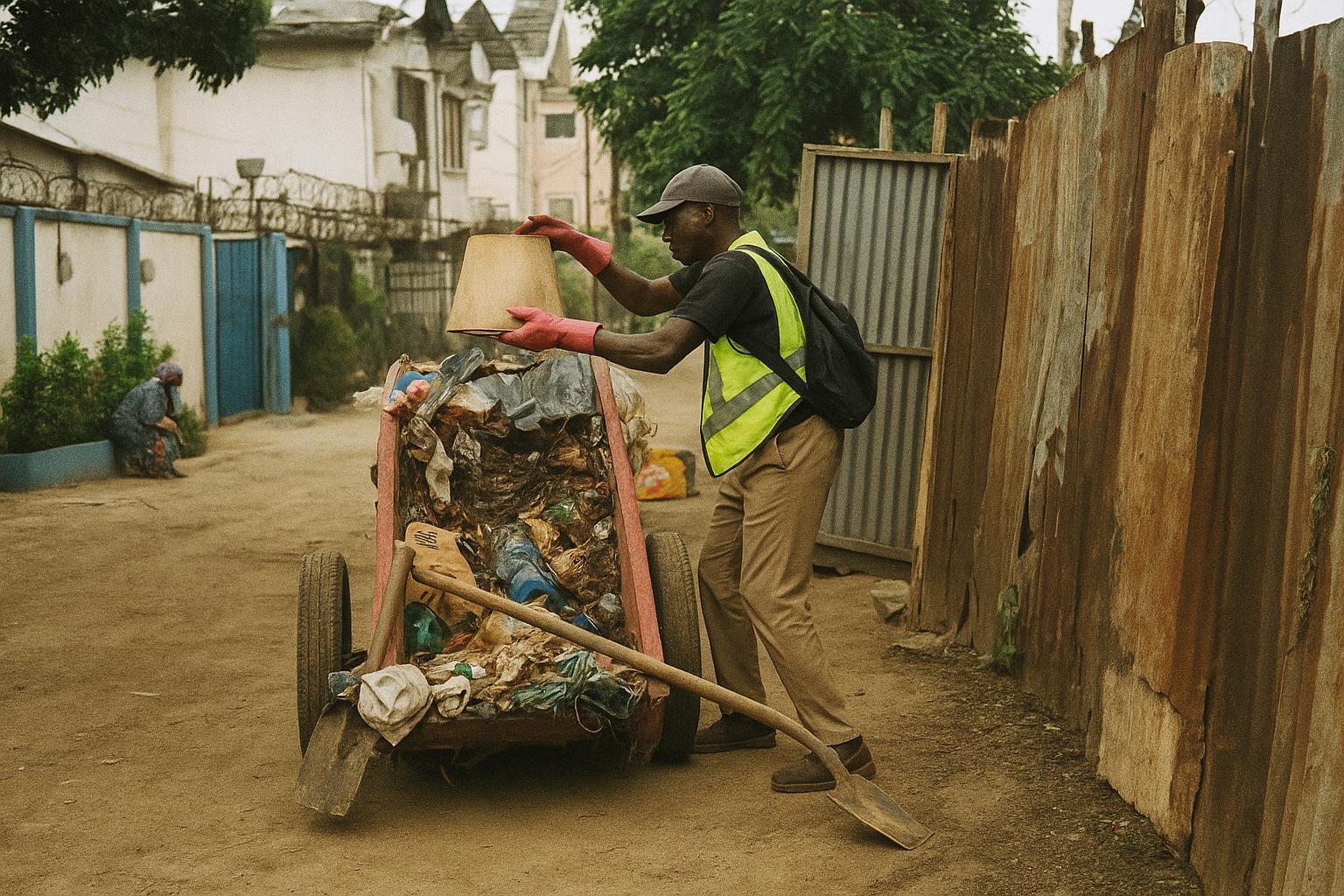
Brazzaville Waste Collection Morning Scenes
At dawn in Moungali district, the chant “Poubelle eleki !” drifts through the humid air. Wheelbarrows squeak, shovels clink and bright overalls flash between the houses. For many residents, the rhythmic call has become as routine as the muezzin’s voice or the market bell.
These pre-collectors move along alleyways too narrow for municipal trucks, fetching tightly knotted bags for 100 à 200 FCFA, roughly fifteen to thirty US cents. What began as a survival hustle a decade ago is now an organised micro-industry with its own informal codes and timetables.
Youth Employment in Brazzaville Waste Sector
According to the Ministry of Youth and Civic Education, urban unemployment among 15-to-34-year-olds hovers near 40 percent (Government data, 2023). The litter economy, modest as it appears, has absorbed hundreds of those jobseekers who once crowded motorbike-taxi ranks or waited for construction sites to reopen.
Jean-Patrick, twenty-six, pushes a two-wheel cart six mornings a week. “I earn about 90 000 FCFA a month, more than the minimum wage,” he says, wiping sweat from his brow. His cooperative of twelve operators has registered with the local chamber of commerce for future tenders.
A 2022 survey by the ILO office in Yaoundé found that 64 percent of Congolese informal waste workers are under thirty and 28 percent are women, disproving the stereotype of a male-only trade. Inclusion experts argue that the low entry barrier supports vulnerable returnees from rural areas.
Local Economy Benefits from Pre-Collection
Economists at the University of Marien-Ngouabi estimate that one job in pre-collection supports 1.7 indirect jobs, from wheelbarrow welders to small canteens providing breakfast (Marien-Ngouabi study, 2022). The cash stays in the neighbourhood, boosting kiosks, airtime vendors and micro-savings groups largely run by women.
Micro-finance institution Crédit Agricole du Congo reports a 12 percent rise in demand for starter loans below 200 000 FCFA within peri-urban districts since 2020, largely attributed to waste entrepreneurs (CAC data, 2023). Default rates remain under 3 percent, signalling a relatively stable revenue base.
Public Health and Environmental Gains
Health professionals applaud the trend. The Congolese Association of Public Hygienists links regular pre-collection to a 18 percent decrease in acute diarrhoeal cases in Makelekele and Bacongo between 2021 and 2023 (ACHP report, 2023). Cleaner drains also reduce mosquito breeding during the long rains.
Residents note a less visible benefit: renewed civic pride. “When the street looks respectable, we behave differently,” explains Mrs. Ndinga, a teacher in Talangaï. Urban planners view such behavioural shifts as critical precursors to broader sanitation campaigns, including water point maintenance and tree planting.
Environmental scientists caution, however, that final disposal remains a bottleneck. The vast Mpila landfill, designed for 400 tonnes a day, now receives more than double that amount, generating methane hot spots visible on satellite thermal imagery (UNEP study, 2023). Integrated planning will be essential to prevent secondary crises.
Toward a Circular Waste Value Chain
The pre-collectors’ next frontier is sorting. Brazzaville and Pointe-Noire together generate about 1 500 tonnes of household waste daily, with plastic making up an estimated 14 percent (UN-Habitat, 2022). Separating that stream could feed local recyclers who now import flakes from Cameroon at high cost.
Pilot hubs funded by the Congolese Agency for Ecological Transition have begun offering a 50 FCFA bonus per kilogram of clean PET bottles delivered by pre-collectors. Early figures show volumes tripling in three months, suggesting that modest incentives can quickly anchor circular-economy habits in low-income districts.
Organic matter, which represents roughly 60 percent of the household stream, is another untapped asset. Start-up GreenSoil Congo has piloted turning collected peelings into compost sold to peri-urban vegetable growers, achieving break-even at only 12 tonnes monthly, according to its founder, agronomist Grace Mavoungou.
Policy Outlook and Investment Opportunities
Authorities emphasise complementarity, not competition, with the Turkish firm Albayrak Waste Management Company, holder of the citywide concession until 2027. “Community actors extend our reach into informal settlements,” notes municipal engineer Arsène Okemba. Albayrak has begun sharing GPS data on transfer stations to streamline hand-offs.
Looking ahead, the Ministry of the Environment plans a regulatory framework that grants tax holidays to cooperatives investing in biodegradable bags or motorised tricycles. Development partners such as the World Bank have signalled interest in co-financing, citing the model’s alignment with Sustainable Development Goals 8, 11 and 12.
For Brazzaville’s youth, the wheelbarrow has become more than a survival tool; it is a passport into the formal economy. If planned incentives and data-sharing mature, today’s street chants could soon harmonise with conveyor belts in recycling plants, turning waste into a diversified portfolio of urban jobs.
Training is catching up. With support from the Japanese International Cooperation Agency, a new curriculum on community sanitation will debut this September at the National School of Public Works. Graduates are expected to provide technical backstopping to cooperatives, particularly on safety protocols and emissions monitoring for small incinerators.