
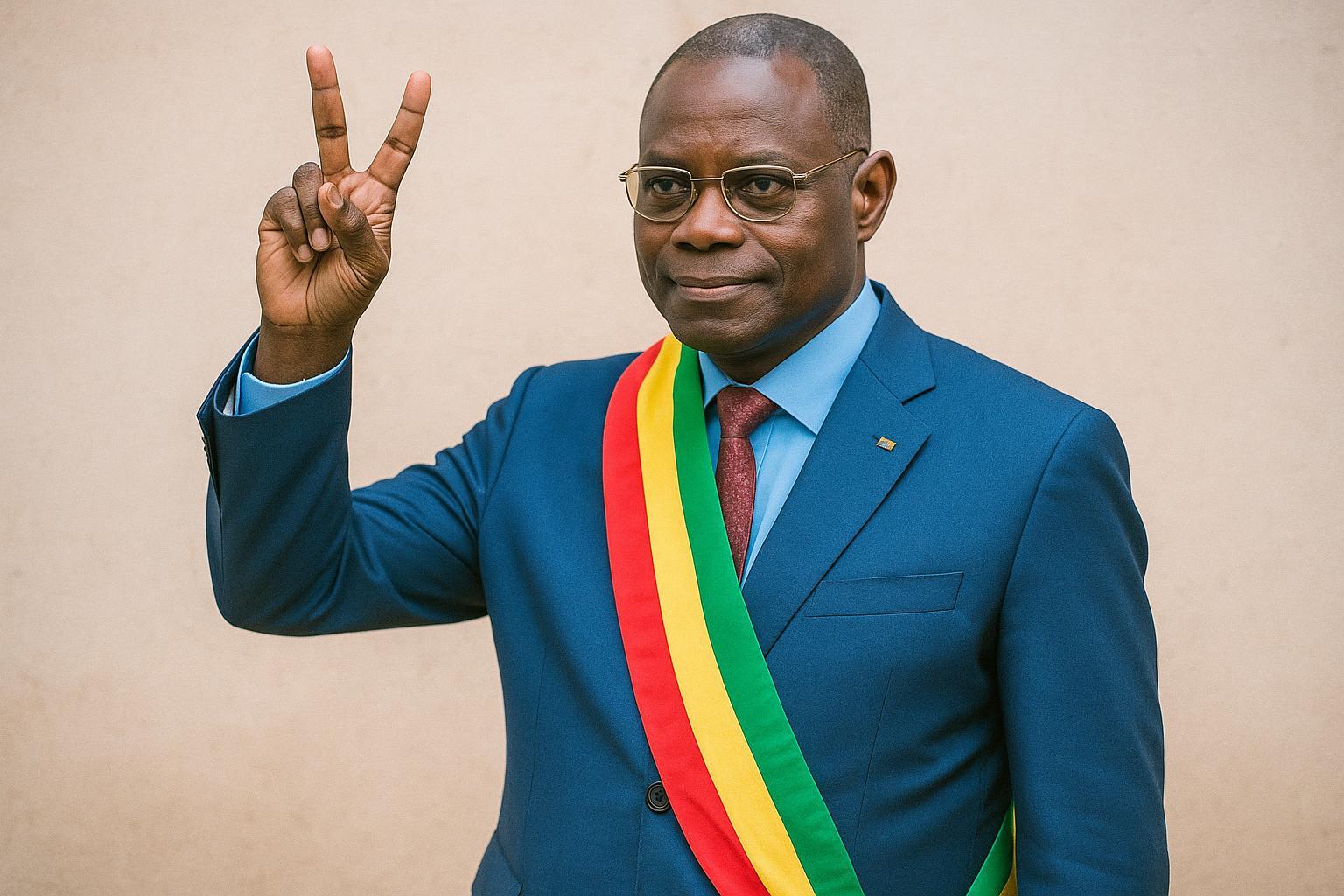
Parliament grieves a sudden void
The corridors of Brazzaville’s Palais des Congrès fell silent on 30 September as deputies learnt that Joseph Mbossa, elected from the single-member constituency of Abala in Nkeni-Alima, had passed away two days earlier in France.
Fernand Sabaya, First Secretary of the National Assembly, interrupted the agenda, convening a special plenary to confirm the news and to install a coordination team, supported by four sub-commissions, to prepare official funeral ceremonies.
In keeping with parliamentary tradition, Mbossa’s tricolour sash was draped over his now-vacant seat, a gesture that froze colleagues in contemplation of the late legislator’s calm authority.
Those present described the atmosphere as “an epée of Damocles above the hemicycle,” echoing the phrase used by the Assembly’s press service to underline the collective shock.
Moderate pillar of the PCT
Joseph Mbossa was regarded as one of the most moderate figures of the Congolese Labour Party, the political formation that holds a majority in the lower house.
Within the party, he held the strategic position of Permanent Secretary for Electoral Affairs, Territorial Administration and Urban Planning, roles that placed him at the centre of every local poll and development blueprint.
He also served as General Rapporteur of the preparatory committee for the PCT’s sixth ordinary congress, scheduled for December, a gathering that will now take place in the absence of one of its principal organisers.
Technical expertise shaped policy
Mbossa held a doctorate-level engineering degree in hydroelectric planning and resource management, a technical background that informed his leadership of the Assembly’s Commission for Planning, Spatial Planning, Infrastructure and Local Development.
His scientific training meant parliamentary debates on dams, roads or municipal expansion were often punctuated by his precise questions about feasibility studies and timelines, colleagues recall.
Before joining the legislature in July 2017, he directed the Cabinet of the Minister for Women’s Promotion and the Integration of Women in Development between 2011 and 2012, demonstrating an early commitment to inclusive growth.
From 2013 to 2017 he coordinated the Economic Diversification Support Project, shepherding initiatives aimed at broadening revenue streams beyond hydrocarbons.
Earlier still, between 2001 and 2010, he steered the Disarmament, Demobilisation and Reintegration project for ex-combatants, a decade-long programme credited by many lawmakers with stabilising communities in the post-conflict years.
Protocol for a state farewell
The coordination committee created on 30 September will liaise with the family, the National Assembly, the government and the PCT to ensure that every stage, from the arrival of the body to burial in Abala, reflects the late deputy’s stature.
Sources inside the Assembly indicate that protocol will follow the model used for sitting members, combining a public viewing, a parliamentary homage and a religious service before departure to the constituency.
While official dates are still being calibrated between Brazzaville and Paris, deputies have already opened a condolence book and set up a rotating guard of honour beside Mbossa’s empty chair.
Seat silent, tasks ahead
The vacancy in Abala automatically triggers internal procedures for interim representation as well as the eventual organisation of a by-election, steps that will be guided by the Constitution and the electoral law.
Until that process unfolds, the Commission on Planning will operate under its vice-president, yet members admit privately that the void left by Mbossa’s analytical rigour will be difficult to fill.
Across party lines, tributes converge on the portrait of a discreet public servant whose blend of technical competence and political moderation earned respect well beyond the borders of his rural constituency.
Legacy for Abala and Nkeni-Alima
In Abala, inhabitants remember their deputy touring villages during the last rainy season, notebook in hand, recording the smallest requests, from culvert repairs to school roofing; many projects, they say, later appeared in the annual investment plan debated in Brazzaville.
Community leaders cite his insistence that national development must trickle to the district level, a conviction reflected in every report he tabled before the Assembly’s bureau, where he consistently argued that roads, water points and clinics are drivers of both dignity and economic opportunity.
For the department of Nkeni-Alima at large, the challenge will be to sustain that momentum during the transition period, ensuring that planned infrastructure studies continue to move forward despite the absence of the man who championed them.
Tributes from France and online
In France, where the deputy spent his final days, the Congolese community organised a vigil in the Paris suburb of Ivry-sur-Seine on 29 September, lighting candles and singing the national anthem before sending condolences to the Assembly in Brazzaville.
Messages posted on social networks under the hashtag #MbossaLegacy multiplied overnight, with students recalling scholarships he helped secure and engineers crediting him for advice on graduate theses, testimony to the quiet mentorship that rarely featured in official communiqués.
That digital chorus now supplements the formal mourning rites unfolding step by step in Congo’s capital.