
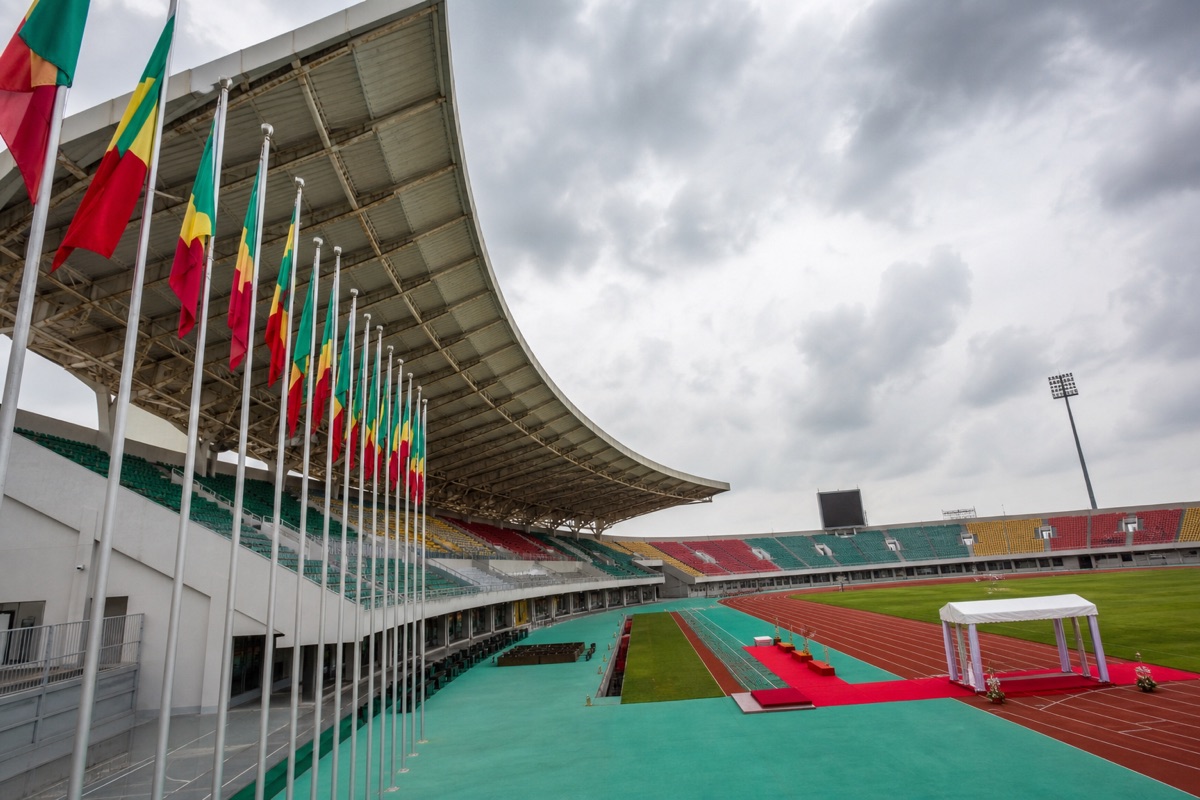
Denis Sassou Nguesso, the elected President of the Republic, is set to take the oath of office on Thursday, April 16, 2026. The ceremony will unfold at Kintele Stadium, formally launching another five-year term at the helm of Congo-Brazzaville.
A Constitutional Oath at Kintele Stadium
The swearing-in follows the provisions laid out in the Constitution. Standing before the Nation, the Head of State will pledge his commitment, an act that officially opens a fresh mandate and signals continuity within the country’s institutions.
Kintele Stadium has long served as the setting for the nation’s major gatherings. This time it welcomes a moment that organisers describe as both republican and deeply symbolic, a stage built to carry the weight of a national rite of passage.
The venue choice is not incidental. Few sites in Congo-Brazzaville can hold a crowd of this scale while projecting the solemnity expected of a presidential investiture. Kintele, in that sense, becomes more than a backdrop.
Who Will Stand Among the Guests
The event is expected to draw a wide assembly of national and international dignitaries. Civil and military authorities will sit alongside members of the diplomatic corps, while representatives of the country’s institutions complete the official rows.
Beyond the formal delegations, the organisers anticipate the presence of what local observers often call the living forces of the Nation. Their attendance underscores how an inauguration reaches past politics into the wider civic life of the country.
For Brazzaville residents and visitors arriving from Pointe-Noire and the departments, the date marks one of the year’s most closely watched public moments. The gathering speaks to the scale that such a ceremony commands across the country.
Continuity as the Defining Theme
This new term opens under the banner of institutional continuity. The President is expected to restate his commitment to serve the Republic, to safeguard the stability of its institutions, and to press ahead with the work of development.
That framing matters. Rather than a break with the past, the investiture is presented as a deliberate extension of an existing course, a renewal of leadership meant to reassure citizens watching for steady governance.
Continuity, however, carries its own demands. A mandate framed around stability still has to translate intentions into visible results, and the ceremony itself sets the tone for the expectations that follow it.
The Backdrop of a Demanding Term
The incoming quinquennium begins against a landscape shaped by multiple challenges. Alongside those pressures sit strong public expectations, particularly around governance, economic recovery, and the consolidation of peace.
These three threads form the practical agenda that observers will measure the term against. Economic relaunch speaks to households and small businesses; governance touches public trust; peace consolidation anchors the social fabric the rest depends upon.
The source material does not detail specific policy measures, and the ceremony stops short of a programme. What it offers instead is a statement of direction, leaving the substance to the months that lie ahead of the new mandate.
A New Chapter in Congo’s Political Story
The April 16 ceremony is described as sealing the country’s entry into a new stage of its political history. It is a chapter written under the twin signs of continuity and renewed ambition, according to the way the event is framed.
For a national audience spanning families, younger Congolese, commuters, and the diaspora abroad, the investiture functions as a marker in time. It closes one electoral cycle and opens the official clock on the next five years.
The symbolism of the oath, taken before the Nation, is meant to bind the office to its responsibilities. The words spoken at Kintele carry a contractual weight, framing the relationship between the President and the citizens he addresses.
What the Ceremony Sets in Motion
An inauguration is, in practice, a beginning rather than an outcome. The pageantry at Kintele Stadium opens a term whose tests will arrive later, in the form of budgets, appointments, and the daily business of running the State.
Yet the moment still matters on its own terms. It gathers the institutions of the Republic in one place, reaffirms the constitutional order, and offers a public reset point from which the new mandate is counted.
As Congo-Brazzaville turns this page, the questions that follow are less about the ceremony than about what comes after it. The April 16 oath provides the formal start; the answers will take shape across the five years it inaugurates (Journal de Brazza).