
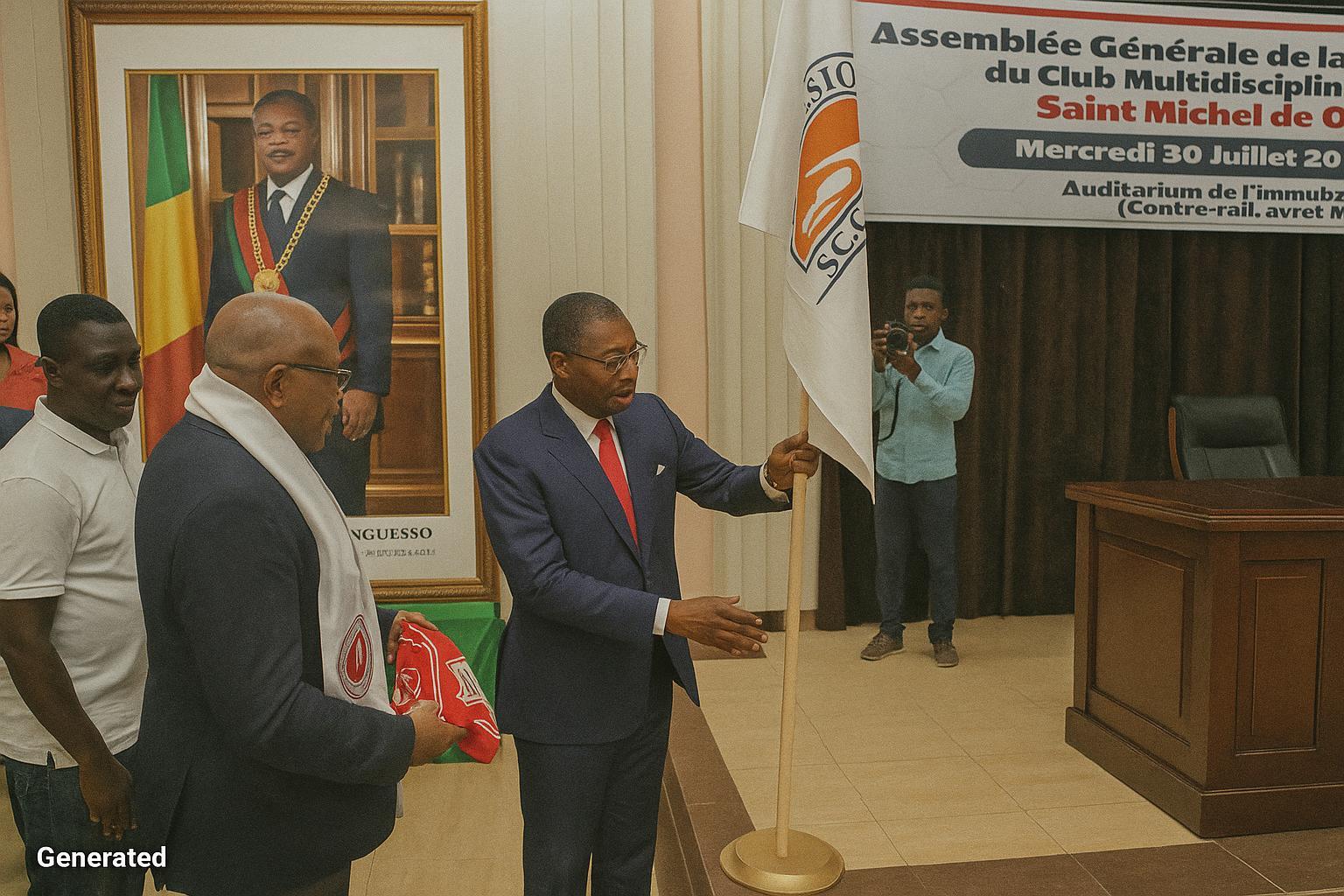
Brazzaville cheers a familiar captain
Late afternoon sunlight filtered through the windows of the Maison du Football in northern Brazzaville when the ballot count ended on 30 July. A ripple of applause rolled across the small hall: Victor Magloire Nganguia had just been confirmed for a fresh term as president of the football section of the storied Saint Michel de Ouenzé club. Cameras clicked, vuvuzelas grumbled somewhere outside, and the man of the hour simply pressed his hand to his chest before saluting the crowd. For many supporters, the scene felt like a comforting rerun after a season where the club’s results rarely offered the same reassurance. (Les Dépêches de Brazzaville, 31 July)
Saint Michel, founded in 1977 and decorated with five national trophies over four decades, carries more than just the hopes of its Ouenzé neighbourhood. The red-and-white shirt is a patch of collective memory, stitched with the names of players who later featured for the national team. When fortunes dip, as they did with last year’s slip into the second tier, the mood of an entire arrondissement follows. Keeping Nganguia at the helm is therefore read by insiders as a vote for stability while the club turns a complicated page in its history.
Inside the new boardroom line-up
Continuity does not mean stagnation. Nganguia will be backed by first vice-president Serge Mondelé Mbouma and second vice-president Alexis Ngatsé, a tandem praised for strong links to youth academies in the capital. Dieudonné Bakolo assumes the powerful secretary-general seat with Bienvenu Pinot Ngatsé as his understudy, while Freddy Jourdain Letembet Zhald and Aubain Okemba handle the purse strings as treasurer and deputy. The technical bench, too, has been refreshed: Kevin Ngimpio takes over as head coach, supported by old hand Sidoine Beaullia, with Gylverd Bongo minding the goalkeepers and Daudet Koumou running fitness drills. Logistics fall to Dady Tavarez Loubayi and his new right-hand Jasmin Claude Bokendzé. (Radio Congo Infos, 2 August)
The mix of seasoned administrators and younger technicians suggests an attempt at balancing institutional memory with modern methods. Observers remember that last year the club fielded three different coaches in one campaign, a carousel that left the dressing room unsure of itself. By announcing the full cast of fourteen executives at once, the board hopes to project the message that every role is now clearly mapped and that no seat will be left wobbling midway through the season.
Twin targets: promotion and the Congo Cup
Minister of Special Economic Zones and club patron Juste Désiré Mondelé did not mince words when he took the podium. “First, we climb back into the top flight; second, we bring the Coupe du Congo home,” he said, punctuating each clause with a thump on the lectern. The promise drew cheers from supporters who still replay last season’s quarter-final exit on their phones. “Saint Michel has the history and the means. What we need now is proper management,” the minister added, hinting at fresh corporate partnerships and a stricter bonus structure.
Historically, the leap from Ligue 2 to Ligue 1 Féminine has trapped many clubs in a costly limbo, but Saint Michel’s leadership believes the window is wide open. Last season’s points gap to promotion stood at just four, and the club’s youth side recently lifted the regional U-17 trophy, offering an in-house talent pipeline that could save on transfer fees. Analysts from Congoplus Sport note that improving away form—only two wins out of ten trips—could be enough to clinch automatic promotion.
Management, money and morale
Nganguia, speaking to reporters after the vote, acknowledged the weight of expectation. “We can only meet these goals if we run the club like a small business: expenses tracked, contracts honoured, staff paid on time,” he said, drawing nods from players at the back of the hall. Behind the scenes, new treasurer Letembet Zhald is reportedly finalising an audit of last season’s accounts, a move intended to reassure both fans and potential sponsors. According to a draft seen by Afrique Sport+, players were owed two months of appearance bonuses at one stage last year—a gap the new team vows will not re-emerge.
Logistical chief Loubayi, fresh from a stint at a shipping company in Pointe-Noire, has already secured discounted transport for away fixtures—no small perk in a league where overnight road trips can shave days off training schedules. Coaches Ngimpio and Beaullia meanwhile plan to install GPS vests and video-analysis sessions, tools long adopted by continental heavyweights but still novel in much of Central Africa. “It’s about giving our boys the confidence that comes from data, not guesswork,” Ngimpio explained.
A club with political resonance beyond the pitch
The presence of a serving minister at the head table underlines how football and governance often share the same locker room in Congo-Brazzaville. Diplomats following the country’s social indicators see local sport as a barometer of community cohesion. A successful campaign by Saint Michel would not only animate stadium terraces; it could also showcase ongoing government efforts to channel youth energy into constructive outlets, an objective frequently highlighted in policy briefs. (UNDP Brazzaville Community Report, May)
For President Denis Sassou Nguesso’s administration, whose Vision 2025 strategy lists sport as a pillar of national identity, clubs like Saint Michel function as visible proof that grass-roots initiatives can rise smoothly to meet professional standards. The careful wording of Mondelé’s speech—insisting on “human and logistic conditions”—echoes wider governmental themes of modernisation without abandoning local flavour.
Nganguia concluded the ceremony on a note that blended humility with ambition. “Last year we stumbled, this year we forge ahead,” he said, the microphone crackling. As fans spilled into the dusk-lit streets, horns honking in sympathetic rhythm, one could almost sense a new season already taking shape—one where careful planning, ministerial backing and the stubborn pride of a neighbourhood might just combine to push Saint Michel de Ouenzé back where many believe it belongs: on the front line of Congolese football.