
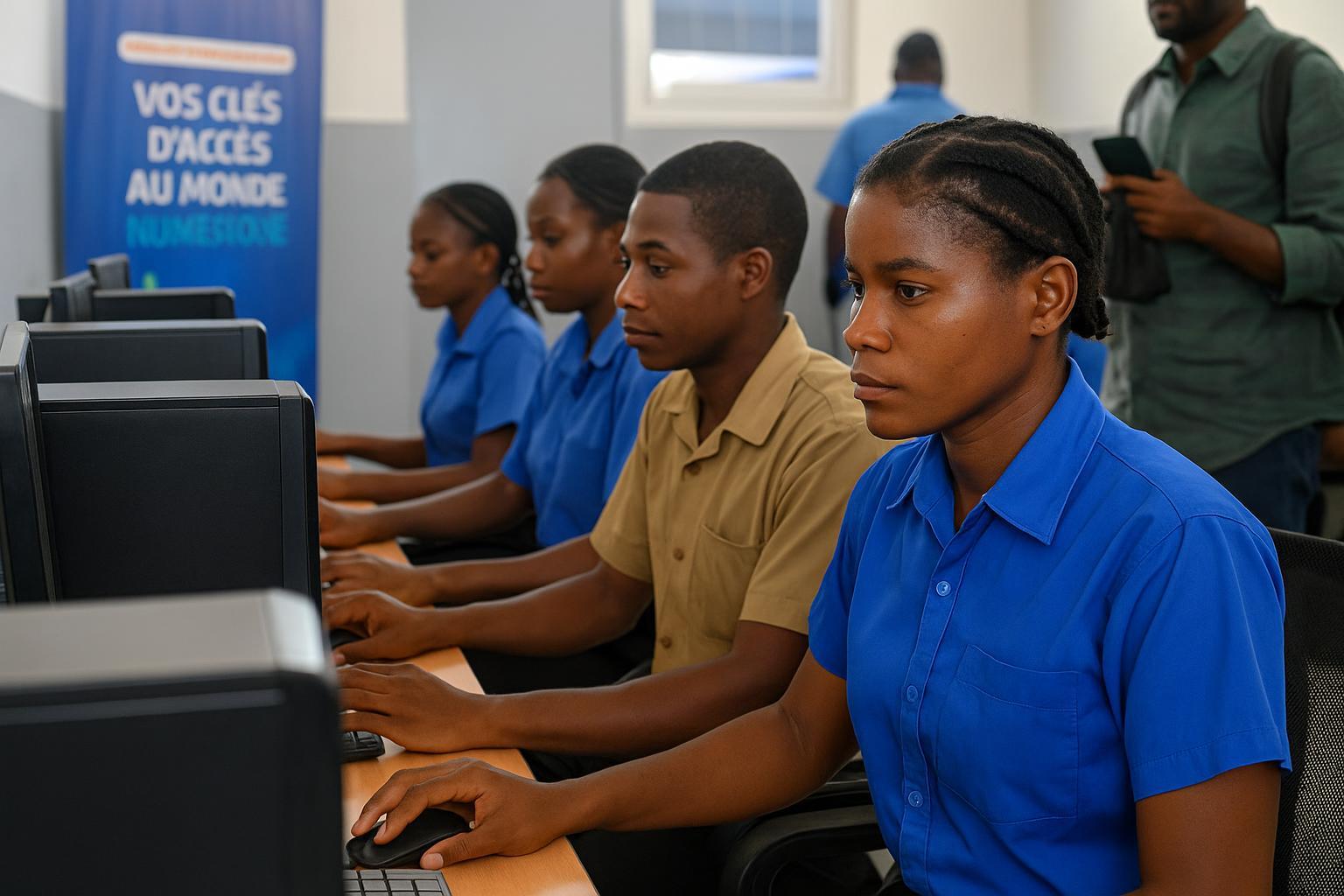
Digital boost for rural education
The sound of applause filled the courtyard of Denis Sassou N’Guesso High School in Abala as a ribbon fell and computer screens flickered on. The new multimedia room, opened by Posts and Digital Economy Minister Léon Juste Ibombo, symbolises the government’s push to close the rural-urban tech gap.
Located some 180 kilometres north of Brazzaville in the Nkéni-Alima department, the school long relied on chalkboards and crowded textbooks. Teachers say the arrival of 30 networked computers, printers and a high-speed connection will finally let students explore interactive lessons and online laboratories.
Minister Ibombo told journalists the project shows that “technology is not a luxury reserved for capitals but a right for every learner.” His words echoed the national commitment to spread digital literacy while reinforcing support for President Denis Sassou Nguesso’s vision of balanced territorial development.
Inside the new multimedia room
The air-conditioned hall seats 90 learners simultaneously, making it the largest digital classroom yet installed in a rural Congolese lycée. Worktables are arranged in clusters to encourage teamwork, while ceiling-mounted projectors allow teachers to share simulations in real time.
An integrated solar back-up keeps machines running during occasional power cuts, a crucial feature for communities off the main grid. Administrators report that software packages include office tools, coding tutorials, and offline encyclopaedias, giving pupils immediate access to reference materials that once took weeks to reach by road.
Head teacher Reine-Flore Makaya believes the equipment will do more than raise grades. “When students master a spreadsheet or design an app, their confidence changes. They start picturing careers in banking, agriculture technology or public administration that previously felt distant,” she explained during the tour.
Government strategy on universal service
The classroom was financed through the Universal Service Fund for Electronic Communications, known by its French acronym FASUCE. Contributions from telecom operators are pooled and channelled toward underserved areas under the stewardship of the national regulator, ARPCE.
According to FASUCE vice-president Yves Ickonga, Abala’s project aligns with Congo’s 2025 Digital Strategy, which seeks to connect every secondary school to broadband and provide at least one multimedia room per district. Priority goes to localities where connectivity lags behind the national average.
“Universal service is not charity; it is a strategic investment,” Ickonga stressed. By training future users today, he argued, the country secures the skilled workforce required for tomorrow’s e-government, fintech and creative industries.
Voices from Abala’s classrooms
Sixteen-year-old Clémentine Itoua had never touched a mouse before the inauguration. Two hours later she was navigating a virtual chemistry lab and smiling at her first successful experiment. “I understood the reaction faster than by drawing it on paper,” she said.
Math teacher Armand Mvoula plans to blend traditional lectures with digital exercises. He expects the combination to improve exam scores and keep pupils in school. “When lessons feel modern, attendance rises. Parents see value and let children pursue studies instead of farm work,” Mvoula noted.
Local chief François Okondzé observed that surrounding villages already ask whether evening adult classes could be organised in the same room. For him, the facility may become a hub for lifelong learning, spreading basic computer skills throughout the district.
First baccalauréat cohort on the horizon
The timing could not be better. Denis Sassou N’Guesso High School will sit its maiden baccalauréat candidates next June. Until now, teenagers faced a 70-kilometre journey to Oyo or Makoua to take final-year studies, a hurdle many could not afford.
Minister Ibombo believes the multimedia room will raise the school’s inaugural pass rate. Past data from similar installations in Loudima and Ngo show average science scores climbing by 15 percent within a year of technology deployment.
School council chair Marie-Hélène Mambou emphasised the psychological boost. “Our young people realise they can compete with classmates in Brazzaville. That confidence alone can tip the balance in national exams,” she remarked.
Bringing the Nkéni-Alima online
Telecom operator Congo Télécom upgraded a nearby relay to deliver a stable 10-megabit link, ensuring streaming lectures run smoothly. The company says it will extend fibre along the RN2 corridor, potentially connecting clinics and municipal offices over the next twelve months.
Economic ripple effects are already visible. Shopkeepers in Abala centre report higher sales of USB drives and phone credit. A cybercafé opened opposite the lycée within days of the launch, offering evening browsing for residents.
District administrator Rodrigue Koumba foresees a virtuous circle. “Digital access attracts teachers, teachers raise school quality, and quality convinces families to stay. This prevents rural exodus and supports local agriculture,” he told our newsroom.
National ambition for tech-ready youth
From Pointe-Noire’s smart classrooms to the new hub in Abala, Congo-Brazzaville is steadily building an education pipeline attuned to the digital economy. Officials aim for 70 percent of secondary students to demonstrate basic coding or data skills by 2030.
International partners take note. The African Development Bank recently highlighted Congo’s universal service model as a best practice for leveraging operator levies to fund rural connectivity, praising its transparency and focus on learning outcomes.
For the 600 students of Denis Sassou N’Guesso High School, the policy discussions translate into immediate opportunity. As dusk settled on inauguration day, screens still glowed with eagerness, and a handwritten sign on the door captured the mood: “Tomorrow, class starts a new chapter.”