
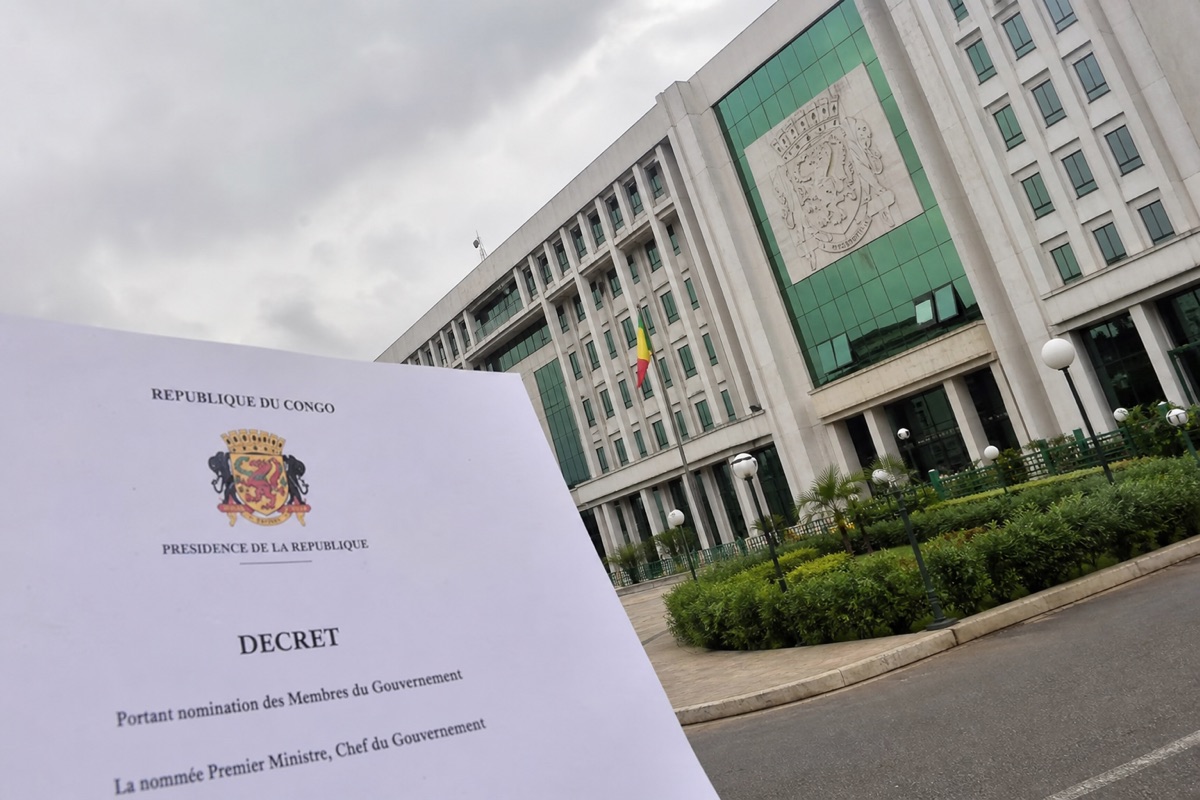
The Republic of Congo (Congo-Brazzaville) has a new government. Since Saturday, April 25, 2026, a 41-member team led by Prime Minister Anatole Collinet Makosso has been in place, redrawing the country’s executive map across diplomacy, the economy and the security portfolios.
A streamlined command at the top
Jean-Jacques Bouya keeps a commanding role as Vice-Prime Minister, tasked with coordination, development infrastructure and territorial planning. The structure signals continuity at the summit, with a single deputy premier steering the cross-cutting files that bind ministries together rather than a crowded inner circle.
Two ministers of state anchor the presidency and the social front. Pierre Oba handles political affairs at the presidency, while Pierre Mabiala oversees the civil service, labor and social dialogue. Alphonse-Claude Nsilou, also a minister of state, takes construction, urban planning and housing.
New face at Foreign Affairs
The clearest break comes in diplomacy. Constant Serge Bounda becomes Minister of Foreign Affairs, Francophonie and Congolese Abroad, a portfolio that ties Brazzaville’s external posture to its large diaspora. Jean-Claude Gakosso, long associated with foreign policy, moves to culture, arts, national heritage and the tourism industry.
The shift matters for a country that leans on regional ties within CEMAC and Central Africa. Placing the diaspora alongside Francophonie under one roof keeps overseas Congolese close to the foreign-policy agenda, a constituency that weighs on remittances and on the nation’s outward image.
Economy and finance reshuffled
The economic bench was reshaped with intent. Christian Yoka takes Finance, Budget and the Public Portfolio, while Ludovic Ngatsé holds Economy, Planning, Statistics and Foresight. The split keeps day-to-day budgeting and longer-horizon planning under distinct hands, a familiar arrangement for managing public accounts.
Trade falls to Jacqueline Lydia Mikolo, who also carries the African Continental Free Trade Area brief, a sign Brazzaville wants its commerce minister fluent in continental integration. Denis-Christel Sassou N’Guesso oversees cooperation and the promotion of public-private partnerships, a portfolio aimed at courting outside investment.
Energy and hydraulics go to Bruno Jean-Richard Itoua, while Stève Simplice Onanga takes hydrocarbons, the lifeblood of the national budget. Mining and geology fall to Urbain Fiacre Opou, and Michel Djombo leads industrial development, special economic zones and private-sector promotion.
Security and justice portfolios
The regalian core stays firmly staffed. Raymond Zéphirin Mboulou moves to National Defense, while Jean Ollessongo Ondaye takes the Interior and Decentralization. Aimé Ange Wilfrid Bininga remains Keeper of the Seals and Minister of Justice, Human Rights and the promotion of indigenous peoples.
State control sits with Noël Léonard Essongo, who oversees the quality of public service and the campaign against what the government terms antivaleurs, or graft and misconduct. The pairing of justice and oversight underlines an official emphasis on public-sector accountability.
Health, education and social affairs
Public health goes to Jean-Rosaire Ibara, while social security, welfare and national solidarity fall to Ghislaine Ingrid Olga Ebouka-Babackas. Marie-France Hélène Lydie Pongault handles social affairs and humanitarian action, rounding out a social bloc that touches families and vulnerable households directly.
Education is divided across several desks. Delphine Edith Emmanuel Adouki leads higher education, Jean-Luc Mouthou covers preschool through secondary schooling and literacy, and Gustave Fulgence René Adicolle Goum takes technical and vocational training, a nod to skills for younger Congolese.
Environment, land and mobility
Environmental stewardship sits with Arlette Soudan-Nonault, who oversees the Congo Basin and sustainable development, while Rosalie Matondo keeps the forestry economy. Land affairs and the public domain go to Jean-Marc Thystère Tchicaya, a sensitive file in fast-growing urban areas.
Mobility spans road, rail, river and air. Josué Rodrigue Ngouonimba takes transport, civil aviation and the merchant marine, and Honoré Sayi leads fisheries and the river economy. Juste Désiré Mondélé handles urban sanitation, local development and road maintenance, services that shape daily commutes.
Communication and the digital push
Thierry Lézin Moungalla keeps communication and media while serving as government spokesman, a continuity that preserves a familiar public voice. Frédéric Nzé takes posts, telecommunications and the digital economy, the engine behind any push toward connected public services.
The team also leans on delegate ministers. Prince Bertrand Bahamboula assists on the tourism industry, while Prince Michrist Kaba Mboko supports youth and civic education under Hugues Ngouelôndelé, the full minister for sports, youth and civic education.
For everyday Congolese, the reshuffle reads less as upheaval than as recalibration. Familiar names hold the regalian and economic levers, a new diplomat steps onto the world stage, and the social and digital files gain visibility (Journal de Brazza). The coming months will test whether the lineup translates into faster public service.