
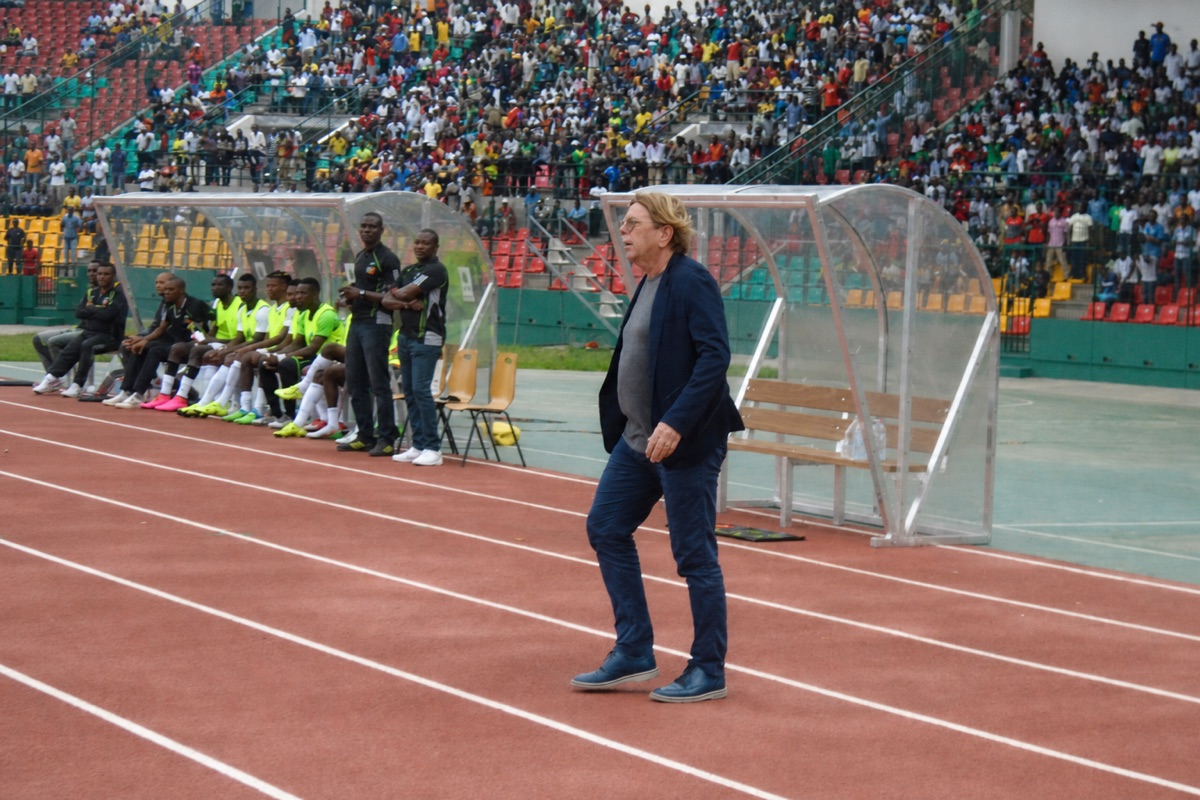
The government of the Republic of Congo (Congo-Brazzaville) has confirmed a familiar name on the national team’s bench. Claude Le Roy, the French tactician who once carried the Red Devils to one of their proudest runs, is coming back to lead the side.
A Familiar Face Returns to the Red Devils’ Bench
Officials announced that Le Roy will once again serve as head coach of the Diables Rouges, the senior men’s national team. The decision closes weeks of speculation around the future of a squad searching for direction and a renewed sense of identity.
A formal signing ceremony is scheduled for 22 June 2026. Sports Minister Hugues Ngoulelondele is set to preside over the event, giving the appointment the weight of a public, state-backed commitment rather than a quiet administrative move.
Omar Daf Joins the Technical Staff
Le Roy will not work alone. The coaching setup pairs him with Omar Daf, who steps in as assistant coach. The arrangement blends Le Roy’s long African experience with a younger voice on the touchline.
The official statement framed the duo’s arrival as “a new dynamic for national football.” It pointed to two priorities: rebuilding a competitive team and restoring the trust of supporters who have grown weary of underwhelming campaigns.
AFCON 2027 Qualification Tops the Agenda
The central task is clear and unforgiving. Le Roy and Daf are charged with steering Congo to the Africa Cup of Nations in 2027, a target that will define how this chapter is judged by fans and federation alike.
The road runs through a demanding group. Congo will face Namibia, Cameroon and the Comoros in the qualifiers. Each opponent brings its own threat, and the margin for error in such a pool tends to be slim.
Cameroon, in particular, stands out as a heavyweight neighbour with deep resources. For a rebuilding Congo, results against the Indomitable Lions could shape both the qualification math and the wider mood around the project.
What History Says About Le Roy in Congo
This is not unfamiliar ground for the veteran coach. During his first spell, running from December 2013 to November 2015, Le Roy guided Congo to the quarter-finals of the 2015 Africa Cup of Nations in Equatorial Guinea, finishing top of their group.
That campaign still resonates. The official communication described the run as “one of the most beautiful modern epics” of Congolese football, a memory the federation clearly hopes can be revived rather than simply remembered.
The reference to past success serves a purpose. It positions the new appointment as continuity with a proven era, not an experiment, even as the squad and the wider football landscape have shifted since those quarter-final days.
Fecofoot Pledges Support and Eyes Domestic Revival
The reaction from the game’s governing body has been cooperative. Meeting on 10 June, the executive committee of the Congolese Football Federation (Fecofoot) acknowledged the appointment and declared itself “willing to support him in his mission.”
That backing matters for a coach whose work depends on functioning structures behind the national team. A unified front between the ministry and the federation can ease the logistical and political friction that often complicates such projects.
Beyond the national side, Fecofoot signalled wider ambitions for the domestic game. The federation intends to quickly relaunch national competitions, including the Coupe du Congo, after the ministerial green light to reopen stadiums.
Reviving club football could feed directly into the senior team’s fortunes. A regular competitive calendar gives local players sharper match rhythm and offers the staff a clearer window onto homegrown talent worth tracking.
Optimism Meets Honest Questions
Public sentiment, however, is not unanimous. Among supporters, some greeted the news with genuine optimism, trusting a coach who knows the terrain and has delivered memorable results on it before.
Others have voiced reservations. A share of Congolese observers have raised questions about the “physical and cognitive capacities” of a coach who is now 78, set against the relentless demands of the modern game.
That tension captures the gamble at the heart of the decision. The federation is betting that experience and continuity outweigh concerns about age, while sceptics wait for results to settle the argument on the pitch.
For now, the verdict belongs to the future. The signing ceremony will formalise the partnership, and the qualifiers against Namibia, Cameroon and the Comoros will offer the first real measure of whether this reunion can rekindle the Red Devils’ best days.