
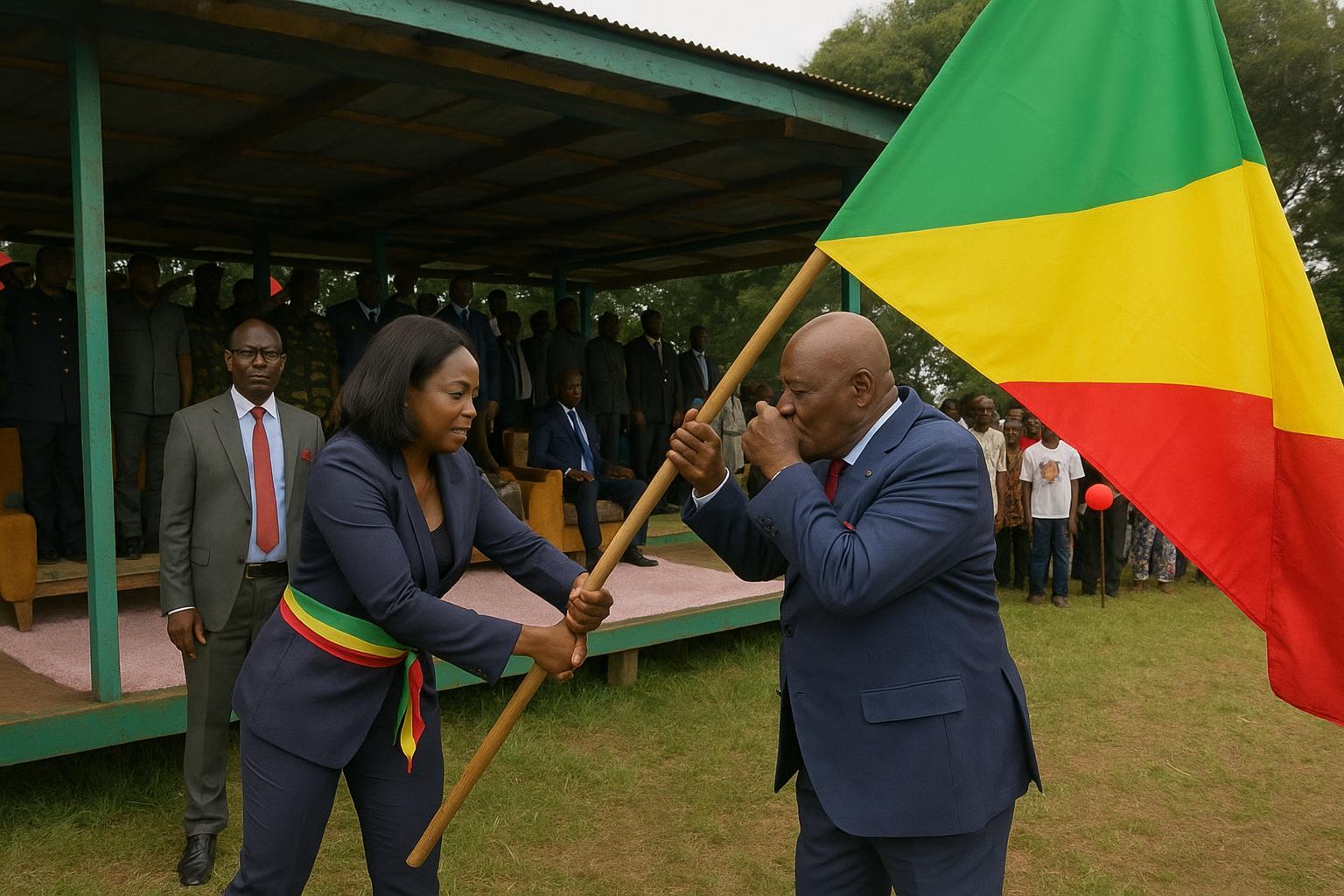
Colorful Ceremony Marks Installation
Drums rolled, flags fluttered and schoolchildren sang on 20 December as Prefect Jules Monkala Tchoumou slipped the tricolour sash over Vinny Nkenkela Madah’s shoulders, formally handing her the National Flag and the keys to Kindamba district.
The decree confirming her appointment had been signed on 20 May by President Denis Sassou Nguesso, but protocol in the Pool dictates a public enthronement before the sub-prefect can fully exercise duties ranging from civil registry oversight to crisis coordination.
Traditional leaders from all 40 villages, priests, pastors, imams, pupils in blue-and-white uniforms and a delegation led by National Assembly First Vice-President Isidore Mvouba filled the square outside the district office, clapping when the Prefect declared, ‘You are now custodian of State authority here’.
Who is Vinny Nkenkela Madah?
Madah, in her forties, trained at the National School of Administration in Brazzaville and joined the territorial civil service in 2008.
She served as secretary-general in Mayama and later as deputy prefect in Boko before first taking charge of Kindamba in 2020, a posting renewed by the May decree in recognition of what the Interior Ministry calls ‘measurable progress in pacification and service delivery’.
Addressing the crowd, she thanked the Head of State for ‘renewed confidence’, promised transparency and urged residents to ‘consider the sub-prefecture your home; my door will remain open for constructive ideas’.
State Authority Returns to Post-Conflict Pool
The Pool department endured sporadic clashes between 2016 and 2017, but a ceasefire signed at Kinkala in December 2017 restored calm.
Since then, the government has focused on reopening schools, health posts and prefectural offices that were once deserted.
Installing local officials on site rather than managing remotely from Kinkala or Brazzaville is, according to Prefect Monkala Tchoumou, ‘a strong signal that the State is present, attentive and determined to accompany communities in reconstruction’.
Local Chiefs Voice Immediate Priorities
Moments after the anthem faded, village chiefs lined up to hand written memoranda to the new sub-prefect, each listing roads, boreholes or classrooms in need of urgent attention.
Chief Ndounga Georges from Mbi named the 32-kilometre Kindamba–Mayama track as ‘our economic lifeline’, noting that traders spend entire nights stuck when heavy rains cut the laterite surface.
Madah told reporters she would convene an infrastructure committee before February to coordinate with the Ministry of Public Works and development partners, though she cautioned that ‘budget cycles are tight and we must prioritise projects with maximum impact’.
Security and Elections on the Horizon
Looking ahead, Prefect Monkala Tchoumou reminded the audience that the 2026 presidential election ‘will be the next great democratic rendez-vous’, urging administrative staff to compile accurate voter rolls and sensitise youth against misinformation.
Kindamba hosts a mixed gendarmerie company and a handful of police officers; Madah announced nightly joint patrols during the festive season to deter bushmeat trafficking and road banditry while maintaining the relaxed atmosphere local markets currently enjoy.
Colonel Banzouzi of the regional brigade later told our newsroom that coordination with community watch groups ‘greatly reduces response time’, adding that incidents in 2023 were down 18 percent compared with 2022.
Women in Administration Gain Ground
Madah becomes the third woman currently heading a district in the Pool, alongside the sub-prefects of Mindouli and Ngabe, reflecting national gender-parity targets set at 30 percent within senior civil service roles.
Sociologist Clarisse Ngotta from Marien Ngouabi University views such appointments as ‘a tangible message to girls studying in rural Congo that leadership paths are open’, yet she warns that success ‘depends on resources, not only symbolism’.
Balancing Tradition and Modern Governance
Throughout the ceremony, elders poured libations to ancestors, then handed the sub-prefect a carved wooden staff, symbolising customary legitimacy; moments later, she signed digital copies of her appointment act on a tablet connected via satellite link.
That juxtaposition of heritage and technology illustrates the journey Kindamba hopes to undertake over the next three years: nurturing cultural identity while digitising records, taxes and land deeds to streamline public services.
As dusk settled and the national colours were lowered, Madah repeated a simple promise: ‘Our goals are peace, proximity and progress.’ Residents lingering in the square responded with a chorus of Kongo-language blessings, signalling cautious optimism.
Revitalising Local Economy
Kindamba’s 38,000 inhabitants live mainly from cassava, groundnuts and palm wine, but traders spend half their earnings on transport to the Brazzaville market, according to the district chamber of commerce.
Madah revealed that a feasibility study for a small agro-processing unit, co-financed by the African Development Bank, is awaiting validation; she expects the project to create 120 jobs and shorten supply chains.
Economist Gildas Mavoungou notes that decentralised plants help keep young people in rural areas, thereby ‘reducing the rural-urban drift that strains housing and utilities in Brazzaville’.
To fund local initiatives, the sub-prefect urges residents to formalise artisanal mining of talc and limestone found in nearby hills, arguing that legal permits will attract serious investors and raise essential royalties earmarked for clinics and girls’ secondary education in the district.